The Second Session of the 85th Congress saw multiple bills that called for silver dollars "in commemoration of the one-hundredth anniversary of the settlement of the State of Colorado and the establishment in Colorado of the United States Air Force Academy." The first bill was introduced in the Senate by Gordon Llewellyn Allott (R-CO) for himself and Senator John Albert Carroll (D-CO) in July 1958. A companion bill was introduced in House of Representatives by William Silas (R-CO) just a few days later. Each of the bills was immediately referred to its respective Committee on Banking and Currency.
The State of Colorado, the 38th to join the Union (on August 1, 1876), was previously the Colorado Territory. The land that became the Colorado Territory (and, ultimately, the State of Colorado), was derived from the Louisiana Purchase of 1803 (eastern portions), as part of the Treaty of Guadalupe Hidalgo at the end of the Mexican American War in 1848 (western portions) and from territory purchased from Texas (central region) in 1850.
In 1858, a small amount of placer gold was found in the South Platte River near the foot of the Rocky Mountains. It was enough, however, to spark a gold rush in the area - the Pike's Peak Gold Rush. At the time, the gold area was part of the Kansas Territory and Nebraska Territory (the Colorado Territory was formed in 1861 and included the land in question). The Rush saw its peak in 1859 when tens of thousands of prospectors and other settlers moved to the area; the rapid population growth helped bring about the formation of the Colorado Territory in 1861. (See the link below for a What If? story about the founding of Denver, CO.)
Pike's Peak from the Garden of the Gods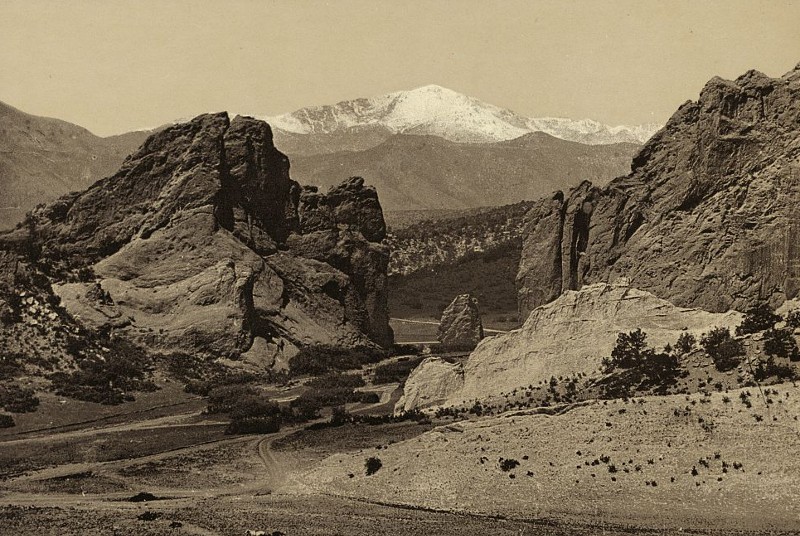 (Image Credit: Library of Congress, Prints and Photographs Division. Public Domain.)
The Air Force Academy (north of Colorado Springs, Colorado) traces its formal roots to 1947 and the passing of the National Security Act; the Act established the Air Force as a separate military service. Congress authorized the Air Force Academy seven years later, in 1954. The Colorado Springs location was chosen from three finalists (Alton, IL and Lake Geneva, WI were the other finalists) in 1954. It took several years of planning and construction, but the Academy's first class moved to the Academy grounds in August 1958.
Iconic Air Force Academy Chapel with Fighter Jet in Foreground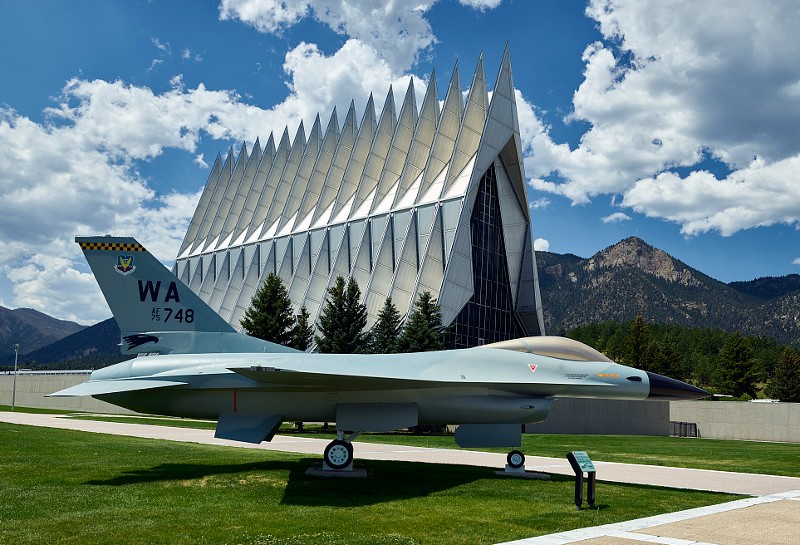 (Image Credit: Library of Congress, Prints and Photographs Division. Public Domain.)
The bills called for 100,000 silver dollars of standard specifications to be struck for general circulation in 1959. No limitations on which Mint facilities could be used for the coinage were stated in the bills. Considering the theme of the commemorative coins, however, It seems very likely that the Denver Mint would have been included in the mix, if not called upon to strike the entire run of 100,000. As the coins were to be a circulation issue, no sponsor was listed in the bills. (At the time, no US silver dollar coins were being struck for circulation, and it's likely that circulation of the coins would have been limited to the western US - and possibly just Nevada for use in the state's casinos.
Neither Committee reported on the bill referred to it. To possibly catalyze action on the coin proposal, Representative John Edgar Chenoweth (R-CO) introduced a bill of the same language in August 1958. It too failed to be reported by the House Committee on Banking and Currency.
When the 85th Congress adjourned on August 24, 1958, the coin bills died for lack of action by either the House or Senate.
During the opening days of the 86th Congress, in January 1959, Senator Allott (for himself and Senator Carroll) tried again. This time, however, the bill called for
half dollars "in commemoration of the establishment in Colorado of the United States Air Force Academy and the one hundredth anniversary of the settlement of the State of Colorado." The title featured a change in the order of the events to be commemorated from 1959, making the new Air Force Academy the "lead," but the same events were to be recognized as in the previous bills.
The new bill once again called for 100,000 coins for general circulation in 1959; the coins would have circulated alongside the Benjamin
Franklin half dollar rather than replace it.
The Senate Committee on Banking and Currency took no action on the bill and it was not considered further in the Senate.
A few months later, in May 1959, bills calling for medals in recognition of Colorado's settlement and the Air Force Academy's establishment were introduced and met with more success - but such will be the topic of a future post.
For a Colorado settling-related story:
-
What If? 1959 Denver, Colorado CentennialFor other of my topics on commemorative coins and medals, including more What If? stories, see:
Commems Collection.







 Posted 02/19/2023 12:16 am





