I've posted previously about the attempt by the International Longfellow Society to secure a commemorative copper one-cent coin in honor of Henry Wadsworth Longfellow - you can read it here:
What If? 1926 Henry Wadsworth Longfellow. In that post, I briefly mentioned a proposed medal and its failure in the House of Representatives - here's a bit more on the unsuccessful medal proposal.
The medal bill was introduced in the Senate by Lynn Joseph Frazier (R-ND) in April 1926. The bill authorized the Mint to strike up to 500,000 medals and provide them to the International Longfellow Society as they required them. No expiration date for striking the medals was included in the bill, nor was a specification of the metallic composition for the medal. Theoretically, the Society could have requested medals in bronze, silver and/or gold (or other metals) over multiple years.
Upon its introduction, the bill was referred to the Senate Committee on Banking and Currency. The Committee reported the bill back to the Senate without amendment and with a recommendation to pass. The Senate soon obliged, without debate, and the bill was sent to the House for its consideration.
It was in the House that issues arose for the Longfellow medal. IMO, the debate regarding the medal bill took on the tone of a smear campaign and/or personal attack - certain members of the House were set against the bill and its sponsor - the International Longfellow Society - and were going to do their best to defeat the bill.
Representative Fiorello Henry La Guardia (R-NY) (the future Mayor of New York City; 1934-45) was the first to raise issue with the medal, stating he objected to it because he didn't believe the International Longfellow Society was a literary or historical society of "national standing" and therefore not worthy of a Government-backed commemorative piece. (I wonder how he would have reacted had he still been in Congress at the time Thomas G. Melish pushed/sponsored the Cincinnati Music Center and Cleveland Centennial half dollars under the name of faux coin organizations?)
Representative Charles Lee Underhill (R-MA) also objected to the bill, making personal attacks against the Society's leader (referring to him as an unnamed "certain person") accusing him of "misrepresentation" regarding Longfellow's birthplace, calling the medal proposal a "graft proposition for one individual" and asserting that passing the bill would "make a nice, easy living for the rest of his life or as long as the provisions of the bill now contemplated shall run." (The Society president was Arthur Jackson; he led the effort to purchase the Longfellow birthplace and save it from demolition in 1914)
Then, to "demonstrate" how he had only the best of intentions in mind, Representative Underhill told a story of his personal connection to Longfellow: "My whole life was influenced by that man, for when I was a boy of 12 years of age, employed as a printer's devil [apprentice] in the city of Cambridge, that man came into the printing office and showed a little interest in me. He said a kindly word to me. A few weeks later Longfellow died. I was anxious to know more about this great man and started to read his works, and from that small beginning practically all the education I have had in tbe world has come as a result of the kindly action of Henry Wadsworth Longfellow in paying some attention to me, a little office boy in a print shop in Cambridge. I would do anything in this world to make the memory of Longfellow sacred and dear to everybody." While I don't doubt the event described by Underhill took place, his presentation of it and its impact on him reeks of hyperbole to me.
My other issue with Underhill is that some of his comments about the medal made it clear that he either did not fully understand the provisions of the bill or was attempting to mislead his fellow Representatives. For example, he appeared to be under the impression that the Government would be bearing the cost of producing the medals when the exact opposite was true (as stated in the bill). IMO, if you're going to debate and attempt to discredit someone, you should make sure you have your facts straight!
In an attempt to bring accuracy back to the discussion, Albert Henry Vestal (R-IN), a member of the House Committee on Coinage, Weights, and Measures, stated "I do know that it is an accepted fact - and no one has disputed it - that Longfellow was born at this particular place which is to be commemorated by this medal, although he spent most of his life in Cambridge Mass." He went on to raise the possibility that at least some of Underhill's objection to the bill could be from the fact that Longfellow's birthplace home is in Maine and not Massachusetts. While Longfellow spent significant time in Cambridge, MA, he was not born there and no amount of bluster could change that fact. And while Longfellow did not spend much time living in the house of his birth (the family moved within months after he was born), the fact remains that the house in Portland, Maine was his birthplace.
Longfellow Birthplace House - Portland, ME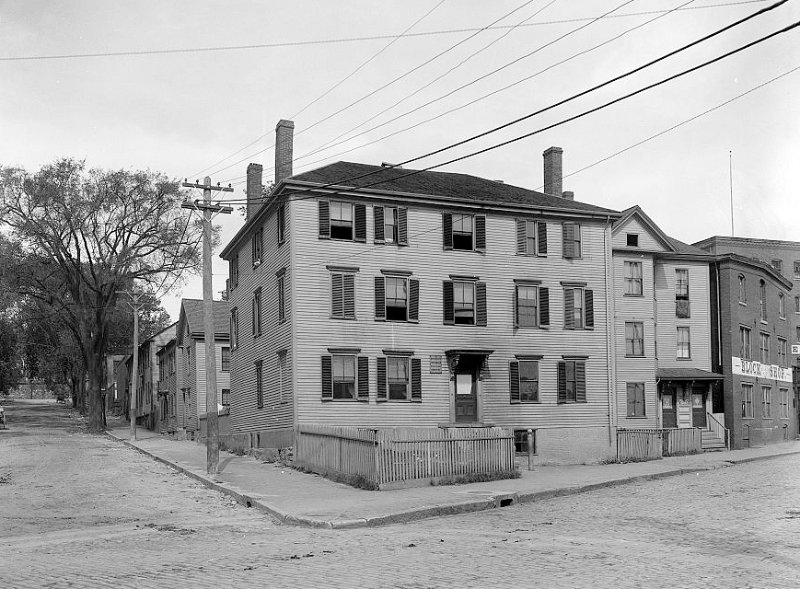 (Image Credit: Image courtesy of the Libary of Congress: Prints and Photographs Division. Public Domain.
In response to the negative comments made about the head of the International Longfellow Society, Vestal commented, "A gentleman by the name of Jackson appeared before the Committee, and a bill was introduced for a coin for this society. This was changed to a medal and is in the form of the bill now before you. He represented himself to be a member of this society, known as the International Longfellow Society. I find that the President of the United States is an honorary member of the Society. William Howard Taft is a member of this society, and some of the great men of the country are members of this international society."
Negative comments by opponents to the bill continued until it was time to call for a vote. In the end, the House voted to reject the bill and end the medal bill's journey. The International Longfellow Society, whether a one-man Society or not, was not to get its desired US Mint-struck commemorative piece. Even without either commemorative piece, the Society's efforts to preserve the Longfellow birthplace house succeeded for a time. Ultimately, however, the house fell into disrepair due to lack of funds and the dilapidated structure was torn down in 1955.
A Final Word: I am not much of a poetry aficionado nor a devout fan of Longfellow (though I do enjoy his "Paul Revere's Ride" poem), so I ask that my criticisms of the medal bill's opponents included above be viewed in the proper context. IMO, the proceedings on the House floor were malicious and mean-spirited - they attacked the honor of someone who was not present to defend themselves and were negatively aggressive in their approach. It comes off to me as "dirty pool" and not a tactic that I ever support.For other of my topics on commemorative coins and medals, including more What If? stories, see:
Commems Collection.










 Posted 02/20/2023 09:20 am


