Theodore Roosevelt, a distant cousin of Franklin Delano Roosevelt, became the 26th US President upon the assassination of William McKinley. Roosevelt was just 43 at the time, the youngest US President in history (John F. Kennedy is the second youngest).
Theodore Roosevelt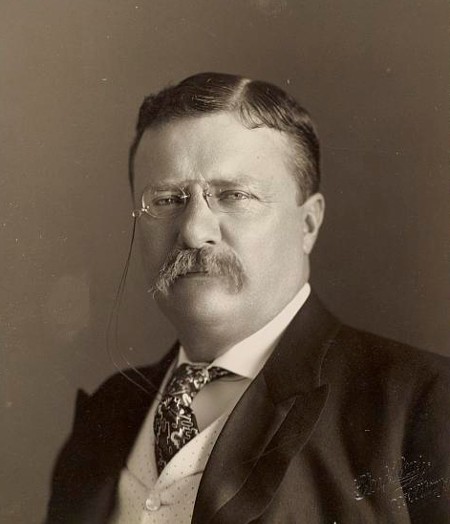 (Image Credit: Library of Congress, Prints and Photographs Division. Public Domain.)
"Teddy" - as he was often called - was born on October 27, 1858 in Manhattan/New York City. He began his political career in New York via election to the New York State Assembly (1882-84). He later served on the US Civil Service Commission (1889-95) and as President of the New York City Board of Police Commissioners (1895-97). Roosevelt was appointed as the Assistant Secretary of the Navy by William McKinley in 1897, but left the post in 1898 to run for Governor of New York. He won that election and served in office in 1899 and 1900. He was then selected for the Democratic Party ticket for President - he was to be candidate for Vice President paired with William McKinley. The duo won the election and took office in March 1901. Roosevelt became President approximately six months later when McKinley was assassinated while attending the Pan-American Exposition in Buffalo, NY in September.
Roosevelt was a reform-minded President who worked to arbitrate the differeces between large business owners and their work forces, was known for his support of the environment (he greatly expanded the nation's National Park System), believed in a strong US foreign policy ("Speak softly and carry a big stick...") and was a proactive supporter of the US taking over and completing the Panama Canal project.
In addition, he was a recipient of the Nobel Prize for Peace as a result of his role in the successful mediation of the treaty that ended the Russo-Japanese War (negotiated in Portsmouth, New Hampshire in 1905).
Roosevelt was a popular president, and won re-election in 1904. He kept to his earlier promise, however, and did not seek a third term in the Election of 1908 (though he had a good chance of winning such an election). Roosevelt died on January 6, 1919 in Oyster Bay, NY.
(Theodore Roosevelt's story is far too large for me to successfully summarize here, so I encourage "independent study" by those with an interest in his life and legacy.)
Two different groups sponsored bills in Congress to recognize the 100th anniversary of Roosevelt's birth: the Pioneer Development Association of North Dakota and the Theodore Roosevelt National Memorial Park Badlands Association. The Pioneer Development group sponsored a bill in 1956, the Badlands Association in 1958.
A North Dakota-Roosevelt link was established in the 1880s when, after the death of his wife and mother, Roosevelt began making hunting trips to the area; he also purchased/built two ranches in the badlands of North Dakota. His experiences in the region led to his writing of three books:
Ranch Life and the Hunting Trail, Hunting Trips of a Ranchman and
The Wilderness Hunter. The experiences also led to his support of conservation and protection of the nation's natural resources.
The 1956 bill was introduced in by William Langer (R-ND) in January at the start of the Second Session of the 84th Congress. The bill called for 100,000 silver half dollars of standard specifications with a design comprised of a "profile of Theodore Roosevelt along with a likeness of the north gate of the Theodore Roosevelt National Memorial Park shall appear on one side of such pieces and on the reverse side of such pieces there shall appear a likeness of the Theodore Roosevelt log cabin which is located on the grounds of the Capitol of the State of North Dakota." The coins were to carry the "1958" date.
The bill was referred to the Senate Committee on Banking and Currency, but did not progress any further. Senator Langer tried again in 1958, introducing a bill for himself and Senator Milton Ruben Young (R-ND) that once again called for 100,000 silver half dollars for the benefit of the Pioneer Development Association. The 1958 version of the bill, however, did not include design specifications as the 1956 bill did.
Also in 1958, Ellis Yarnal Berry (R-SD) introduced a bill in the House of Representatives that sought half dollars for the benefit of the Theodore Roosevelt National Memorial Park Badlands Association; the "badlands" park was located in western North Dakota. As with the Langer bills, Berry's bill called for 100,000 silver half dollars bearing a "1958" date. It was referred to the House Committee on Banking and Currency,
None of the bills (1956 or 1958) placed a restriction on which US Mint facility(ies) could be used to produce the coins - three-coin P/D/S sets were a definite possibility.
Neither of the 1958 bills was reported out of Committee, and so suffered the same fate as Langer's 1956 proposal. When the 85th Congress adjourned in August 1958, both bills died for lack of action and a potential Theodore Roosevelt half dollar slipped away.
A medal bill for the benefit of the Theodore Roosevelt Centennial Commission was introduced in the House of Representatives in May 1958, but also failed to gain the needed support.
I've posted about previous unsuccessful attempts to secure a Theodore Roosevelt commemorative coin, you can read about them here:
-
What If? 1920 Theodore Roosevelt Two-Cent Coin-
What If? 1924 Roosevelt, Harding And Wilson 2-1/2 Cent CoinsFor other of my posts about commemorative coins and medals, including more What If? Exploratory stories, see:
Commems Collection.








 Posted 02/28/2023 06:05 am


