In a previous post about proposed commemorative coins for the 100th Anniversary of Colorado's settlement and the establishing of the Air Force Academy near Colorado Springs, CO - (read it here:
What If? 1959 Colorado Settlement Centennial - Air Force Academy Establishment - I mentioned that bills calling for a commemorative medal to mark the same events met with better success.
Here is that medal's story...I recommend the original post (linked above) for background on the events in question.
The first bill to propose a medal for the Colorado Settlement-Air Force Academy as a replacement for the failed coin bills was introduced in May 1959 in the House of Representatives by Wayne Norviel Aspinall (D-CO). It was one of four bills introduced on May 18, 1959 with two additional bills introduced, one on each day, on May 19 and May 20. Six bills in total! On the 18th, in addition to Aspinall's bill, bills were introduced by John Edgar Chenoweth (R-CO), Byron Lindberg Johnson (D-CO) and Byron Giles Rogers (D-CO). On the 19th, Gordon Llewellyn Allott (R-CO) introduced a bill in the Senate on behalf of himself and John Albert Caroll (D-CO). Representative Johnson (D-CO) introduced a second version of his bill on the 20th.
The bills had minor wording variations, but were aligned on the key specifications. Each of the bills called for the striking of up to 10,000 silver medals for the benefit of the Rush to the Rockies Centennial Commission; no medals could be produced after December 31, 1959. Each of the bills was referred to its respective chamber's Committee on Banking and Currency.
Johnson's second bill was the one that moved forward. It was reported back by the House Committee without amendment and with a recommendation to pass. When brought up for consideration in the House, Representative Leslie Cornelius Arends (R-IL) wanted confirmation that the bill had agreement (i.e., no objections) on both sides of the aisle. Once Representative Johnson confirmed such situation, the bill moved forward without issue and was passed via Unanimous Consent.
Once received in the Senate, the bill was read twice and placed on the Senate Calendar. When the Senate version of the bill was brought up for consideration, Clair Engell (D-CA) made a motion to consider the House bill instead. As no objection was voiced to the motioned change, the House bill was read for a third time and passed. The Senate bill was postponed indefinitely.
With approval in both chambers, the bill was examined and signed in each, then sent to the President for his review and approval. The bill was signed into law by US President Dwight David Eisenhower on June 23, 1959.
The 0.900 fine silver medal is 1-5/16th inches in diameter (~33.35 mm). It's obverse presents the official "Rush to the Rockies" logo of the Centennial. It features an ox-drawn Conestoga wagon (used by the original settlers) with a cowboy on horseback leading the wagon. In the background is depicted the Rocky Mountains, and in the foreground, at the six o'clock position, is seen a Native American shield that features a standing bison (an arrow is presented in front of the shield, a bow behind it).
The medal's reverse depicts an adaptation of the Air Force Academy Seal circa-1959. The Seal features a Falcon perched atop a shield with upswept wings protecting two falcon chicks (eyases). The shield features the now-seldom-used "Prop and Wings" symbol of the Air Force. The shield also features a star for each of then-current five branches of the US Military. Encircling the central design is a ring of 13 stars, symbolic of the original US states.
Arthur Roy Mitchell was responsible for the design of the medal,
Frank Gasparro, a US Mint Assistant Engraver at the time, handled the sculpting/engraving of the design. The medal was struck at the US Mint in Philadelphia.
1959 Colorado Settlement-Air Force Academy Establishment Distribution Medal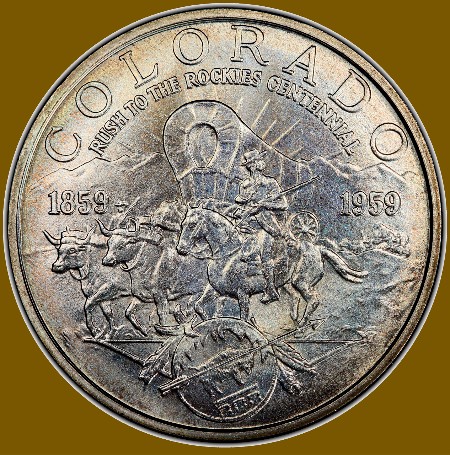
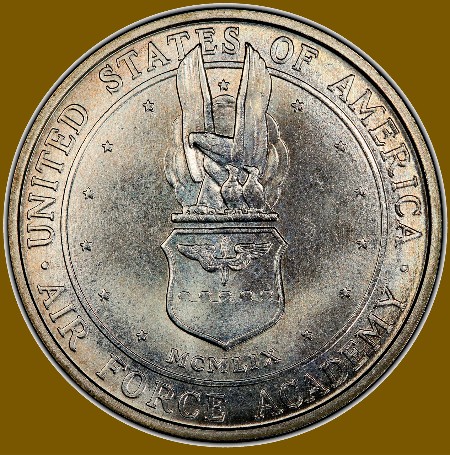
The medals were distributed in a custom-printed holder that features commemorative inscriptions in blue and a line-drawing of the medal's obverse in gold. The medal was shipped in a polypropylene bag that was secured behind the holder's flap. When the flap is opened, it reveals brief details about the medal. The holder and medal were distributed in a plain, unmarked white envelope. Here's mine:
1959 Colorado Settlement-Air Force Academy Establishment Distribution Holder - Closed Flap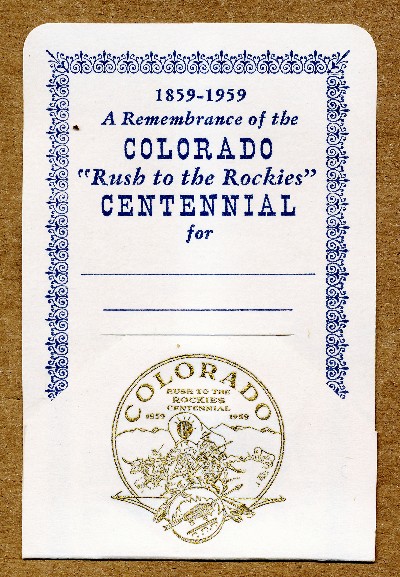 1959 Colorado Settlement-Air Force Academy Establishment Distribution Holder - Open Flap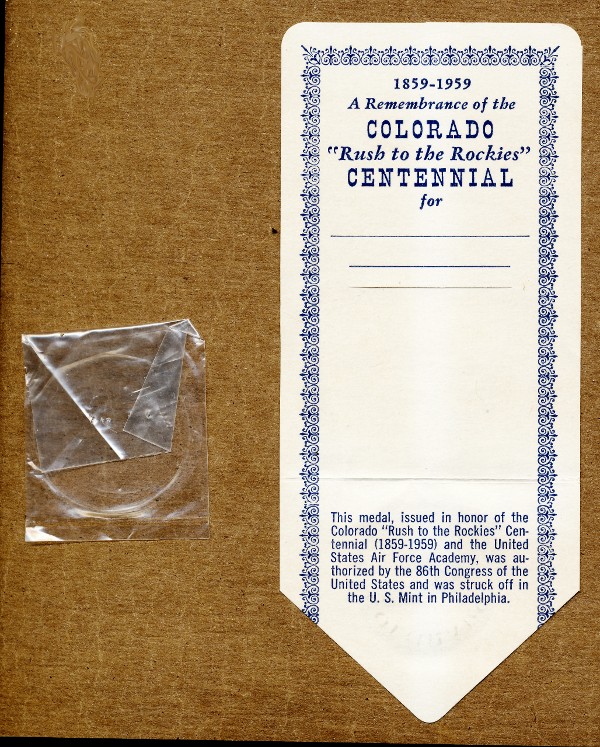
For more of my topics on commemorative coins and medals, see:
Commems Collection.







 Posted 03/30/2023 5:47 pm





