A bill calling for a half dollar coin to be struck "in commemoration of the 75th anniversary of the institution of Labor Day" was introduced in August 1955 in the House of Representatives by John Jacob Rhodes (R-AZ).
Labor Day (in the US) was established as a national holiday by President Grover Cleveland in 1894, but had previously been celebrated at the State or Local level beginning in 1882; the first celebration of Labor Day took place on September 5, 1882 in New York City. The 1894 Act designated the first Monday in September for the day of celebration. Prior to the Act, the celebrations were not standardized, but generally took place during the first week of September.
Credit for the initial concept of a "Labor Day" to celebrate the working class is debated. Some give credit to Peter J. McGuire (General Secretary, Brotherhood of Carpenters and Joiners), while others credit Matthew Maguire (Secretary, Central Labor Union of New York).
Early Labor Day Parade, New York City - Circa 1909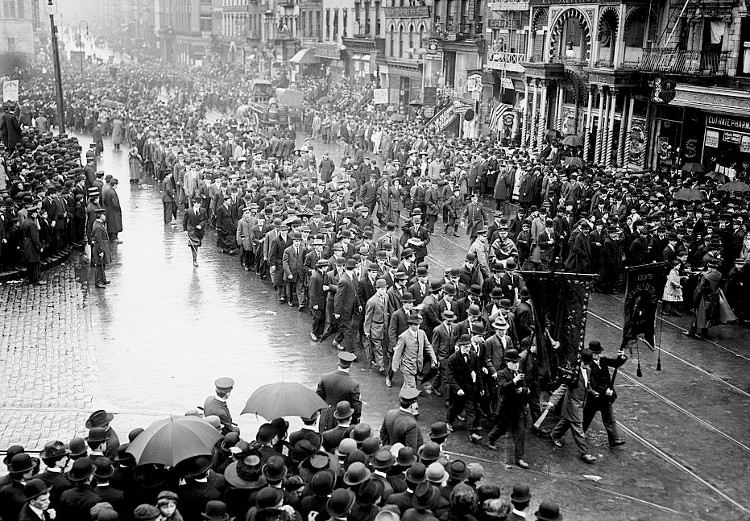 (Image Credit: Library of Congress, Prints and Photographs Division. Public Domain.)
A brief, interesting history of the holday can be found on the web site of the US Department of Labor:
History of Labor Day.
The bill specified the coins were to feature a "1957" date - the 75th anniversary of the local celebrations of Labor Day that began in 1882 (vs. the 1894 Public Law). The coin was to be a circulating issue, with its designs to be selected by the Secretary of the Treasury in consultation with the US Secretary of Labor. The coins were to be issued only during the 1957 calendar year.
Upon its introduction, the bill was referred to the House Committee on Banking and Currency. The Committee took no action on the bill and did not report it out for further consideration. As no companion bill was introduced in the Senate, the dream of a Labor Day half dollar died due to lack of action.
For more of my topics on commemorative coins and medals, including a list of other What If? posts, see:
Commems Collection.







 Posted 03/29/2023 10:06 am





