I call this one a Phantom due to the fact that a) no legislation for the piece was ever introduced in Congress, and b) the lack of a coin bill was directly caused by Congress' previous actions.
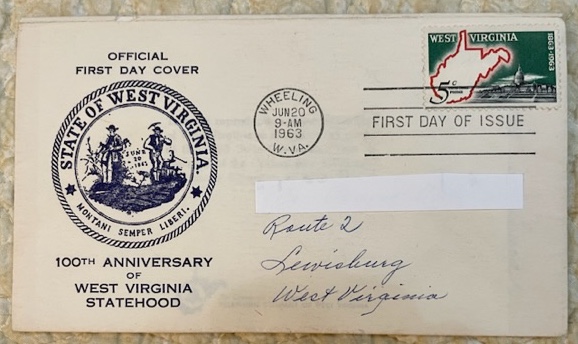
I've posted before about the group of 1937 commemorative coin bills that were introduced to commemorate a city, county or the Statehood of West Virginia - there were four in total. The failure of each to gain passage convinced Greenbrier County, WV, in 1938, to pursue a privately-struck medal for the 160th anniversary of its founding vs. going after a coin. (You can read a summary about the previous West Virginia coin attempts here:
Quick Bits #12 - West Virginia History and also individually via
Commems Collection.)
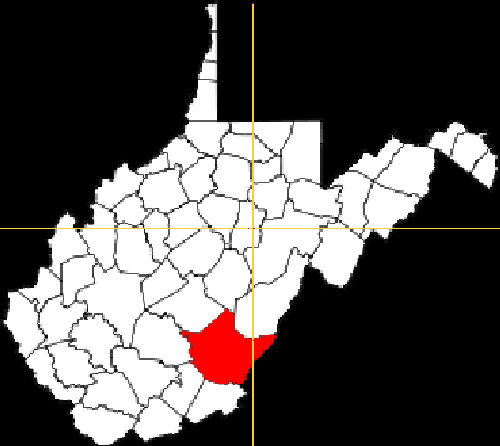
Greenbrier County is located in southwest West Virginia and borders Virginia; it is the second largest county in West Virginia (1,021 square miles). Greenbrier County was carved from the original Montgomery and Botetourt Counties while all were still a part of Virginia; it gets its name from the river that flows through it. The County was founded in March 1778. The County Seat is Lewisburg which is close to White Sulfur Springs, the home of the famous Greenbrier Resort and Spa. (Contributing Source: Greenbrier County web site:
https://greenbriercounty.net/) In case you were wondering, Randolph County at 1,040 square miles is the largest West Virginia county.Pursuing a privately-struck medal for its 1938 milestone was a relatively easy decision for Greenbrier County representatives based on the recent experiences of their in-state neighbors. Had an attempt for a commemorative half dollar been made, I would bet that it would have ended the same way the previous West Virginia commemorative proposals ended - time and effort spent, but no coin. (Especially considering the sponsor was a relatively unknown county looking to mark an unusual anniversary milestone (160th) - a "Most Obscure" candidate?)
1938 Greenbrier County, WV Commemorative Medal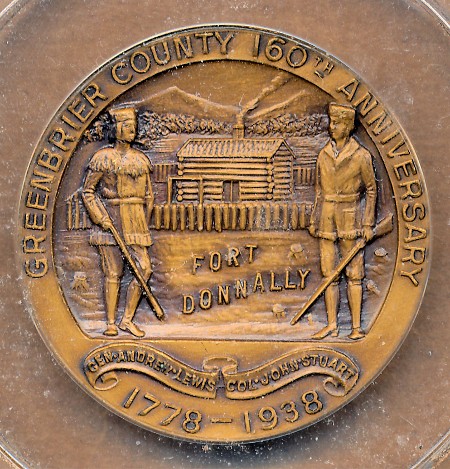
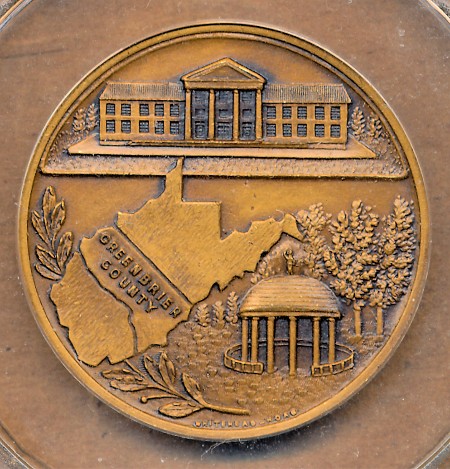
The antiqued bronze medal is 30 mm in diameter.
The obverse presents General Andrew Lewis and Captain John Stuart in the foreground with a depiction of Fort Donnally (circa 1770s) in the background.
The Irish-born Lewis served under George Washington in the Virginia Regiment during the French and Indian War. He later successfully led Virginia militia forces at the Battle of Point Pleasant in 1774, a part of Lord Dunmore's War against Shawnee and Mungo Native American warriors. He was also a key officer in the Continental Army during the American Revolution, being appointed a Brigadier General (1776) and being selected to serve on a committee that was to plan the defense of Virginia from the British.
He also was elected to serve several terms in the Virginia House of Burgesses in the 1770s, after moving his family to Botetourt County, VA. His time in the House and his military career overlapped.
Captain John Stuart was born in Augusta County, Virginia in 1749. He was an important early settler, leader and protector (from indigenous Native Americans) (of the future) Greenbrier County, being part of the party that established the first successful European settlement there in 1769. He came to be known as the "Father of Greenbrier County."
He also participated in the 1774 Battle of Point Pleasant, leading a regiment from Greenbrier. He later helped defend area settlements from Native American attacks, including a 1778 attack on Fort Donnally.
Stuart served as the Clerk of Greenbrier County and was a member of Virginia's Constitutional Convention in 1788 - he was a strong supporter of ratification of the US Constitution.
The medal's reverse is a mix of elements representing aspects of the country's history. At top, is the Greenbrier County Courthouse. Also included is a map of West Virginia (lower left) that highlights Greenbrier County and, in the lower right, the Spring House at the Greenbrier White Sulphur Springs resort - the iconic symbol of the Spa and Resort.
Note: At the time the events being commemorated by the medal took place, West Virginia did not exist; it was a part of Virginia at the time. West Virginia did not become a separate US Stste until 1863 - becoming the 35th State during the US Civil War.For other of my posts about commemorative coins and medals, including more What If? and What If? Phantom stories, see:
Commems Collection.





 Posted 05/01/2023 11:23 am