I promised to return with a story about the 1962 Sam Rayburn Congressional medal...here it is!I've posted before about the attempts in Congress to secure a commemorative half dollar to honor long-time Congressman and Speaker of the US House of Representatives shortly after his death - you can read the 1962 story here here:
What If? 1962 Sam Rayburn - Life And Legacy and the 1969 story here:
What If? 1969 Sam Rayburn - Library. Though the coin bills did not get approved, a US Mint-struck medal in his honor was authorized. Here's its story...
Prior to Rayburn's death on November 16, 1961, the US House of Representatives held a lengthy tribute for its long-time Speaker. The tribute took place on June 12, 1961 - the day his tenure as Speaker of the House was officially double that of the next longest-serving Speaker (Henry Clay, Kentucky, three non-consecutive terms between 1811 and 1825). On that day, Rayburn had served for 16 years, 273 total days; Clay had served for 8 years, 136 1/2 days. As part of the tribute, a Joint Resolution was introduced in the House that congratulated the Speaker on his service and expressed the House's "deep appreciation...for his impartiality, integrity, and outstanding parliamentary skill in presiding over the House; for enhancing the dignity and traditions of the Speakership; and for his continuing devotion to legislative duty in this House for more than 48 years."
The Senate also choose to recognize Rayburn. In September 1961, Ralph Webster Yarborough (D-TX) introduced a Joint Resolution that called for the striking of a Congressional Gold medal "in recognition of the distinguished services of Sam Rayburn, Speaker of the House of Representatives." Yarborough introduced the Resolution on behalf of himself and Robert Samuel Kerr (D-OK). The Resolution was immediately referred to the Senate Committee on Banking and Currency, A few days later, 48 additional co-sponsors were added (50 total Senators attached their name to the Resolution!).
The Resolution was not immediately acted upon by the Committee, however, and Rayburn died from cancer - in November 1961 - before it reported on it. (At the time of his death, Rayburn had served as House Speaker for 17 years, 62 days.) As a result of the timing of its Report, the Committee amended the Resolution by inserting the phrase "the estate of the late" in between "to" and "Sam Rayburn" as originally written. As amended, the Committee recommended the Resolution pass.
(Note: The positive recommendation was only the second time such a recommendation for a Gold medal was made regarding a member of Congress - the first was for Alben W. Barkley while he was Vice President. Since then others have followed.) The Committee stated that it was recommending the Resolution "only because Sam Rayburn was an extraordinary man, one of the truly great men of his generation."
The amended Resolution was passed in the Senate without debate and sent on to the House. When brought up for consideration in the House, Herbert Ray Roberts (D-TX) rose to voice support for the Resolution and recommend its passage. He touted Rayburn's long-term service, his dedication and devotion to the House and the people of his home district and the State of Texas. The impassioned pleas was hardly necessary, however, as the Resolution had widespread support anf passed via Unanimous Consent (i.e., without objection).
With the House and Senate in agreement on the Resolution, each chamber examined and signed it before it was presented to the President. President John Fitzgerald Kennedy signed the Resolution into law on September 26, 1962.
Note: In addition to the authorized Gold Medal, the Joint Resolution also made provision for the Mint to strike and sell bronze duplicates.The obverse of the medal presents a front-facing portrait of Rayburn with the US Capitol Dome in the background over his right shoulder. To the portrait's right sre the dates of Rayburn's birth ("1882") and death ("1961"). "SAM RAYBURN" is seen at the top rim.
The central design elements on the medal's reverse are a gavel (representing Rayburn's time as Speaker) and a sprig of the Texas State flower - the Blue Bonnet. The inscription "FOR SERVICES RENDERED TO THE PEOPLE OF THE UNITED STATES" encircles at the rim.
The design/sculpt of the obverse of medal was handled by US Mint Sculptor-Engraver
Frank Gasparro; the reverse was completed by US Mint Sculptor-Engraver Philip E. Fowler.
1962 Sam Rayburn Congressional Medal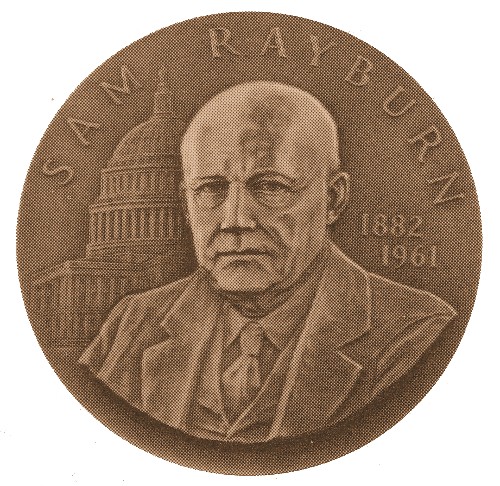
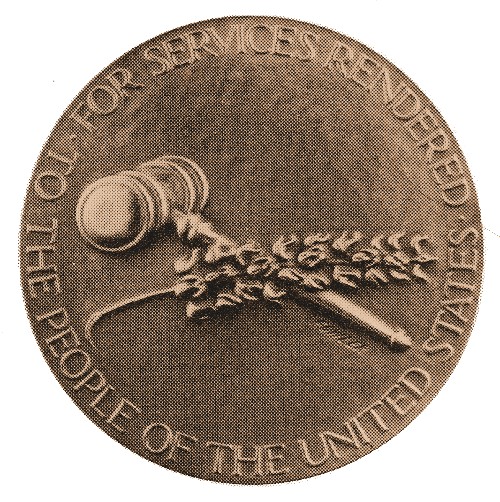 (Image Credit: I didn't have immediate access to my example of the medal, so I am including US Mint images as found in Medals of the United States Mint Issued for Sale, 1972 Edition.as temporary placeholders.)
For more of my topics on commemorative coins and medals, see:
Commems Collection.






 Posted 05/11/2023 10:41 am





