I decided to expand upon my original "Origin Story" for the World's Columbian Exposition - Columbus Half Dollar with a few additional points in a quick "Revisit." So...
(You can find my original Columbian Exposition "Origin Story" post here:
1892-93 Columbian Exposition - Origin Story.)
The US Congress awarded the World's Columbian Exposition to Chicago, Illinois in April 1890 - President Benjamin Harrison signed the bill into law on April 25, 1890. A significant driver behind Chicago's selection by Congress (vs. St. Louis, New York or Washington, DC) was its insistence that it could raise the needed funds for staging the Exposition without financial aid from the US Government - Congress believed the businessmen/bankers/sponsors in Chicago could do it based on preliminary fundraising efforts!
Grand Basin with Exhibition Buildings at World's Columbian Exposition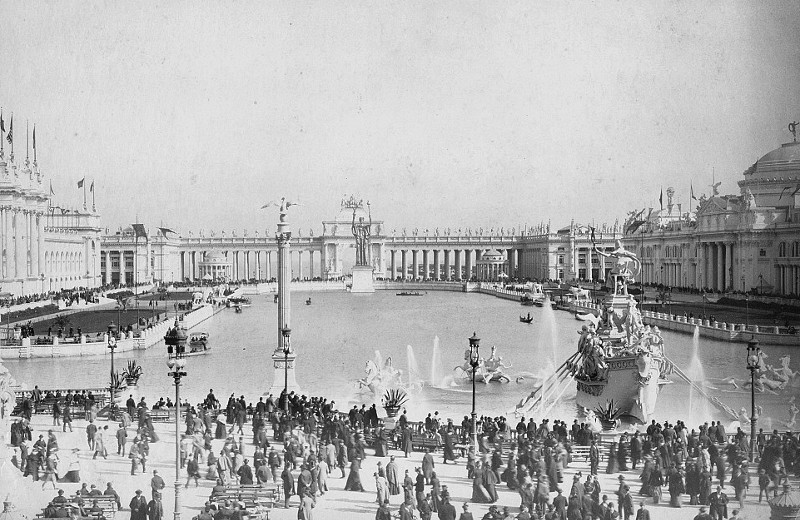 (Image Credit: Library of Congress, Prints and Photographs Division. Public Domain.)
Such optimism proved a bit unfounded, however, and after raising approximately $10 million privately and $5 million from the City of Chicago, the Exposition Company realized that it needed additional funds to complete its task. With such a realization, the Company's Board decided that it would make an appeal to Congress. J. W. St. Clair - one of four members of the Exposition's Council of Administration - developed language for a bill intended to be introduced in Congress that called for the minting of 10 million souvenir half dollars for the Exposition.
The draft was turned over to Allan Cathcart Durborow, Jr. (D-IL) who introduced the bill in the House of Representatives in March 1892. Durborow's bill was later replaced by one from Representative James Bernard Reilly (D-PA) that reduced the quantity of coins from 10 million to 5 million. Importantly, Reilly's bill switched the coins from being a loan that the Company was to repay to an outright approrpiation that did not require repayment. (See my original "Origin Story" (link above) for details on the bills in Congress).
The title of Reilly's bill:
"To aid in carrying out the act of Congress approved April twenty-fifth, eighteen hundred and ninety, entitled "An act to provide for celebrating the four hundredth anniversary of the discovery of America by Christopher Columbus, by holding an international exposition of arts, industries, manufactures, and products of the soil, mine, and sea, in the city of Chicago, in the State of Illinois," and appropriating money therefor."
The bill stated:
"there shall be coined at the mints of the United States silver half dollars of the legal weight and fineness, not to exceed five million pieces, to be known as the Columbian half dollar, struck in commemoration of the World's Columbian Exposition...
"there is hereby appropriated from the Treasury the said five millions of souvenir half dollars, and the Secretary of the Treasury is authorized to pay the same to the World's Columbian Exposition."
Had the Company been able to sell all of the coins struck on its behalf, it would have raised $5 million as it had planned to sell each half dollar for $1.00 - a 100% profit on each sale. Of course, we know that the Company was not able to come close to selling 5 million of its souvenir coins and earning its full potential profit! (See
To the Melting Pot: 1892-93 World's Columbian Exposition Half Dollar.)
The Exposition's large attendance - over 29 million - enabled it to turn a profit of ~$1 million and pay dividends to its investors. Had the souvenir half dollars the Exposition Company received (and kept/didn't return for melting) been subject to loan repayment, its profits would likely have been wiped away.
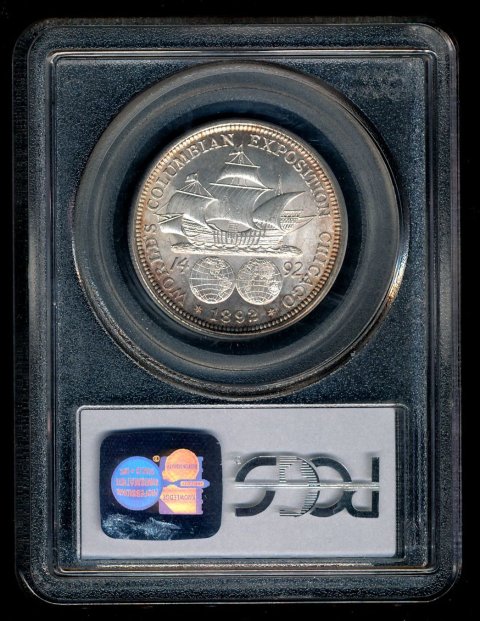
1892 World's Columbian Exposition - Columbus Half Dollar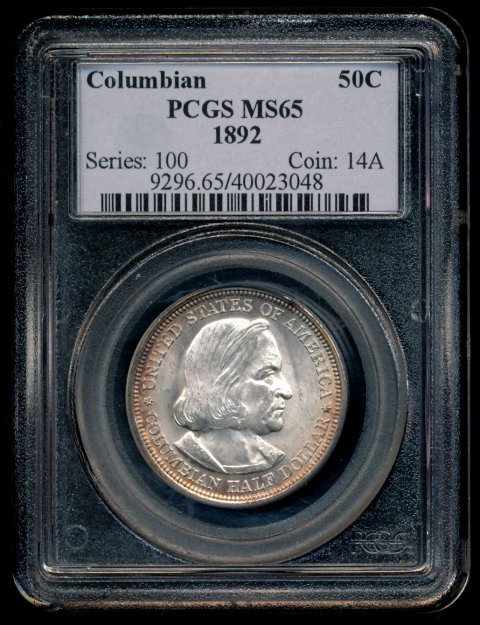
For other of my posts about commemorative coins and medals, including other stories about the Columbian Exposition coins, see:
Commems Collection.







 Posted 07/17/2023 1:10 pm





