(I recommend reading Part I / Organization & Initial Fundraising if you haven't already done so.)My Jefferson Memorial Association medal is definitely one with a personal story. Back in the early-2000s, I had been looking for an example of the medal for a couple of years without success. I decided to attend the New Jersey Token and Medal Show (surprisingly held in Delaware that year) in hopes of finding the piece at a show focused on exonumia. Once again, I was thwarted, however. The friend with whom I was traveling and I became aware of a coin show in New Carrollton, Maryland.
We decided to pull off I-95 for a bit and check out the show. Much to my surprise, I came across one of the medal's in a dealer's case while walking the bourse. I definitely wanted a closer look at the piece, but the dealer was off walking the bourse himself at the time. So, I sat down and waited for his return. After a short time, he returned and asked, "Can I show you something?" I casually (at least I think it was casually!) asked to see the "Jefferson medal" and once I confirmed that it was the medal I was seeking, I asked the dealer if he would accept a lower price vs. what it was marked (though I must admit it was a very reasonable asking price!). We agreed on a new price, and I walked away with a sought-after medal for my collection and a smile!
But enough about me...
In February 1903, bills were introduced in the Senate, by John Warwick Daniel (D-VA,) and in the House of Representatives by Asbury Churchwell Latimer (D-SC), that called for the striking of "certain souvenir medallions for the benefit of the Thomas Jefferson Memorial Association of the United States." (The Senate bill was introduced two weeks before the House bill.) The medals were "for the purpose of aiding in the erection at the city of Washington, District of Columbia, of an appropriate memorial to the author of the Declaration of Independence, Thomas Jefferson."
As was standard, the House bill was referred to the House Committee on Coinage, Weights, and Measures. The Senate bill, however, was, curiously, referred to the Senate Committee on the Library. I appears that it was simply a mistake, as the Committee on the Library soon asked to be discharged from consideration of the bill and recommended that it be referred to the Committee on Finance - such was done without objection.
The day before the House bill was introduced, the Senate bill was reported back from the Finance Committee, with the Treasury Department's statement that it did not object to the medal bill and that the Philadelphia Mint could produce the medals as needed.
The bill was considered in the Senate under Unanimous Consent rules and passed without objection; it was then sent to the House for its consideration. Upon receipt, the bill was referred to the House Committee on Coinage, Weights, and Measures. The House Committee reported the bill back without amendment and with a recommendation for it to pass.
The bill had a slightly rougher time in the House vs. Senate, however. Representative Latimer attempted to get the bill passed via Unanimous Consent, but multiple Representatives (from the Republican side of the aisle - i.e., not Jefferson's party) rose to voice objections. One exchange between the Democrat Representative Latimer and Republican Representative Sereno Elisha Payne (R-NY) was particularly comical to me (the dripping sarcasm by each is wonderful! IMO):
PAYNE: As I understand, it is claimed on your side of the House that Thomas Jefferson was the father of Democracy, is it not?
LATIMER: I am willing to recognize him as such.
PAYNE: Is there is not money enough, generosity enough, patriotism enough, and filial love enough to make these people, claiming to be in sympathy with the principles of Jefferson, by voluntary subscription or otherwise, raise a fund for the purpose of erecting a monument to so great a man as Jefferson was, without going into a sort of gift enterprise to raise a fund?
LATIMER: I can say this to the gentleman from New York, that we are not asking him to contribute one dollar toward this memorial. The Democrats of the country will willingly undertake this enterprise, with such patriotic Republicans as love the memory of Thomas Jefferson. The object of this, as I have said, is simply to give this association an opportunity to raise some money for this great patriotic purpose, and I am willing with that statement to leave it to the House of Representatives.Dorsey William Shackleford (D-MO) then rose and derailed the bill's consideration with extended remarks about a unrelated bill that led to several other unrelated discussions. Eventually, a vote on the bill was called and the "Yeas" totaled 188 and the "Nays" totaled just 2; 160 Representatives either stated "Present" upon being called or did not vote. With more than two-thirds voting in favor, the bill was passed.
The bill was examined and signed in each chamber, then sent to the President for his approval. On March 3, 1903, President Theodore Roosevelt signed the bill into law. (Public Law: 57-170)
Soon thereafter, the Mint struck the Association's medals at the Philadelphia Mint. The medal was struck in bronze in two sizes: 1.5 inches and 3.0 inches.
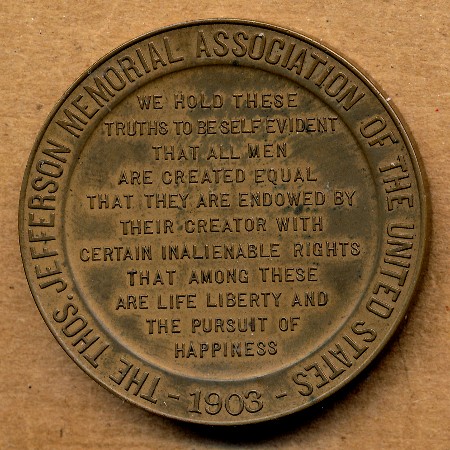
1903 Thomas Jefferson Memorial Association Medal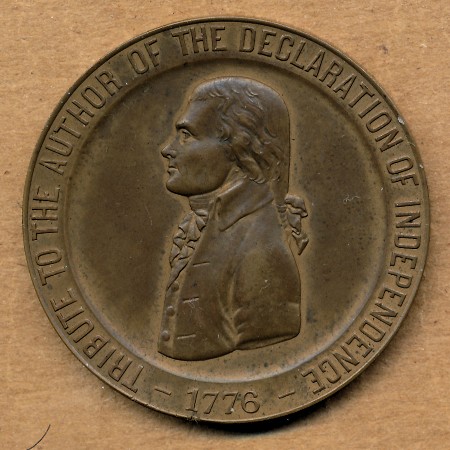
The medal's obverse presents a left-facing portrait of Jefferson, first seen on the Jefferson Indian Peace Medal of 1801; the design and engraving of the Indian Peace Medal was the work of
Robert Scot, Chief Engraver of the US Mint at the time. Encircling at the rim is the inscription: "TRIBUTE TO THE AUTHOR OF THE DECLARATION OF INDEPENDENCE - 1776".
The reverse of the medal is comprised only of inscriptions: "THE THOS. JEFFERSON MEMORIAL ASSOCIATION OF THE UNITED STATES" encircling at the rim and, in the center, from the Declaration of Independence, "WE HOLD THESE / TRUTHS TO BE SELF EVIDENT / THAT ALL MEN / ARE CREATED EQUAL / THAT THEY ARE ENDOWED BY / THEIR CREATOR WITH / CERTAIN INALIENABLE RIGHTS / THAT AMONG THESE / ARE LIFE LIBERTY AND / THE PURSUIT OF / HAPPINESS".
Ultimately, the Association was unsuccessful in raising the needed funds to create a Jefferson Memorial (based on the Greek Parthenon or otherwise), and its lasting legacies are the medal and its
The Writings of Thomas Jefferson collection. It gave up its quest and dissolved.
In 1934, Congress passed a House Joint Resolution that created the Thomas Jefferson Memorial Commission and specified that it was to develop a plan for constructing a "permanent memorial" to Jefferson in Washington, DC. Among the 12 Commissioners to be selected for the Commission were three to be selected by the Thomas Jefferson Memorial Foundation (a group founded in 1923 to purchase, restore and maintain Jefferson's Monticello) - the group was not related to the previous Memorial Association.
Construction on the Jefferson Memorial began in November 1938; its cornerstone was laid one year later. The completed Memorial was dedicated in April 1943; President Franklin Delano Roosevelt led the dedication ceremonies. The Memorial is located on the southern side of the Tidal Basin, just south of the Washington Monument, and is in line with the White House. It was designed by John Russell Pope who created a classical-style, open-air, circular building with a shallow dome and a north-facing Portico.
Jefferson Memorial with Cherry Blossoms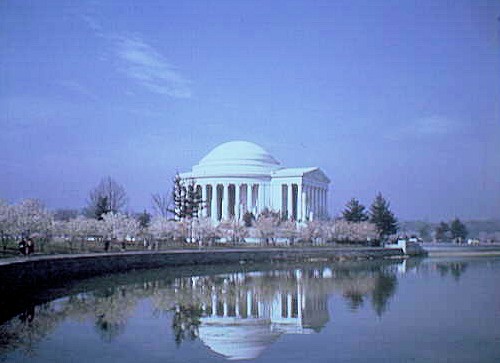 (Image Credit: Theodor Horydczak Collection, Library of Congress, Prints and Photographs Division.)
To learn more about the Jefferson Memorial Association's organization and its fundraising, see
Part IFor other of my posts about commemorative coins and medals, see:
Commems Collection.







 Posted 07/14/2023 4:20 pm





