In December 2007, companion bills were introduced in the Senate - Jeff Bingaman (D-NM) - and House of Representatives - Tom Udall (D-NM) - that called for a two-coin program "to commemorate the 400th anniversary of the founding of Santa Fe, New Mexico, to occur in 2010." The program was to include a Gold Half Eagle ($5.00) and a Silver Dollar. The Senate bill referred to the event as the "Santa Fe 400th Anniversary," while the House bill referred to it as the "Santa Fe Quadricentennial." (Different phrasing, but same meaning.)
Santa Fe 400th Anniversary Logo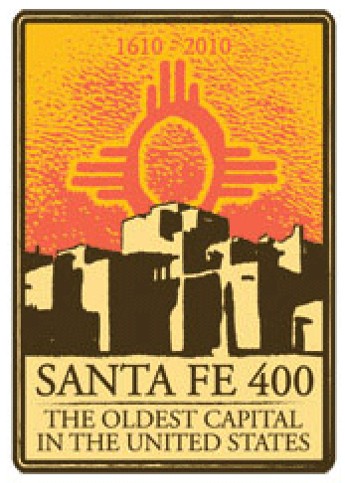
While introducing his coin bill, Senator Bingaman remarked:
"In 2010, the City of Santa Fe will commemorate the arrival of Spanish settlers and the designation of the City of Santa Fe as the capital city of the Spanish territory now known as New Mexico. On their arrival the Spaniards found a thriving Native American culture. These native American and Spanish cultures served to enrich each other and led to a creation of a vibrant social, cultural, and financial center that made the settlement of the western U.S. possible. Although it was not always a smooth road it is the unique combination of the Spanish, native American, and Anglo cultures in Santa Fe that make it an American treasure. Santa Fe has long been heralded for its thriving arts community, as a world class travel destination, and for its natural beauty. These treasures and its proud history as a cultural meeting place make Santa Fe worthy of the national recognition of a commemorative coin. I urge all Senators to support this bill."Representative Udall also spoke on behalf of the Santa Fe coin bill. He basically reiterated the Findings included in the bills (see below), and concluded with:
"For the rich blend of cultures steeped in centuries of heritage, it is only fitting that the Congress recognize the 400th anniversary of the Nation's oldest capital originally known as La Villa Real de la Santa Fe de San Francisco de Asis. I urge my colleagues to join me in passing this legislation."The Senate bill was referred to the Senate Committee on Banking, Housing, and Urban Affairs. The House bill to the House Committee on Financial Services, which further referred it to the Subcommittee on Domestic and International Monetary Policy, Trade, and Technology.
Each of the bills included a series of findings about Santa Fe and its history. From the Senate bill:
"Congress makes the following findings:
(1) Santa Fe, New Mexico, the site of native occupation centuries before European incursions, was officially elevated from a plaza established in 1608 to a villa and capital city in 1610. Santa Fe has been the meeting place and home of many cultures.
(2) The Palace of the Governors, built in the early 17th century served as the governor's quarters and the seat of government under 3 flags. It is the oldest continuously used public building in the United States.
(3) La Fiesta de Santa Fe, a cultural, religious, and social celebration, commemorating the resettlement of Santa Fe by General Don Diego de Vargas in 1692 continues today as an attraction for tourists and locals alike.
(4) At the nexus of 3 historically important trails, Santa Fe brought people and goods together over the Santa Fe Trail to and from Missouri, California, and Mexico City.
(5) Commerce on the Santa Fe Trail brought a much needed boost to the economy of the American West during the recession of the early 19th century. Santa Fe was the rendezvous place for traders, mountain men and forty-niners on route to California, and is today home to a multicultural citizenry and world class art market.
(6) The Santa Fe area is a center of market activity for arts and culture year round, culminating in the world renowned Indian Market, Spanish Colonial Art Market, and International Folk Art Market.
(7) New Mexico is the home to the oldest and continuously inhabited indigenous communities in North America. Native communities now residing in New Mexico include--
(A) Acoma Pueblo;
(B) Alamo Navajo Chapter;
(C) Canoncito Navajo Chapter;
(D) Cochiti Pueblo;
(E) Isleta Pueblo;
(F) Jemez Pueblo;
(G) Jicarilla Apache Tribe;
(H) Laguna Pueblo;
(I) Mescalero Apache Tribe;
(J) Nambe Pueblo;
(K) Picuris Pueblo;
(L) Pojoaque Pueblo;
(M) Ramah Navaho Chapter;
(N) San Felipe Pueblo;
(O) San Ildefonso Pueblo;
(P) San Juan Pueblo;
(Q) Sandia Pueblo;
(R) Santa A
na Pueblo;
(S) Santa Clara Pueblo;
(T) Santo Domingo Pueblo;
(U) Taos Pueblo;
(V) Tesuque Pueblo;
(W) Zia Pueblo;
(X) Zuni Pueblo; and
(Y) many others that disappeared or were moved after European contact.
(8) The Pueblo Revolt of 1680 is known to be one of the first "American Revolutions" when the Pueblo people ousted Spanish colonists from New Mexico.
(9) The Santa Fe area has long attracted tourists, artists, and writers. The classic novel Ben Hur was written, in part, by then Governor Lew Wallace, in the Palace of the Governors.
(10) A commemorative coin will help to foster an understanding and appreciation of New Mexico, its history and culture and the importance of Santa Fe and New Mexico to the history of the United States and the world.
The House version of the bill featured the same Findings (with some minor wording/format changes) plus one additional:
"Santa Fe was the rendezvous place for traders, mountain men, and "Forty-Niners" on route to California and is today home to a multicultural citizenry and world class art market."The coin program was to include up to 100,000 Gold Half Eagles and 500,000 Silver Dollars. The issue price of each coin was to include a surcharge - $35 and $10, respectively - with 50% of the surcharge funds collected provided to the Santa Fe 400th Anniversary Committee and 50% to be paid to the US Department of the Interior to support its ongoing initiatives to preserve and research Santa Fe, as well as provide educational and commemoration programs.
Though each version of the bill had a number of co-sponsors, neither made it out of Committee, so no Santa Fe 400th Anniversary coins were struck by the US Mint. It was a busy Congress (110th) for commemorative coin bills, with 17 different programs (representing 30+ bills) proposed - five of the programs were authorized, four would be authorized in a future Congress via subsequent bills.
For other of my posts about commemorative coins and medals, including more What If? stories about classic-era and modern US commemorative coins, see:
Commems Collection.







 Posted 08/31/2023 12:05 pm





