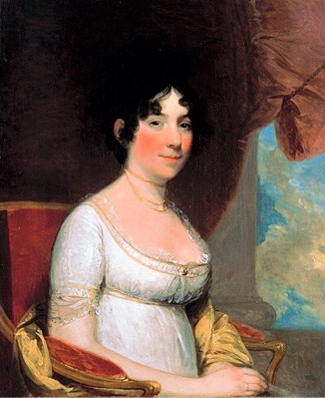
The 1999 Dolley Madison Silver Dollar, with its designs "emblematic of the 150th anniversary of the death of Dolley Madison and the life and achievements of the wife of the fourth President of the United States" is interesting from several perspectives:

It was the result of an unusual journey through Congress as it wasn't the coin originally proposed for its stated objectives. (Can you say "Plan B"?
It was designed by jeweler and silversmith Tiffany & Co. artists vs. Mint staff or open competition.
It is one of the few US commemorative coins that features a commercial, registered trademark logo (i.e., T & CO.) as part of its designs.
The Dolley Madison Commemorative Coin Act began life as a bill calling for the "Secretary of the Treasury to mint coins in commemoration of the 250th anniversary of the birth of James Madison." The bill was introduced in the House of Representatives by Tom Bliley (R-VA) and was referred to the House Committee on Banking and Financial Services, which subsequently referred it to its Subcommittee on Domestic and International Monetary Policy.
Portrait: James Madison by John Vanderlyn (1816)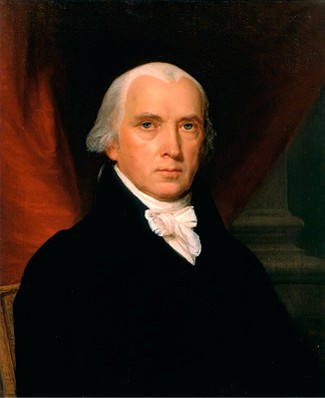 (Image Credit: White House Art Collection, CC BY US 3.0. Public Domain.)
The original bill called for up to 500,000 silver dollars for the benefit of the National Trust for Historic Preservation in the United States; the National Trust was to use the funds to establish an endowment to permanently support Montpelier (James' and Dolley's home in Virginia) and fund needed restoration projects. The issue price of the silver dollars was to include a surcharge of $10.00 for this purpose.
As required, the Chairman of the Subcommittee, Michael Newbold Castle (R-DE), forwarded the bill to the Citizen's Commemorative Coin Advisory Committee (established in 1993, replaced by the Citizen's Coin Advisory Committee in 2003). The Advisory Committee supported the objectives of the bill but found that it went against its rule of honoring the same person more than once in a 10-year period - James Madison was commemorated in the 1993 Bill of Rights commemorative coin program.
The Advisory Committee agreed with the objective of raising funds to protect and preserve Montpelier, and so recommended the bill be amended to honor Dolley instead of James and be used to mark the 150th anniversary of her death. Dolley served as White House hostess, first during the widowed Thomas Jefferson's administration and then during her husband's; she was known for her grace and diplomatic skills in the role. She is also remembered for her bravery in remaining in the White House as British soldiers approached during the War of 1812 until she ensured that the full-length portrait of George Washington - painted by Gilbert Stuart - was saved and spirited away to New York to keep it from being destroyed and/or captured by the British (the British set fire to multiple buildings US capital in 1814).
Portrait: Dolley Madison by Gilbert Stuart (1804)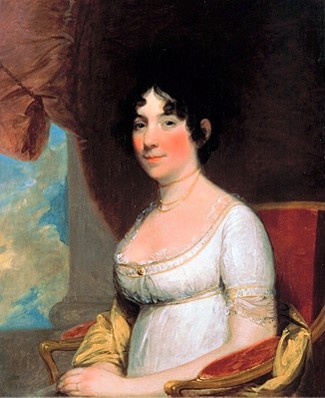 (Image Credit: White House Art Collection, CC BY US 3.0. Public Domain.)Standing Portrait: George Washington by Gilbert Stuart (1796)
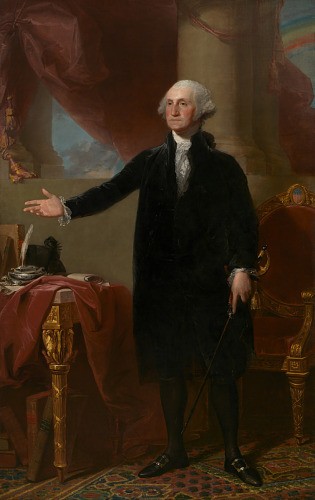 (Image Credit: National Portrait Gallery, Smithsonian Institution. Public Domain.)
The Committee reported the bill with the recommended amendments and it was passed in the House. From there, it was sent to the Senate for its consideration, but was not acted upon. Instead, the essential components of the bill were folded into a multi-commemorative coin bill that also included (in order of listing in the bill) the 1999 George Washington Death Bicentennial Gold Half Eagle, the 1998 Black Revolutionary War Patriots Silver Dollar, the 1999 Franklin Delano Roosevelt Gold Half Eagle, the 1999 Yellowstone National Park 125th Anniversary Silver Dollar, the 1997 National Law Enforcement Officers Memorial Silver Dollar and the 1997 Jackie Robinson 50th Anniversary of breaking the Major League Baseball color barrier gold and silver coins. (it's interesting to note that the combined bill began life as a single-coin bill proposing only the Black Revolutionary War Patriots Silver Dollar but was amended to include the other coins.)
The combined bill was eventually passed by the House and Senate and became law on October 20, 1996 when it was signed by US President William "Bill" Clinton. (Public Law 104-329)
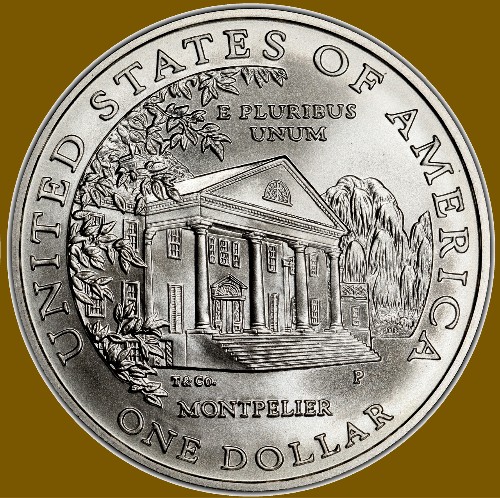
The obverse of the coin presents a portrait of First Lady Dolley Madison at left-front, with the Madison's Temple in the gardens of Montpelier in the background. (The "Temple" was a place for sitting, relaxing and reflecting. James Madison is believed to have had the "temple" built "to celebrate both knowledge and liberty" - from plaque at site.) Dolley is framed by a bouquet of her favorite flower - Cape Jasmines. The coin's reverse presents the front/main entrance of Montpelier framed by willow trees and other foliage. As noted above, the designs are the creation of Tiffany & Co. artists, but the engraving/modeling of the designs was handled by the US Mint: Obverse -
T. James Ferrell; Reverse -
Thomas D. Rogers.
Why Tiffany and Co.? The private sector company was commissioned by the National Trust for Historic Preservation to create the designs. It did so and then donated the designs to the National Trust, which provided them to the Mint for use in creating the coin dies. Based on the popularity of the designs among collectors, I would say that Tiffiany & Co. was successful with its efforts! (Tiffany & Co, has a long history of philanthropy - it was founded in 1837 - and has donated millions of dollars toward preserving natural and historical treasures.)
The Silver Dollar was available in Proof and Uncirculated versions, being available for delivery beginning on January 8, 1999 (the coin could be ordered beginning October 2, 1998 but was not immediately delivered as per its authorizing legislation. Each version of the coin was available at a Pre-Issue Discount - $33.00 for the Proof and $30 for the Uncirculated. The two-piece set (one of each version) was available for $59.95 Pre-Issue. After February 8, 1999, the prices increased to $37.00 (Proof) and $32.00 (Uncirculated); the price of the two-piece set increased to $64.95.
The coin had an authorized maximum mintage of 500,000, but did not achieve a sell-out. Sales of the Proof version of the coin totaled 224,403; the Uncirculated version sold 89,104 units. Each of these numbers includes the coins sold as part of the two-coin set which had sales of 66,156.
For my collection, I added an Uncirculated version.
1999 Dolley Madison Silver Dollar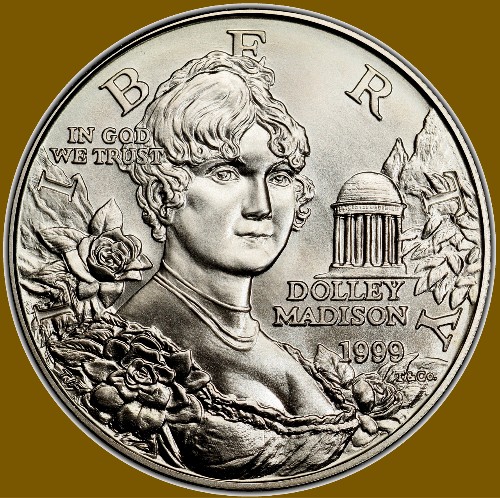
For other of my posts about commemorative coins and medals, including more on other modern-era US commemorative coins, see:
Commems Collection.







 Posted 09/25/2023 12:21 pm