Here's my 1902 50 Centavos coin from Columbia. It's part of my "Images of Liberty" collection featuring coins from around the world with allegorical representations of "Liberty."
1902 Columbia 50 Centavos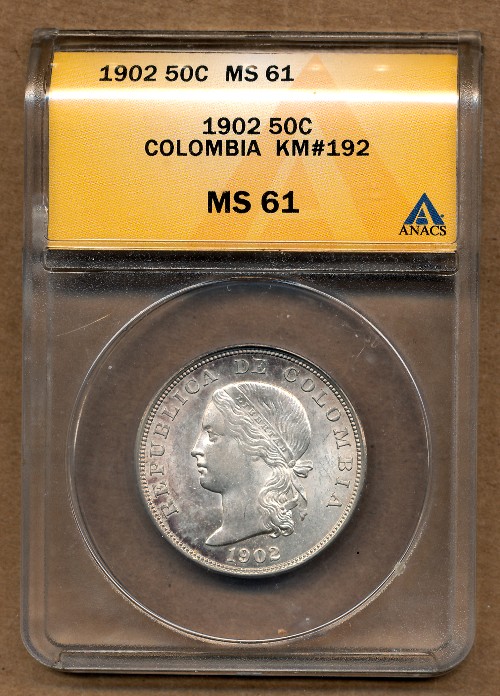
The coin's obverse presents a left-facing bust portrait of a female allegorical figure representing
Liberty. LIBERTAD is inscribed in her head band. Above the portrait is found "REPUBLICA DE COLUMBIA" (Republic of Columbia) with the date "1902" below. Denticles are seen at the rim.
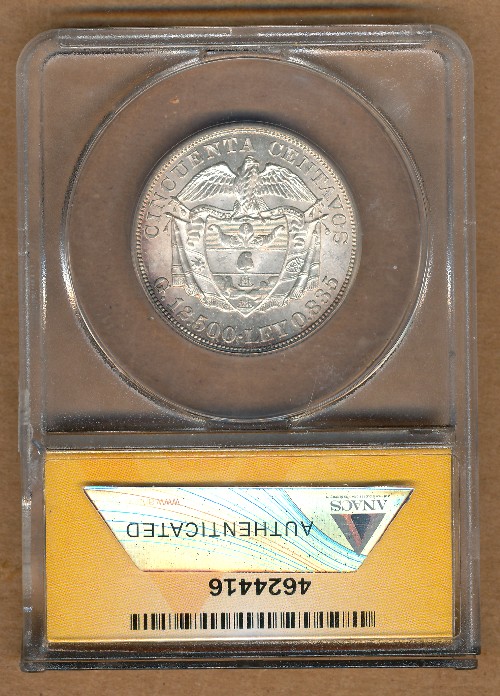
The reverse depicts the Arms of Columbia. At its top is seen an Andean condor with spread wings and an olive branch wreath in its beak. At its feet is a ribbon inscribed with Columbia's National Motto: "LIBERTAD Y ORDEN" (English: "Liberty and Order").
The condor surmounts a Shield divided into three horizontal sections. The top segment depicts a pair of overflowing cornucopia that face each other; the left horn is full of gold and silver, the right is filled with tropical fruits. The cornucopias are meant to symbolize the agricultural and mineral wealth of Columbia. Between, and just above, the cornucopias is seen a pomegranate which is meant to symbolize Colombia's colonial history. The middle section or "Freedom and Liberty" section, depicts a Phrygian cap - long an international symbol of freedom. The lower section presents two sailing ships on the sea which are meant to represent Columbia's history of maritime trade/commerce.
The Shield is flanked by early flags of Columbia, i.e., those in use prior to the adoption of its current flag in 1861; Columbia's current Arms feature its modern flag.
The denomination (50 Centavos) is above the Arms and the coin's weight (12.5 grams) and silver finess (0.835) are presented below it. As on the obverse, denticles are seen at the rim.
The coin was struck by the US Mint in Philadelphia, PA; 960,000 were minted. The US Mint also struck 400,000 1902 Five Centavos coins for Columbia. The US did not strike additional coins for Columbia until 1916.
The coin was sent to ANACS for grading and was returned to me as an MS-61. This surprised me a bit, as I expected a high AU grade not MS. My reasoning was that the coin's beautiful cartwheel luster seemed to be disturbed on
Liberty's cheek to my eyes. Maybe ANACS believed it to be a "weak strike" issue vs. "wear" issue and thus graded it in the MS range. In any case, the coin is very attractive in hand and truly does exhibit great luster.
For other of my posts about commemorative coins and medals, plus other World coins, see:
Commems Collection.







 Posted 10/09/2023 09:47 am





