Coin Community Family of Web Sites
Specializing in Modern Numismatics Coin, Banknote and Medal Collectors's Online Mall Royal Canadian Mint products, Canadian, Polish, American, and world coins and banknotes. Shop for APMEX Bullion on eBay!Vancouvers #1 Coin and Paper Money Dealer Shop CCF Members on eBay! 300,000 items to help build your collection!


Username:
Password:
Save Password
Forgot your Password?


This page may contain links that result in small commissions to keep this free site up and running.

Welcome Guest! Registering and/or logging in will remove the anchor (bottom) ads. It's Free!

Commems Collection Modern: 1970 Stone Mountain Dedication

To participate in the forum you must log in or register.
Author Previous TopicReplies: 9 / Views: 1,642Next Topic  
CCF Master Historian of USA Commemoratives
Learn More...
commems's Avatar
United States
12252 Posts
 Posted 11/25/2023  09:36 am Show Profile   Bookmark this topic Add commems to your friends list Get a Link to this Message Number of Subscribers
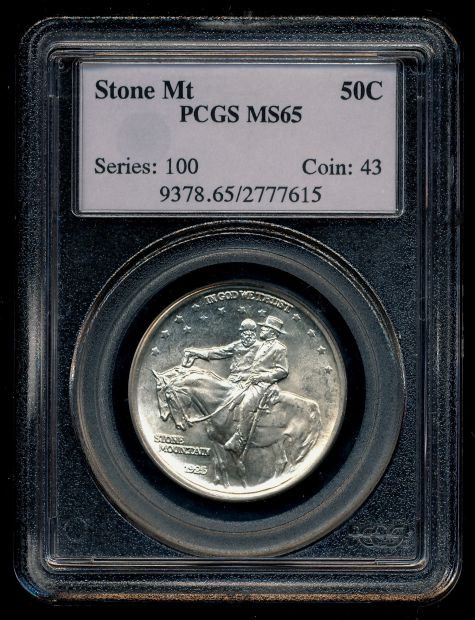
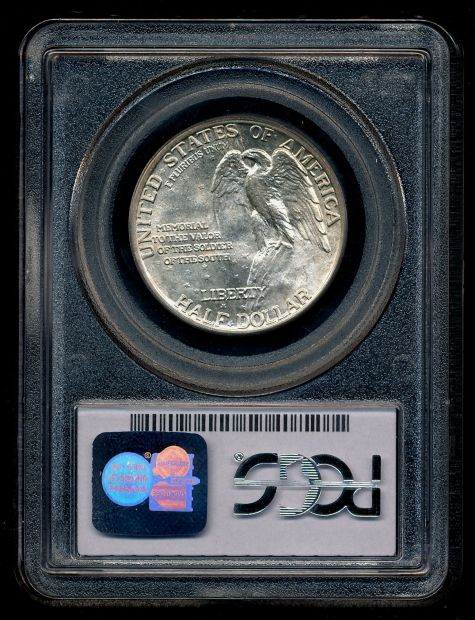
The carving of the Stone Mountain Memorial, outside of Atlanta, GA, began in 1923. To mark this beginning, and financially support the carving, the US Congress authorized a commemorative half dollar that was sponsored and sold by the Stone Mountain Confederate Monumental Association. The project suffered through multiple financial issues, a well-publicized rift with its initial sculptor - Gutzon Borglum - and timeline issues that ultimately left the Memorial in an unfinished state for decades. (I've covered these topics in previous posts, see Commems Collection for more.)

1925 Stone Mountain Memorial Half Dollar
Commems-Collection-Modern:-1970-Stone-Mountain-Dedication Commems-Collection-Modern:-1970-Stone-Mountain-Dedication


Three very similar (though not identical) bills were introduced on the same February day during the 91st Congress (February 16, 1970). The bills called for the striking of medals (not coins) to commemorate "the completion of the carvings on Stone Mountain, Georgia, depicting heroes of the Confederacy;" the medals were sponsored by the Stone Mountain Memorial Association. Two of the bills were introduced in the House of Representatives, one in the Senate. Each of the bills allowed for medals to be struck through December 31, 1971.

The two House bills were introduced by Benjamin Bentley Blackburn (R-GA) and Robert Grier Stephens, Jr. (D-GA), respectively; the Senate bill by Herman Eugene Talmadge (D-GA) on behalf of himself and Richard Brevard Russell, Jr. (D-GA). (Georgia's representation in Congress united behind the medal bills!) The House bills were referred to the House Committee on Banking and Currency with a subsequent referral to the Committee on Consumer Affairs, the Senate bill was referred to its version of the Committee on Banking and Currency.

The Senate Committee was the first to report back, and did so with a recommendation for the bill to pass with with an amendment. The original Senate bill did not set a limit on the number of medals that could be struck, but the Treasury Department recommended that an upper limit be put in place. In reporting the bill, the Committee, after consulting with the bill's primary sponsor - Senator Talmadge - set the maximum to 500,000 medals. IMO, a more than reasonable upper limit.

The Senate accepted the Committee's recommended amendment and passed the bill without objection or debate; the bill was then sent to the House where it was referred to Committee.

The House Committee on Banking and Currency reported on the parallel House version of the bill, with a recommendation for it to pass with one technical amendment. The Treasury Department requested that the bill's specified 500,000 medal limit the bill included be moved from Section 2 of the bill to Section 1. (One of the differences between the original Senate and House bills.)

When the bill was brought up for consideration in the House, it was passed, with the Treasury's requested amendment. The House then brought up the Senate version of the bill and passed it without debate. Once the Senate bill was passed by the House, its version was "laid on the table" and the Senate bill moved forward.

The Senate bill was then examined and signed in each chamber, before being presented to the President. US President Richard Milhous Nixon signed the bill into law on May 14, 1970.

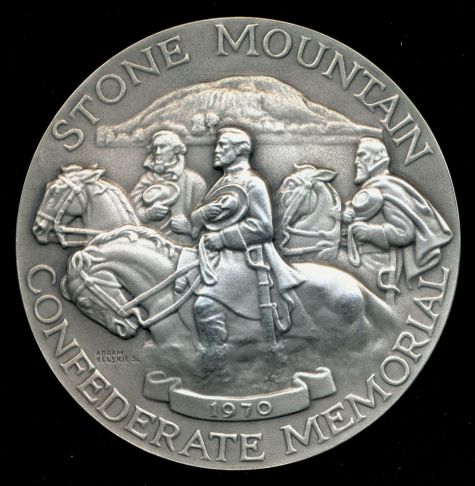
The medal's obverse features an equestrian scene that is somewhat similar to the 1925 half dollar. On the medal is seen (left to right): Jefferson Davis, General Robert E. Lee and General Stonewall Jackson. (On the coin, Jackson occupied the position taken by Davis on the medal, and Davis was omitted.) In the background is seen a distant view of Stone Mountain, the world's largest, exposed granite rock. The inscriptions "STONE MOUNTAIN" and "CONFEDERATE MEMORIAL" encircle the graphic elements at the rim. (The medal's depiction is in line with the actual Stone Mountain carving.)

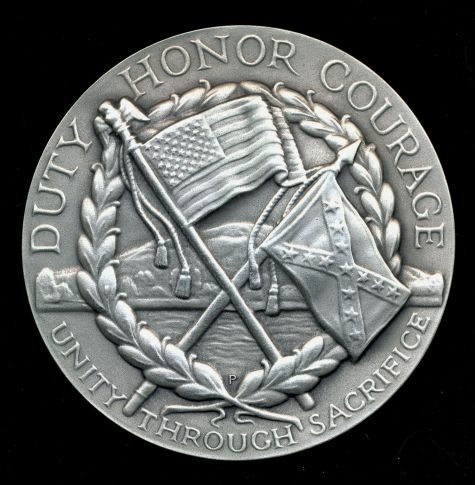
The medal's reverse features the inscriptions "DUTY HONOR COURAGE" at the top rim, and "UNITY THROUGH SACRIFICE" at the bottom. In the center is found a laurel wreath encircling crossed US and Confederate Battle flags, with the pole of the US Flag in the front position. Stone Mountain is seen in the background.

The medal was designed and sculpted by Abram Belskie. It was struck in silver and bronze, with each metal being used for a small and a large version. The first batch of medals was struck by the US Mint, later strikes were made by the Medallic Art Company.

The US Mint strikes are slightly larger (3 inches vs. 2-3/4 inches and 1-9/16 inches vs. 1-1/2 inches, respectively) and are denoted with a "P" mint mark on the reverse.


1970 Stone Mountain Memorial Dedication Medal
Commems-Collection-Modern:-1970-Stone-Mountain-Dedication Commems-Collection-Modern:-1970-Stone-Mountain-Dedication
Note: the example shown here was struck by the US Mint vs. being a Medallic Art Company (MACO) product - observre the "P" mint mark found on reverse just above the crossed boughs of the wreath.


For other posts about commemorative coins and medals, see: Commems Collection.




Collecting history one coin or medal at a time! (c) commems. All rights reserved.
Edited by commems
11/25/2023 09:39 am
Bedrock of the Community
Coinfrog's Avatar
United States
94367 Posts
 Posted 11/25/2023  10:39 am  Show Profile   Bookmark this reply Add Coinfrog to your friends list Get a Link to this Reply
I wonder if such a medal could be issued today?
CCF Master Historian of USA Commemoratives
Learn More...
commems's Avatar
United States
12252 Posts
 Posted 11/25/2023  11:12 am  Show Profile   Bookmark this reply Add commems to your friends list Get a Link to this Reply

Quote:
I wonder if such a medal could be issued today?

An interesting thought to ponder, but this isn't the place for political debate.


Collecting history one coin or medal at a time! (c) commems. All rights reserved.
Moderator
Learn More...
nickelsearcher's Avatar
United States
15386 Posts
 Posted 11/25/2023  5:52 pm  Show Profile   Bookmark this reply Add nickelsearcher to your friends list Get a Link to this Reply
Fabulous history read on this medal. I had no idea this US Mint struck medal existed - nor that subsequent medals were privately struck.

Thank you @commems for your continued scholastic sharing.
Take a look at my other hobby ... http://www.jk-dk.art
Moderator
Learn More...
nickelsearcher's Avatar
United States
15386 Posts
 Posted 11/25/2023  6:01 pm  Show Profile   Bookmark this reply Add nickelsearcher to your friends list Get a Link to this Reply
Interesting to observe a feature on the medals reverse that I would appreciate others views on:

Note the wavy field design contained between the crossed boughs of the wreath and the base of Stone Mountain, and through which the poles of the two flags pass through.

What do you suppose Mr. Belskie meant shorty by these surfaces?

The wavy surfaces bring to my eye a resemblance of water features.

I've been to the Stone Mountain to see it with my own eyes and there are no water features.

What do you think?
Take a look at my other hobby ... http://www.jk-dk.art
Pillar of the Community
Learn More...
hokiefan_82's Avatar
United States
3634 Posts
 Posted 11/25/2023  6:29 pm  Show Profile   Bookmark this reply Add hokiefan_82 to your friends list Get a Link to this Reply
Very interesting, commems, thank you!
Member of SPMC, FCCB, ANA and ANS.
My U.S. Classic Commemorative Complete Set: https://www.NGCcoin.com/registry/co...sets/278741/
My U.S. Fractional Note Set: https://notes.www.collectors-societ...eSetID=34188
Moderator
Learn More...
jbuck's Avatar
United States
187582 Posts
Pillar of the Community
psuman08's Avatar
United States
1751 Posts
 Posted 11/29/2023  3:28 pm  Show Profile   Bookmark this reply Add psuman08 to your friends list Get a Link to this Reply
The high relief medal is quite stunning. I still don't understand why it was made at the mint and privately.
CCF Master Historian of USA Commemoratives
Learn More...
commems's Avatar
United States
12252 Posts
 Posted 11/29/2023  6:09 pm  Show Profile   Bookmark this reply Add commems to your friends list Get a Link to this Reply

Quote:
I still don't understand why it was made at the mint and privately.


The US Mint was used to strike the original batch of medals. By then switching to MACO (i.e., a private manufacturer) the Stone Mountain Memorial Association no longer had to abide by the Public Law's provisions that restricted the medal's production. For example, no medals could be struck after December 31, 1971. Also, if demand warranted, more than 500,000 medals could be struck by MACO. Such flexibility was appealing to the Association.

The Association got the best of both world's, a Congressionally-authorized National Medal AND the flexibility and benefits of contracting with a private mint.


Collecting history one coin or medal at a time! (c) commems. All rights reserved.
CCF Master Historian of USA Commemoratives
Learn More...
commems's Avatar
United States
12252 Posts
 Posted 11/29/2023  6:12 pm  Show Profile   Bookmark this reply Add commems to your friends list Get a Link to this Reply

Quote:
What do you suppose Mr. Belskie meant shorty by these surfaces?

The wavy surfaces bring to my eye a resemblance of water features.

I've been to the Stone Mountain to see it with my own eyes and there are no water features.

What do you think?

My understanding is that the lines represent the grassy field at the base of the mountain vs. water.


Collecting history one coin or medal at a time! (c) commems. All rights reserved.
  Previous TopicReplies: 9 / Views: 1,642Next Topic  

To participate in the forum you must log in or register.


Disclaimer: While a tremendous amount of effort goes into ensuring the accuracy of the information contained in this site, Coin Community assumes no liability for errors. Copyright 2005 - 2026 Coin Community Family- all rights reserved worldwide. Use of any images or content on this website without prior written permission of Coin Community or the original lender is strictly prohibited.
Contact Us  |  Advertise Here  |  Privacy Policy / Terms of Use

Coin Community Forum © 2005 - 2026 Coin Community Forums
It took 0.34 seconds to rattle this change. Forums

