The carving of the Stone Mountain Memorial, outside of Atlanta, GA, began in 1923. To mark this beginning, and financially support the carving, the US Congress authorized a commemorative half dollar that was sponsored and sold by the Stone Mountain Confederate Monumental Association. The project suffered through multiple financial issues, a well-publicized rift with its initial sculptor - Gutzon Borglum - and timeline issues that ultimately left the Memorial in an unfinished state for decades. (I've covered these topics in previous posts, see
Commems Collection for more.)
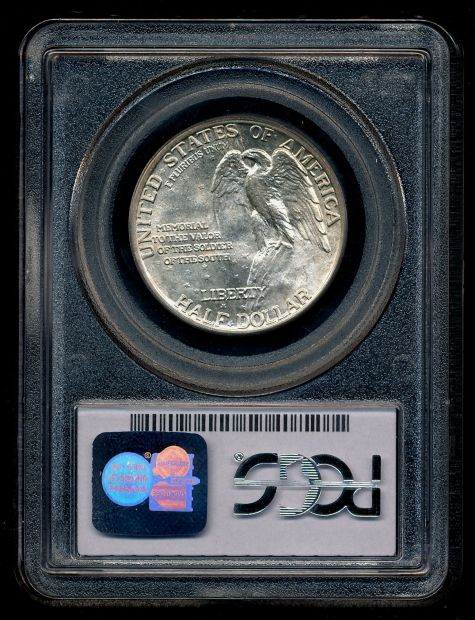
1925 Stone Mountain Memorial Half Dollar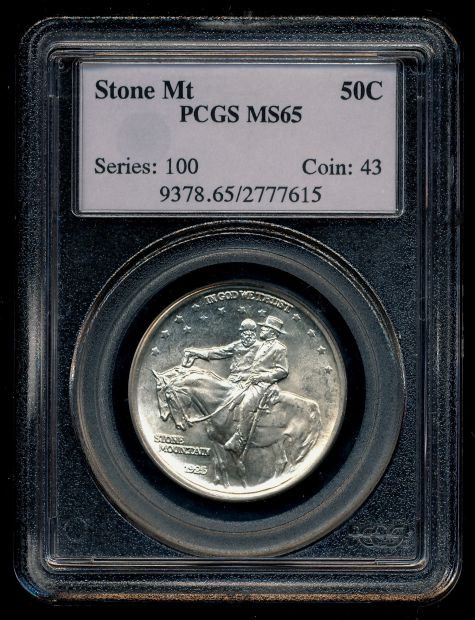
Three very similar (though not identical) bills were introduced on the same February day during the 91st Congress (February 16, 1970). The bills called for the striking of medals (not coins) to commemorate "the completion of the carvings on Stone Mountain, Georgia, depicting heroes of the Confederacy;" the medals were sponsored by the Stone Mountain Memorial Association. Two of the bills were introduced in the House of Representatives, one in the Senate. Each of the bills allowed for medals to be struck through December 31, 1971.
The two House bills were introduced by Benjamin Bentley Blackburn (R-GA) and Robert Grier Stephens, Jr. (D-GA), respectively; the Senate bill by Herman Eugene Talmadge (D-GA) on behalf of himself and Richard Brevard Russell, Jr. (D-GA). (Georgia's representation in Congress united behind the medal bills!) The House bills were referred to the House Committee on Banking and Currency with a subsequent referral to the Committee on Consumer Affairs, the Senate bill was referred to its version of the Committee on Banking and Currency.
The Senate Committee was the first to report back, and did so with a recommendation for the bill to pass with with an amendment. The original Senate bill did not set a limit on the number of medals that could be struck, but the Treasury Department recommended that an upper limit be put in place. In reporting the bill, the Committee, after consulting with the bill's primary sponsor - Senator Talmadge - set the maximum to 500,000 medals. IMO, a more than reasonable upper limit.
The Senate accepted the Committee's recommended amendment and passed the bill without objection or debate; the bill was then sent to the House where it was referred to Committee.
The House Committee on Banking and Currency reported on the parallel House version of the bill, with a recommendation for it to pass with one technical amendment. The Treasury Department requested that the bill's specified 500,000 medal limit the bill included be moved from Section 2 of the bill to Section 1. (One of the differences between the original Senate and House bills.)
When the bill was brought up for consideration in the House, it was passed, with the Treasury's requested amendment. The House then brought up the Senate version of the bill and passed it without debate. Once the Senate bill was passed by the House, its version was "laid on the table" and the Senate bill moved forward.
The Senate bill was then examined and signed in each chamber, before being presented to the President. US President Richard Milhous Nixon signed the bill into law on May 14, 1970.
The medal's obverse features an equestrian scene that is somewhat similar to the 1925 half dollar. On the medal is seen (left to right): Jefferson Davis, General Robert E. Lee and General Stonewall Jackson. (On the coin, Jackson occupied the position taken by Davis on the medal, and Davis was omitted.) In the background is seen a distant view of Stone Mountain, the world's largest, exposed granite rock. The inscriptions "STONE MOUNTAIN" and "CONFEDERATE MEMORIAL" encircle the graphic elements at the rim. (The medal's depiction is in line with the actual Stone Mountain carving.)
The medal's reverse features the inscriptions "DUTY HONOR COURAGE" at the top rim, and "UNITY THROUGH SACRIFICE" at the bottom. In the center is found a laurel wreath encircling crossed US and Confederate Battle flags, with the pole of the US Flag in the front position. Stone Mountain is seen in the background.
The medal was designed and sculpted by Abram Belskie. It was struck in silver and bronze, with each metal being used for a small and a large version. The first batch of medals was struck by the US Mint, later strikes were made by the Medallic Art Company.
The US Mint strikes are slightly larger (3 inches vs. 2-3/4 inches and 1-9/16 inches vs. 1-1/2 inches, respectively) and are denoted with a "P" mint mark on the reverse.
1970 Stone Mountain Memorial Dedication Medal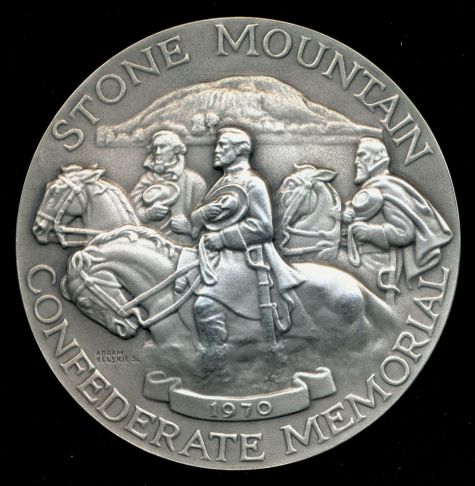
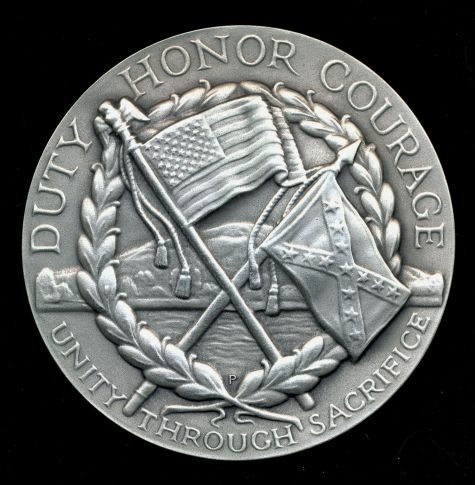 Note: the example shown here was struck by the US Mint vs. being a Medallic Art Company (MACO) product - observre the "P" mint mark found on reverse just above the crossed boughs of the wreath.
For other posts about commemorative coins and medals, see:
Commems Collection.









 Posted 11/25/2023 11:12 am


