Coin Community Family of Web Sites
Coin, Banknote and Medal Collectors's Online Mall Specializing in Modern Numismatics Shop for APMEX Bullion on eBay!Royal Canadian Mint products, Canadian, Polish, American, and world coins and banknotes. Shop CCF Members on eBay! Vancouvers #1 Coin and Paper Money Dealer 300,000 items to help build your collection!


Username:
Password:
Save Password
Forgot your Password?


This page may contain links that result in small commissions to keep this free site up and running.

Welcome Guest! Registering and/or logging in will remove the anchor (bottom) ads. It's Free!

Commems Collection Classic: 1934 Maryland Tercentenary - Design Similarity?

To participate in the forum you must log in or register.
Author Previous TopicReplies: 5 / Views: 661Next Topic  
CCF Master Historian of USA Commemoratives
Learn More...
commems's Avatar
United States
12252 Posts
 Posted 11/30/2023  11:05 am Show Profile   Bookmark this topic Add commems to your friends list Get a Link to this Message Number of Subscribers
A brief notice about the arrival and local availabilty of the Maryland Tercentenary half dollar appeared in multiple newspapers in Maryland in July 1934.

In addition to announcing the availability of the coins, the pieces also stated:

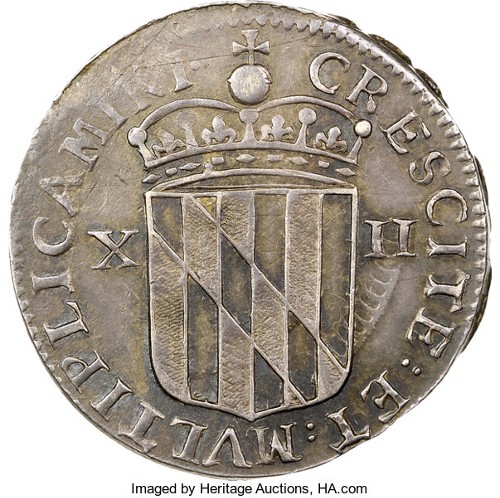
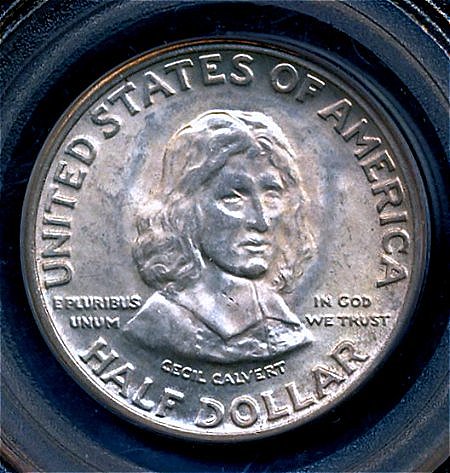
"It is said one of the features which makes the coin desirable is its similarity to the old Lord Baltimore shilling, used in the colony in the seventeenth century."

But how similar are the designs?

Cecil Calvert, who inherited the land grant for the Province of Maryland upon the death of his father (George), had coins struck for use in the Maryland colony (with the expectation that they would circulate in the other colonies as well). Four different denominations were struck: silver coins of four Pence, six Pence and 12 Pence (One Shilling) plus a small number of pattern pieces for a copper one penny coin called a denarium.

It is believed that the coins were struck at the Tower Mint in London in 1659 and 1660; the silver coins were delibrately struck underweights by ~30% (vs. the British standard of the time) to ensure Cecil Calvert would profit by their use. Calvert soon found himself in trouble over the coins, however, as it was argued by some that he did not have coining authority. Calvert was brought before the Committee of the Council for the Plantations in England. It does not appear that he received any type of harsh punishment regaring his coinage, however, and he was able to export the siilver coins to the Province of Maryland, with records indicating that circulation of the pieces began by 1663 and continued for years after.

The three silver coins shared a common design, with the size of the coin and its inscribed denomination changing as appropriate. Nicholas Briot is the credited designer.

Each of the coins features a portrait of Cecil Calvert, 2nd Lord Baltimore on the obverse and a design incorporating the Calvert family Coat-of-Arms surmounted by a crown/coronet indicative of George Calvert's status as a British Baron.

(1659) Lord Baltimore Shilling
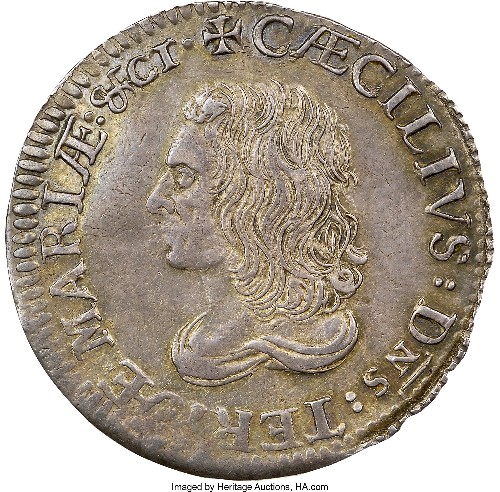
Commems-Collection-Classic:-1934-Maryland-Tercentenary---Design-Similarity? Commems-Collection-Classic:-1934-Maryland-Tercentenary---Design-Similarity?
(image Credit: Heritage Auxtions. https://www.ha.com)

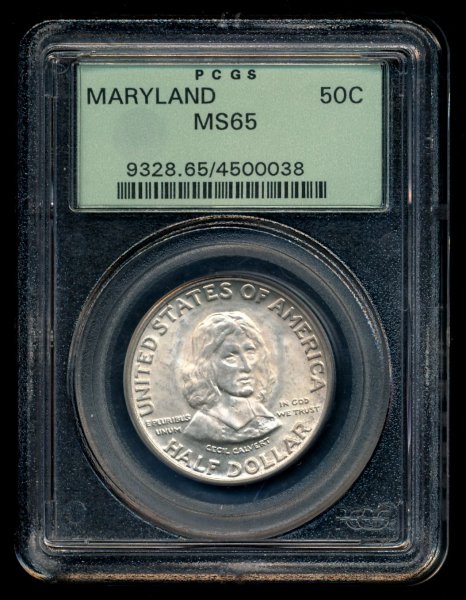
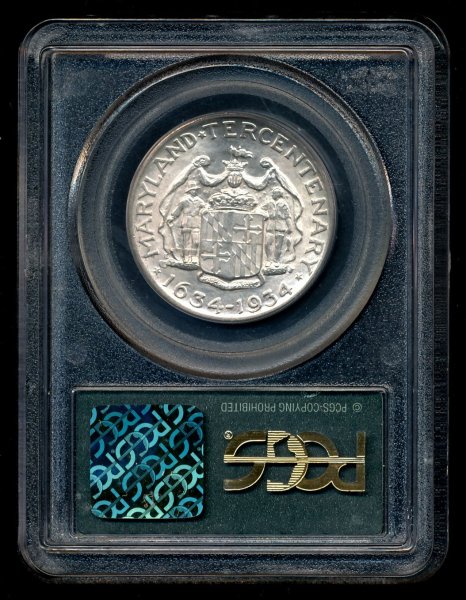
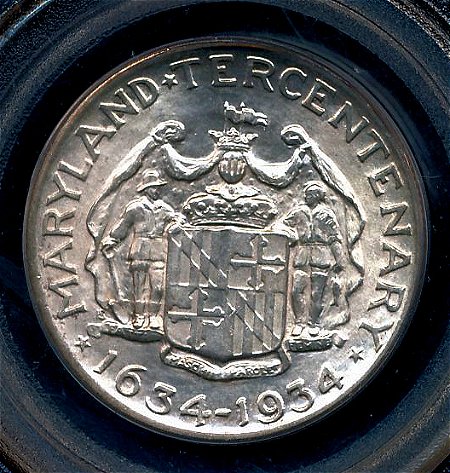
1934 Maryland Tercentenary Half Dollar
Commems-Collection-Classic:-1934-Maryland-Tercentenary---Design-Similarity? Commems-Collection-Classic:-1934-Maryland-Tercentenary---Design-Similarity?

Commems-Collection-Classic:-1934-Maryland-Tercentenary---Design-Similarity? Commems-Collection-Classic:-1934-Maryland-Tercentenary---Design-Similarity?

IMO, the design similarities would have to be considered a stretch, but they do share a similarity in theme: portrait of Calvert on the obverse, Shield/Coat-of-Arms on the reverse. What do you think?


For other posts about commemorative coins and medals, including more on the Maryland half dollar, see: Commems Collection.

For a bit more on the Coat-of-Arms side of the Maryland half dollar, check out:

- Official Seals On Classic US Commemoratives - Part III




Collecting history one coin or medal at a time! (c) commems. All rights reserved.
Moderator
Learn More...
jbuck's Avatar
United States
187582 Posts
Bedrock of the Community
Coinfrog's Avatar
United States
94367 Posts
 Posted 11/30/2023  2:10 pm  Show Profile   Bookmark this reply Add Coinfrog to your friends list Get a Link to this Reply
Excellent info as always!
Moderator
Learn More...
nickelsearcher's Avatar
United States
15386 Posts
 Posted 12/01/2023  06:36 am  Show Profile   Bookmark this reply Add nickelsearcher to your friends list Get a Link to this Reply
Concur with your views @commems that the coins share a related design theme - but I don't consider them to have a directly related design.
Take a look at my other hobby ... http://www.jk-dk.art
Moderator
Learn More...
Sap's Avatar
Australia
16806 Posts
 Posted 12/02/2023  04:51 am  Show Profile   Bookmark this reply Add Sap to your friends list Get a Link to this Reply

Quote:
IMO, the design similarities would have to be considered a stretch, but they do share a similarity in theme: portrait of Calvert on the obverse, Shield/Coat-of-Arms on the reverse. What do you think?


They are "similar", only in the sense that they depict the same person's portrait (so the obverse will look similar) and they have related coats of arms on the reverse (so those will look similar too). I'm also reasonably sure that such a similarity was not the intent of the later coin's designers (or they would have tried much harder).

I would have rather said that the Baltimore shillings actually "look similar to" English crown shillings of the day, or indeed French and Italian regal coinages from the same time period - which was presumably both the intent of the design, and the reason why Lord Baltimore was hauled before the Committee. If his coins looked more like the New England or Pine Tree coinages, I doubt an eyebrow would have been raised. But the Lord Baltimore coinage design definitely has more of an "I am the Emperor of Maryland" theme going for it.
Don't say "infinitely" when you mean "very"; otherwise, you'll have no word left when you want to talk about something really infinite. - C. S. Lewis
Pillar of the Community
Russian Federation
5172 Posts
 Posted 12/02/2023  07:19 am  Show Profile   Bookmark this reply Add january1may to your friends list Get a Link to this Reply

Quote:
I would have rather said that the Baltimore shillings actually "look similar to" English crown shillings of the day, or indeed French and Italian regal coinages from the same time period - which was presumably both the intent of the design, and the reason why Lord Baltimore was hauled before the Committee. If his coins looked more like the New England or Pine Tree coinages, I doubt an eyebrow would have been raised. But the Lord Baltimore coinage design definitely has more of an "I am the Emperor of Maryland" theme going for it.
Indeed just a few years later, in the mid-1660s, the luigini of various French and Italian states had extremely similarly styled designs (as nicely discussed here on CCF).
I'd have almost suggested that Lord Baltimore could have been deliberately ripping off on those, but the timing doesn't quite fit - if his issue was in 1659 then most of the proliferation hadn't happened yet.
  Previous TopicReplies: 5 / Views: 661Next Topic  

To participate in the forum you must log in or register.


Disclaimer: While a tremendous amount of effort goes into ensuring the accuracy of the information contained in this site, Coin Community assumes no liability for errors. Copyright 2005 - 2026 Coin Community Family- all rights reserved worldwide. Use of any images or content on this website without prior written permission of Coin Community or the original lender is strictly prohibited.
Contact Us  |  Advertise Here  |  Privacy Policy / Terms of Use

Coin Community Forum © 2005 - 2026 Coin Community Forums
It took 0.23 seconds to rattle this change. Forums