The bill that resulted in the 2004 Thomas Alva Edison Silver Dollar started life as a two-coin (and potentially three-coin) bill, proposing a Silver Dollar, a Silver Half Dollar and a possible Copper-Nickel (CuNi) Clad Circulating Half Dollar. The bill was introduced by Paul Gilmor (R-OH), on behalf of himself and 45 colleagues, on February 11, 1997.
Thomas Alva Edison, Circa 1915-1920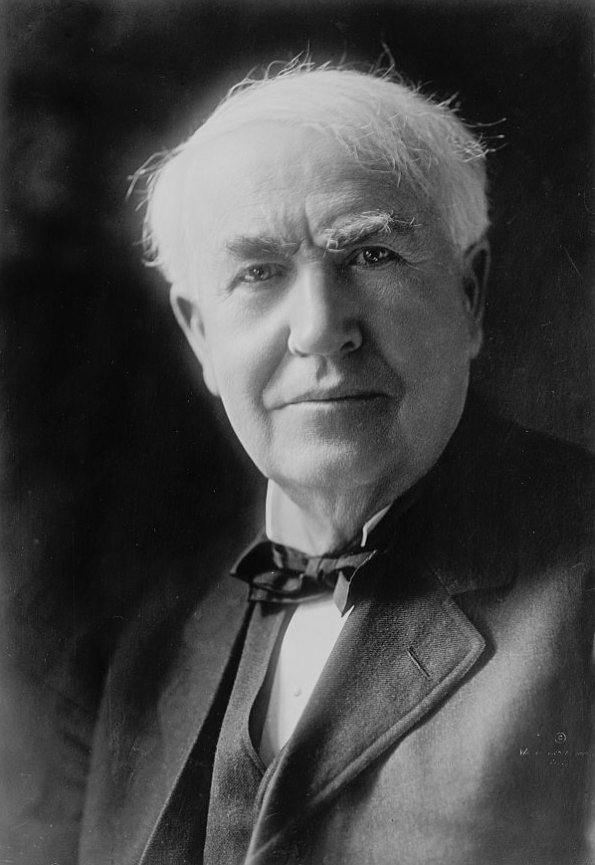 (Image Credit: Library of Congress, Prints and Photographs Division. Public Domain.
Originally proposed as a 1997 commemorative program for the 150th Anniversary of Edison's birth, the numismatic tribute became a 2004 single-coin commemoration of the 125th Anniversary of Edison's incandescent light bulb.
From the original bill:
"The Congress finds that--
(1) Thomas Alva Edison, one of America's greatest inventors, was born on February 11, 1847, in Milan, Ohio;
(2) the inexhaustible energy and genius of Thomas A. Edison produced more than 1,300 inventions in his lifetime, including the incandescent light bulb and the phonograph;
(3) in 1928, Thomas A. Edison received the Congressional gold medal "for development and application of inventions that have revolutionized civilization in the last century''; and
(4) 1997 will mark the sesquicentennial of the birth of Thomas A. Edison."Upon its introduction, the bill was referred to the House Committee on Banking and Financial Services, with a further referral to its Subcommittee on Domestic and International Monetary Policy. A companion bill was introduced in the Senate by Frank R. Lautenberg (D-NJ) and was referred to the Senate Committee on Banking.
The bills called for 350,000 Silver Dollars, 350,000 Silver Half Dollars and the potential issue of a circulation Half Dollar (released from January 1, 1997 through July 31, 1998; the striking of a circulating half dollar was to be left to the discretion of the Secretary of the Treasury.
Per the bill, the coins were allowed to "bear the same design as the commemorative coins minted under title I of the Thomas Alva Edison Sesquicentennial Commemorative Coin Act" (i.e., the same design as the silver collector coins). It's not clear from the bill's wording if the Silver Dollar and Silver Half Dollar were to have a common design or distinct designs, which causes the design specification for the circulating half dollar to be a bit ambiguous.
The bills languished in their respective Committees, with no Committee reports coming forward. Nineteen (19!) months later, Michael Newbold Castle (R-DE) took to the floor of the House of Representatives and asked that the Edison coin bill be brought up for consideration. Though its front stage consideration had not progressed in over 18 months, the bill had undergone significant backroom changes by the time Castle brought it up for consideration. It should be noted that during the period of apparent inactivity, Representative Gilmor was actively building a list of needed co-sponsors for the coin bill - something he stated was "no small task" - 290 co-sponsors (i.e., two-thirds of House members) are required before a coin bill can be brought for consideration.
In the amended bill, gone was the Silver Half Dollar, gone was the potential circulating half dollar, gone was the objective of marking the 150th anniversary of Edison's birth in 1997, and replaced with the commemoration of the 125th anniversary of the "first practical incandescent electric lamp" in 2004.
Also, added to the original list of surcharge beneficiaries was the Hall of Electrical History in Schenectady, New York. The original bill listed seven beneficiaries - all were retained in the updated bill. They were:
(1) Museum of Arts and History - Port Huron, Michigan
(2) Edison Birthplace Association - Milan, Ohio
(3) National Park Service (specifically for the "invention factory" of Thomas A. Edison in West Orange, New Jersey.
(4) Edison Plaza Museum - Beaumont, Texas
(5) Edison Winter Home and Museum - Fort Myers, Florida
(6) Edison Institute / "Greenfield Village" - Dearborn, Michigan
(7) Edison Memorial Tower - Edison, New Jersey
Note: The Silver Dollar was launched at Greenfield Village on February 11, 2994.A surcharge of $10 per coin was set in the revised/amended bill, with the total amount collected to be split among the eight (8) sponsors/beneficiaries.
In addition, the maximum authorized mintage for the Silver Dollar was adjusted from the original 350,000 to 500,000.
Multiple Congressmen rose to offer their support for the bill and to praise Edison. The bill was ultimately passed in the House by a vote of 397 "For," 1 "Against" and 36 "No Vote." The revised/amended bill was next considered by the Senate. It met no objection in the Senate, passing via Unanimous Consent. Senator Lautenberg, the sponsor of the original Edison coin bill in the Senate voiced his support for the House bill and extolled the virtues and accomplishments of Edison himself.
The approved bill was examined and signed in each chamber, then presented to the President. US President William Jefferson "Bill" Clinton signed the bill into law on October 31, 1998.
The obverse of the coin features a front-facing portrait of Edison in his laboratory in Menlo Park, NJ; he is shown holding an early version of his light bulb. US Mint Sculptor-Engraver
Donna Weaver was responsible for the design.
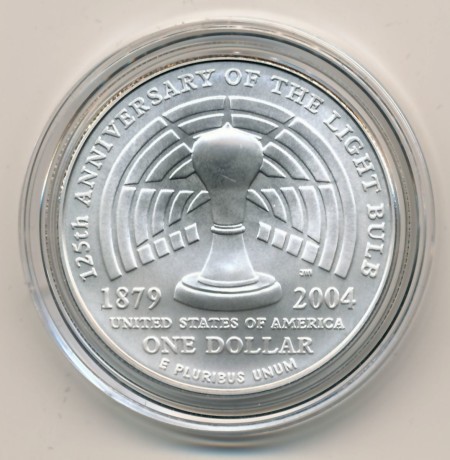
The reverse, designed by then Sculptor-Engraver
John Mercanti, depicts a circa 1879 Edison light bulb with rays of light emanating from it. The reverse also includes the anniversary dates "1879 - 2004." (Note: On May 19, 2006, Mercanti was promoted to Chief Engraver of the US Mint; he retired from the Mint in late 2010.)
The Proof version of the coin sold 211,055 units; the Uncirculated version had total sales of 92,150 (including 24,370 in the Thomas Alva Edison Collector's Set).
Pricing for the Proof coin was $33 Pre-Issue/$37 Regular Issue; for the Uncirculated version: $31 Pre-Issue/$33 Regular Issue. The Collector's Set was priced at $49.
2004 Thomas Alva Edison Silver Dollar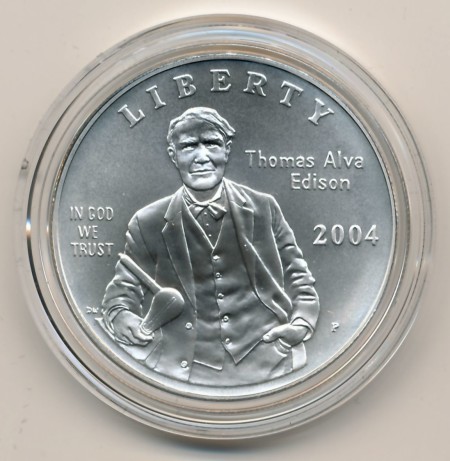
Check out what is, IMO, the most interesting special packaging option yet produced by the US Mint, see:
-
2004 Thomas Alva Edison Collector's SetFor a discussion of a medal that marked the Centennial of Edison's birth, see:
-
1947 Thomas Edison Centennial - So-Called Half DollarFor more of my stories about commemorative coins and medals, including more on the modern US commemorative coin series, see:
Commems Collection.







 ....
....

 Posted 08/06/2024 5:27 pm





