Let's open with a bit of history...George Washington - Gilbert Stuart Portrait (circa 1798-1800).
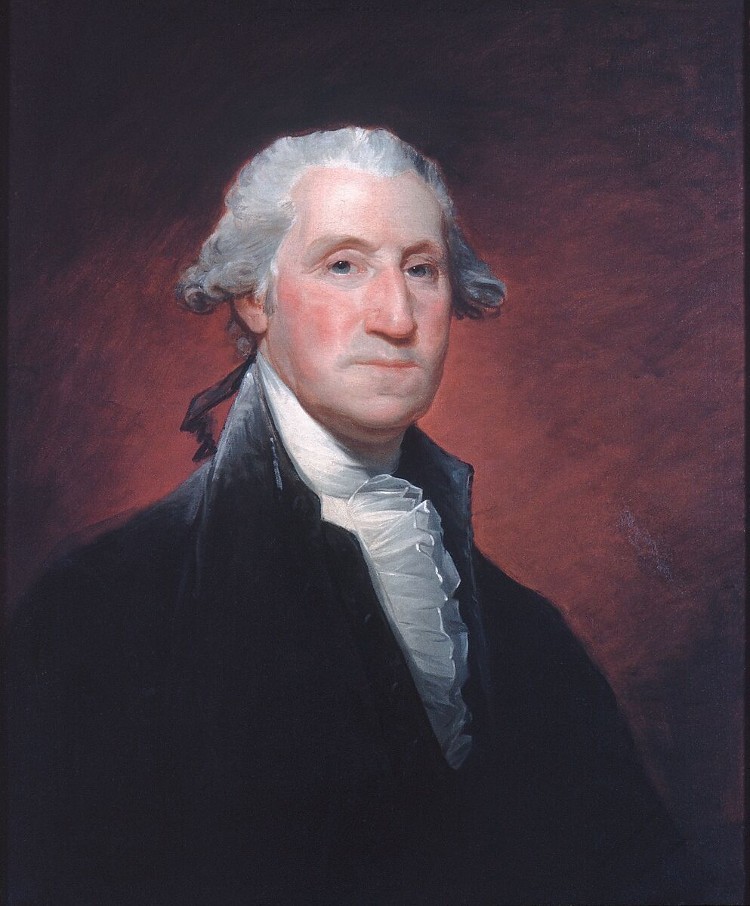 (Image Credit: Metropolitan Museum of Art. Public Domain.)
George Washington was born on February 22, 1732 at Popes Creek in Westmoreland, Virginia. (His birthplace is now preserved as a National Monument administered by the National Park Service. (See more here:
George Washington Birthplace National Monument.)
George moved with his family from Pope's Creek to a farm on the east bank of the Rappahannock River (across from Fredricksburg, Virginia) in November 1738; George was six at the time, but closing in on his seventh birthday. The farm is now generally referred to as "Ferry Farm" due to the ferry landing and ferry road present on the property - the Washington's, however, did not own or operate the ferry service. The Washingtons referred to the farm as "Home Farm".
The farm was purchased by George's father, Augustine, at auction. Augustine continued his ownership of the Pope's Creek property as well, along with a plantation on Little Hunting Creek in present-day Fairfax County, Virginia. (You may know this property by its well-known name of Mount Vernon.) When Augustine died in 1743, he left "Ferry Farm" to George, the Little Hunting Creek plantation to one of George's older half-brothers - Lawrence (a son of Augustine by his first wife - Jane Butler.) and the Pope's Creek property to another of George's older half-brothers - Augustine Jr. (another son of Augustine's by his first wife).
George lived at Ferry Farm until the early 1750s. Beginning 1751-52, he spent an increasing amount of his time with his older brother Lawrence at Mount Vernon or on trips seeking medical treatment (for Lawrence). After Lawrence died in 1754, the plantation passed first to his daughter - Sarah - then to his former wife - Anne - after Sarah died in 1756. Anne and her new husband, George Lee, leased the property to George Washington beginning in 1754. When Anne died in 1761, the property passed to George W (as per Lawrence Washington's will).
George's mother, Mary Ball Washington, continued to live at Ferry Farm until 1772, when she moved to Fredericksburg, VA. George sold his boyhood home in 1774.
Note: Ferry Farm is said to have been the site of two famous (though not necessarily factual) events of George Washington's life. It was there that he allegedly couldn't tell a lie about chopping down a cherry tree with his hatchet and where he threw a silver dollar across the river. The veracity of each of these American legends is seriously questioned today, but digging into them is beyond the scope of this coin-related post. I encourage you to explore these interesting tales on your own!The story continues here:
What If? 1996 George Washington Boyhood Home - Part II / Coin History 








 Posted 09/22/2024 7:28 pm


 Uncirculated American Silver Eagles


