WARNING! This is a long one! 
Here's a coin program that I believe would have been "loved" by some collectors and "hated" by others - a gold, silver and copper-nickel (CuNi) clad coin program that would have authorized the striking of coins "in commemoration of the centennial of the Panama-Pacific International Exposition and the Panama Canal."
Companion bills were introduced in the Senate, by Dianne Feinstein (D-CA), and House of Representatives, by Michael Honda (D-CA). The bills were introduced on August 2, 2012 and were immediately referred to the appropriate Committees: the Senate Committee on Banking, Housing, and Urban Affairs and the House Committee on Financial Services with a subsequent referral to its Subcommittee on Domestic Monetary Policy and Technology.
The bills included extensive "Findings".
"The Congress finds the following:
(1) The 1915 Panama-Pacific International Exposition was a world's fair held in San Francisco, California. The Exposition ran from February 20 until December 4, 1915.
(2) The Exposition commemorated the completion of the Panama Canal and the 400th Anniversary of the discovery of the Pacific Ocean by the Spanish explorer Vasco Nunez de Balboa.
(3) The event was a significant factor in the economic recovery of San Francisco, which had been nearly destroyed by an earthquake and subsequent fire in 1906.
(4) President William Howard Taft announced the choice of San Francisco as location of the Exposition in 1911, and construction began shortly thereafter.
(5) There were hundreds of buildings on the grounds; most were built to last only the duration of the Exposition. Every State then in the Union was represented with a building. Many nations were represented at the Exposition as well: 22 foreign governments had buildings. The fair occupied 76 city blocks.
(6) The only building to survive the Exposition, and its most visible remnant, is the Palace of Fine Arts, which was designed by noted architect Bernard R. Maybeck.
(7) Congress authorized the United States Mint to issue five different coins dated 1915 in connection with the Panama-Pacific International Exposition. The coins represent a high water mark for American commemorative coins. Produced at the San Francisco Mint, these were the first United States commemorative coins to bear the motto "In God We Trust", and included the silver Panama-Pacific half dollar and four gold coins in denominations of one dollar, 2½ dollars, a 50-dollar round coin, and a unique 50-dollar octagonal coin.
(8) The octagonal $50 gold piece was the largest coin authorized by Congress, and the first minted since 1852 in a shape other than round.
(9) The Panama Canal, which cuts across the Isthmus of Panama, was built between 1890 and 1914. It was the world's greatest engineering feat of its time and required a labor force of almost 40,000.
(10) While the initial French efforts to build the canal were disastrous, President Theodore Roosevelt, recognizing the value of a canal, led the United States in buying the equipment and concession of the unsuccessful French effort to build the canal for $40 million, and championed the effort that overcame malaria and immense logistical problems. The Canal opened on August 15, 1914—401 years after Balboa first crossed Panama.
(11) Stretching 51 miles, the Panama Canal connected the Atlantic Ocean and the Pacific Ocean, saving sailors a dangerous 8,000-mile journey around Cape Horn and through the Straits of Magellan, and cutting in half the time previously required to sail between the oceans.
(12) The United States should mark the centennial of this important event in San Francisco and the monumental achievement of the opening of the Panama Canal.
(13) The proceeds from the surcharge on the sale of such commemorative coins will assist in supporting the educational programs of the San Francisco Museum and Historical Society and the preservation of Theodore Roosevelt's home in Oyster Bay, New York."The program was to pay homage to the two $50 gold coins of the 1915 program, as well as to the silver half dollar. The program was to include two gold Half Eagles ($5 coins), one round, one octagonal; a silver dollar and a CuNi clad half dollar. The bill specified that "the coins minted under this Act shall be a close likeness of the two gold and one half dollar coins issued by the San Francisco Mint at the opening of the Pan-Pacific Exposition and the medal awarded to every United States citizen who worked for a continuous 2-year period on the construction of the Panama Canal."
The Gold Half Eagles were to "have an obverse depicting the head of the goddess Minerva, with a Corinthian-style helmet, enclosed in a ring of beads" and a reverse "depicting an owl perched on a pine bough complete with four pine cones and multiple sprigs of pine needles surrounded by the same ring of beads depicted on the obverse." Encircling the design was to be "the inscriptions "PANAMA-PACIFIC EXPOSITION" and "SAN FRANCISCO" in a single line of text circling the entire rim, with the words separated by dots. The octagonal version of the coin was also to have an "obverse and reverse that depicts, in the eight angles of the vertices, eight stylized dolphins that form an outer circle."
As the coins were to adhere to the current standard specifications for each denomination (i.e., the Gold Half Eagle was to be 0.850 inches in diameter vs. the 1.7/1.73 inches (43.20/44.0 millimeter) diameter of the original round/octagonal Quintuple Eagles ($50 gold coins), I think it would have been interesting to see how the original design fared in such an extreme downsizing.
The Gold Dollar of the 1915 program was to be replaced by a Silver Dollar. It was to be a close likeness, in the form of a coin, of the Roosevelt Medal. Its obverse was to depict US President Theodore Roosevelt, with its reverse "depicting the Culebra Cut, a 9-mile, 272-foot-deep excavation through the Cordillera Mountains." It was also to include the original medal's inscriptions "THE LAND DIVIDED, THE WORLD UNITED" and (optionally) "PRESENTED BY THE PRESIDENT OF THE UNITED STATES". The former inscription was the Canal Zone's motto.
Original Theodore Roosevelt / Panama Canal Service Award Medal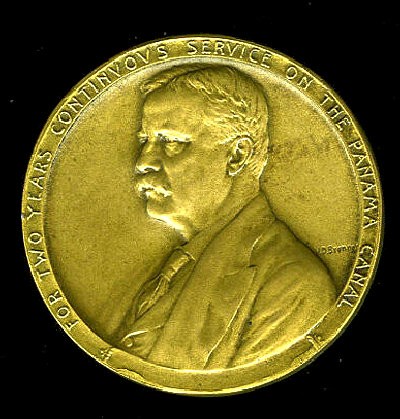
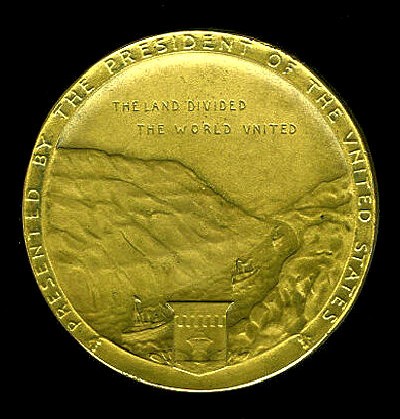 (Image Credit: Heritage Auctions.)
The Clad Half Dollar was "to be a close likeness of the 1915 Panama Pacific Exposition half dollar coin." Its obverse was to depict
Columbia scattering flowers from a cornucopia held by a small child, and its reverse was to depict an eagle perched on a Union shield, flanked by oak (left) and olive (right) branches.
The coins were to be date "2015" - the Gold Half Eagles and Clad Half Dollar to feature Roman numerals (i.e., MMXV) and the Silver Dollar to use standard Arabic numbers (i.e., 2015).
Maximum mintage figures for each coin were set at up to 50,000 for each of the Gold Half Eagle varieties, and no more than 500,000 each of the Silver Dollar and Clad Half Dollar.
The issue price of each coin was to include a surcharge: $35 for the Gold Half Eagles, $10 for the Silver Dollar and $5 for Clad Half Dollar. Collected surcharge funds were to be split between the San Francisco Museum and Historical Society "for the design and construction of appropriate exhibitions" (75%) and the National Park Foundation "for programs, construction, or preservation work at President Theodore Roosevelt's home in Oyster Bay, New York (25%).
Neither the Senate nor House bill was reported out of Committee, and so died for lack of action when the 112th Congress adjourned.
I'm not generally a fan of re-using previous coin designs, but the Silver Dollar and its use of the Roosevelt/Panama Canal presentation medal's design is likely something I would have enjoyed.
For more of my stories about commemorative coins and medals, including other What If? stories, see:
Commems Collection.






 Posted 10/03/2024 12:01 pm





