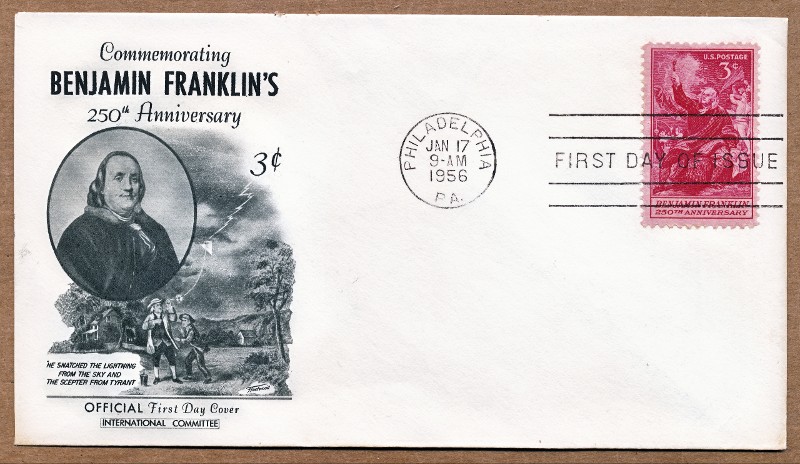
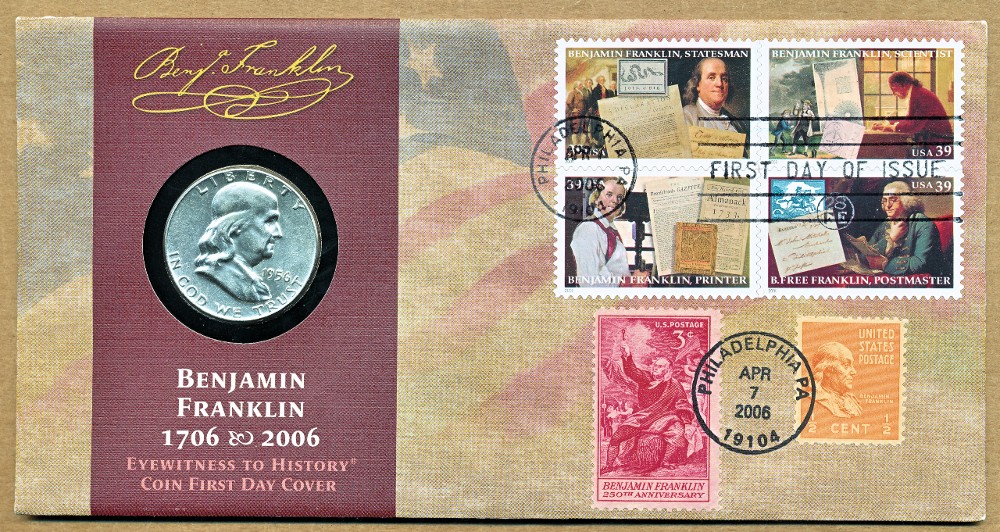
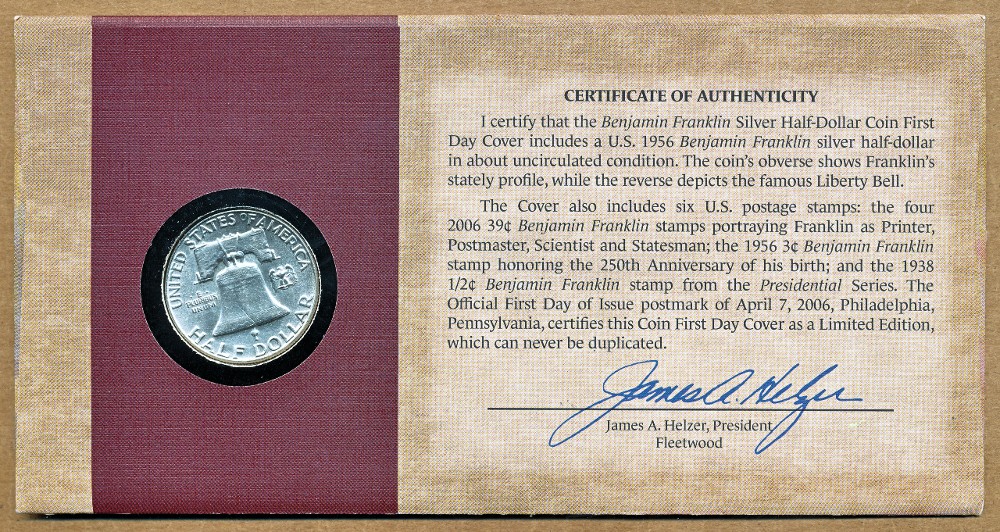
Continuing the Benjamin Franklin 250th Anniversary Medal story from Part I...There were three Benjamin Franklin commemorative medal bills introduced in the 84th Congress in January 1955; the Senate bill was first, followed within days by a pair of bills introduced in the House of Representatives.
The Senate bill was introduced by James Henderson Duff (R-PA) - for himself and Senator Edward Martin (R-PA) - just as in the previous Congress. The bill was referred to the Senate Committee on Banking and Currency. The House bills were introduced by James Aloysius Byrne (D-PA) and Hugh Doggett Scott, Jr. (R-PA); each of the bills was referred to the House Committee on Banking and Currency. -
The bills expanded on the previous proposal (i.e., 83rd Congress bill) by adding the Societe d'Agriculture, Sciences, Belle Lettres et Arts, Orleans (formerly Societie Royale) (France) to the list of named recipient organizations ("scientific, educational, and welfare societies of which Benjamin Franklin was a member.") and supplementing the list with authorization for 50 bronze medals to be used by the Two Hundred and Fiftieth Anniversary Committee of the Franklin Institute to present to "other institutions and societies founded or helped in their early development by Benjamin Franklin."
The Senate bill became the lead bill of the three, receiving a favorable report from its Committee, though with an amendment that added "The Library Company (Philadelphia, PA)" to the list of named societies to which would be presented a medal.
The Senate passed the amended bill without issue and sent it to the House for concurrence. In the House, the bill was referred to the House Committee on Banking and Currency. It was reported back without amendment with a recommendation to pass.
When brought up for consideration in the House, the bill received no objection, but William Joseph Martin, Jr. (R-MA) rose to question whether it was appropriate for the US Government to go against its 20-year policy and ostensibly go into "the business of manufacturing medals" for a third party. The question
was not debated at the time, however.
As no specific objection to the bill was raised, it was read a third time and passed by the House without further issue. With both chambers authorizing the bill, it was sent to US President Dwight David Eisenhower for review and approval. Eisenhower signed the bill into Public Law on August 4, 1955. The US Mint struck the medals.
The obverse of the medal features a left-facing portrait of Franklin, flanked by his birth year and its 250th Anniversary year. The inscription "Medal of the Congrefs" is seen below Franklin's portrait. The medal's reverse depicts a weather vane, surmounted by an eagle, with a key forming the bottom segment of its pole; branches are shown extending from the central pole. The weather vane and key are positioned upon an open book. The design is symbolic of Franklin's science experiments regarding electricity and his early dedication and support of sharing knowledge through books. Flanking the weather vane at its bottom is the inscription "WISE AND GOOD MEN ARE THE STRENGTH OF A NATION".
Note: The quote appears to be a paraphrasing of a sentiment Franklin expressed to Samuel Johnson in a letter on August 23, 1750. In the letter he said: "Wise and good men are, in my opinion, the strength of a state much more so than riches or arms..."1956 Benjamin Franklin 250th Anniversary Medal 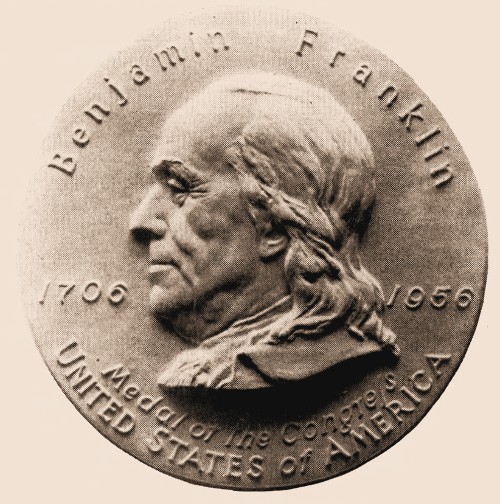
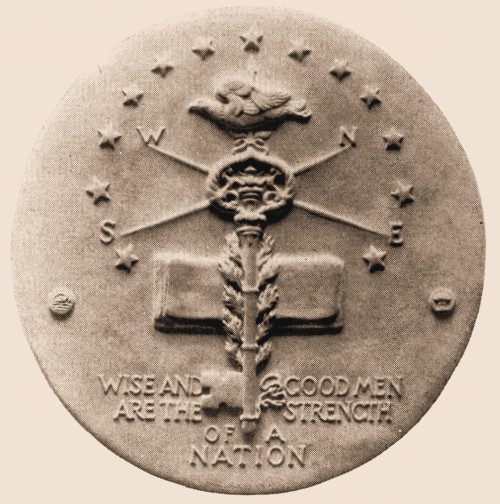 (Image Credit: American Numismatic Association, The Numismatist, December 1956.) Laura Gardin Fraser
 was the medal's designer/sculptor.
As a fan of Benjamin Franklin, I would very much enjoy having one of these medals in my collection. With its limited production and use as a VIP presentation piece, however, I am not readying a space for it in my cabinet. (As the piece was not a "List Medal" of the US Mint, duplicates for sale to the public were not struck.)
Note: Winston Churchill received the first of the 50 presentation/award medals, Eleanor Roosevelt received the second.For other of my posts about commemorative coins and medals, including other What If? stories, see:
Commems Collection. 








 Posted 06/05/2025 07:06 am