Following up on my What If? post about the unsuccessful US Bicentennial gold coins (What If? 1976 US Bicentennial Gold Coinage)...The Public Law that authorized the American Revolution Bicentennial Commission (ARBC) medals program kicked off its Congressional journey in May 1971, during the 92nd Congress, when Roman Conrad Pucinski (D-IL) introduced a bill in the House of Representatives ("House") that called for "the striking of medals in commemoration of the bicentennial of the American Revolution." The bill was introduced with 23 co-sponsors.
Note: Congress replaced the ARBC with the American Revolution Bicentennial Administration (ARBA) via Public Law 93-179 which was signed into law on December 11, 1973.The bill was referred to the House Committee on Banking and Currency, with a further referral to its Subcommittee on Consumer Affairs.
Note: Other Bicentennial medal bills were also introduced in the House and Senate during the 92nd Congress, but Pucinski's bill was the only one to advance and become law.Pucinski proposed a national medal to commemorate 1776, along with up to 13 medals commemorating "specific historical events of great importance, recognized nationally as milestones in the continuing progress of the United States of America toward life, liberty, and the pursuit of happiness." This created the potential for up to 14 different medal designs!
The bill left it for the ARBC to decide on the specifics of the medals produced, including their metallic composition. This ARBC-to-Decide provision ultimately enabled bronze, silver, gold-plated and solid gold medals to be struck by the US Mint (under direction of ARBC or ARBA, depending on the year).
The Subcommittee held a Hearing on the bill in June 1971 - its first medal bill Hearing since 1963! The Hearing heard testimony from both proponents and opponents. Noteworthy supporters included: Mary T. Brooks, Director of the Bureau of the Mint, William L. Dickey, Deputy Assistant Secretary of the Treasury and George E. Lang of New York , a member of the American Revolution Bicentennial Commission and Chairman of its advisory panel on coins and medals.
Also present to show support were Chester Krause (publisher,
Numismatic News) and Margo Russell (Editor,
Coin World). In addition, Michael Cerullo, Jr. of Robbins Company and William Louth of Medallic Art Company (each a leading private producer of medals) were in attendance to support the legislation.
From this list of supporters, it is easy to conclude that the ARBC medals had widespread support within the Federal Government, as well as support from private industry and the hobby itself.
Of course, the support was not universal, with multiple State Bicentennial Commission representatives urging limitations on the program (they didn't want it to negatively impact their own planned commemorative medal issues) and Joseph Segel (President, Franklin Mint) arguing against the program stating it is "not the proper purpose of the ARBC to reduce the market for private business." (the Franklin Mint was planning a full roster of American Bicentennial products).
Ultimately, the Subcommittee was not swayed by the bill's opponents and voted to support the bill. Its parent Committee also supported the measure and issued a Report that encouraged the passing of the bill without amendment; it took some time after the Hearing for the full Committee to review the bill and present its Report, however - the Report was not issued until January 1972.
The bill was called up for consideration in the House promptly, in February 1972; a fairly lengthy discussion ensued that included multiple proposed amendments:
- James Albertus McClure (R-ID) - Amendment #1: an amendment that would have replaced the original bill with an expanded one that would authorize a National Medal, an award medal, up to 13 medals for "specific historical events" and individual State Bicentennial medals. The National Medal and the 13 "specific event" medals - carryovers from Pucinski's bill - were to be struck by the US Mint, the award and State medals were to be struck by private mints. In addition, the amendment stated:
Each medal with the exception of the awards medal shall be of four or more varieties: One shall be struck in .925 fine silver, one shall be struck in bronze, and two shall be struck in .925 fine silver and bronze, respectively, and be of such size so as to be an inexpensive facsimile of the more costly medals authorized under this Act. The awards medal shall be struck in .925 fine silver and be of only one size which shall be determined by the Commission. In addition, the Commission, in consultation with the Secretary may direct that any of the medals authorized...be struck in gold. (Emphasis added.)
McClure's amendment language appears to be in response to the recommendations made by William T. Louth, President of Medallic Art Company:
When appearing before the Bicentennial Commission it was my recommendation that an award medal be developed for the exclusive use of the Commission. I recommended that there be a low relief medal that would be struck for mass distribution on rapid equipment and a higher relief medal of larger diameter for those who wanted to have a special piece for display purposes. I also suggested that perhaps both of these medals be issued in bronze and silver. It seemed to me that a single medal properly produced and widely distributed would lend importance to this piece and would eliminate some of the confusion relative to having a series of medalsAs presented to the House, McClure's amendment accidentally included a request for a silver-clad dollar coin - the language appears to have called for a circulation coin. McClure quickly realized the error and requested that the dollar-coin request be dropped from the amendment. This led to a bit of a procedural debate that resulted in the amendment being left as introduced. (More about the dollar coin in a future post!)
- James Albertus McClure (R-ID) - Amendment #2: A simpler amendment vs. #1, limited to the language presented above regarding "four or more varieties."
There was significant debate regarding the amendments, but, in the end, the House passed the original bill (i.e., sans amendments) and sent it on to the Senate for its consideration. In the Senate, the bill was passed without debate or objection.
The bill was then examined and signed in each chamber, presented to the President and approved by US President Richard Milhous Nixon on February 15, 1972.
With that, ARBC medal production was approved. First up was a series of pre-Bicentennial medals that were available in Bronze (beginning in 1972), Sterling Silver (beginning in 1973) and in Philatelic-Numismatic Covers (PNCs) (beginning in 1972). In 1976, a National Medal in Bronze, gold-plated Bronze, Silver and various sizes of Gold were struck. A large, high-relief silver medal was also struck. No medals followed the 1976 Bicentennial - at least from the US Mint.
Among the gold medals produced was a large (3") version that had a weight of 13.5 troy ounces; several smaller gold medals were also struck. (I'm planning a post on the 1976 National Bicentennial Medals.)
1976 Gold ARBA National Bicentennial Medal - 13.5 Ounces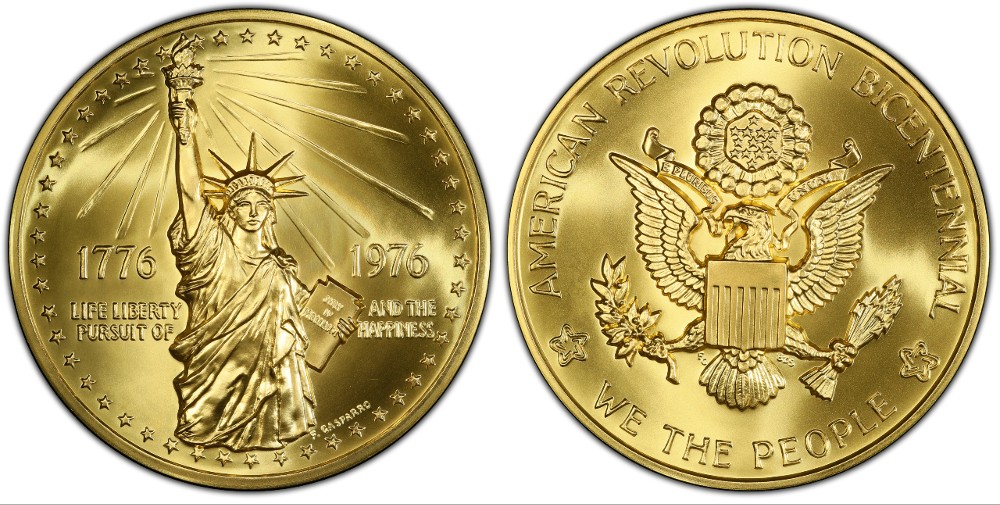 (Image Credit: PCGS CoinFacts.)
For details on the "specific-event" medals produced, see:
-
US Mint ARBA Medals - Part I-
US Mint ARBA Medals - Part III've also presented the ARBC/ARBA Philatelic-Numismatic Covers (PNCs), you see them here:
-
ARBC/ARBA PNCsFor other of my posts about commemorative coins and medals, see:
Commems Collection. 







 Posted 07/02/2025 12:26 pm


