The 1935 Hudson, NY Sesquicentennial Half Dollar and the 1935 California-Pacific International Exposition (aka "San Diego") Half Dollar were signed into law by President Franklin Delano Roosevelt ("FDR") on May 2, 1935 and May 3, 1935, respectively.
Just over a month later, on June 17, 1935, FDR sent a letter to the Chairman of the Senate Committee on Banking and Currency that proposed a transition from US Mint-struck commemorative coins to commemorative medals.
The letter began with an "issues" statement regarding the proliferation of US commemorative coins that was clearly prepared by the Treasury Department. It covered the oft-repeated arguments of the Treasury:
1) the increasing frequency of commemorative coins, especially those of only local significance, has the potential to damage the US coinage system
2) the commemorative coins have limited circulation
3) the multiple designs of the coins cause confusion within the public and negatively impact the integrity of US coinage, and
4) sponsoring organizations selling the coins at a profit is an inappropriate use of US coinage.
After this, FDR switched to a softer, more personal tone:
"It seems to me that historical events could be very suitably and properly commemorated through the striking by the Government of medals in lieu of coins..."
"By the substitution of appropriate commemorative medals for special 50-cent pieces much is to be gained. The size of the medals can be made larger than 50-cent pieces, thus providing for more suitable inscriptions and more artistic commemorative designs. It is my thought that sculptors and artists will be encouraged thereby to raise the standards of medal making in the United States."
"Under the present system of seeking to obtain special legislation of commemorative coins, many anniversaries commemorating local historical events are under a serious handicap."
Roosevelt concluded his letter by encouraging the approval of the commemorative medal bill he had enclosed. It was a non-binding proposal to replace commemorative coins with commemorative medals, nothing more.
1935 Hudson, NY Sesquicentennial Half Dollar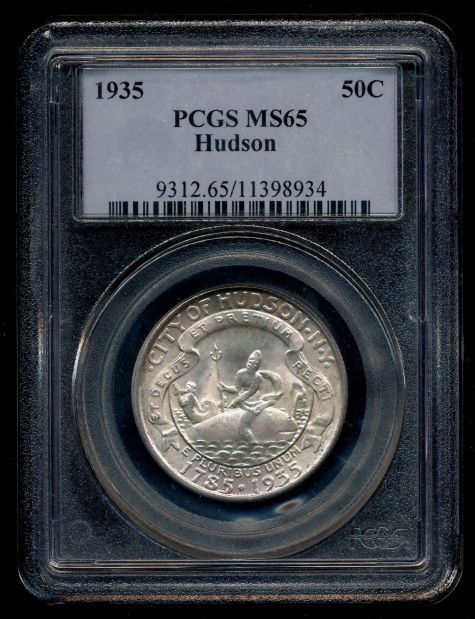
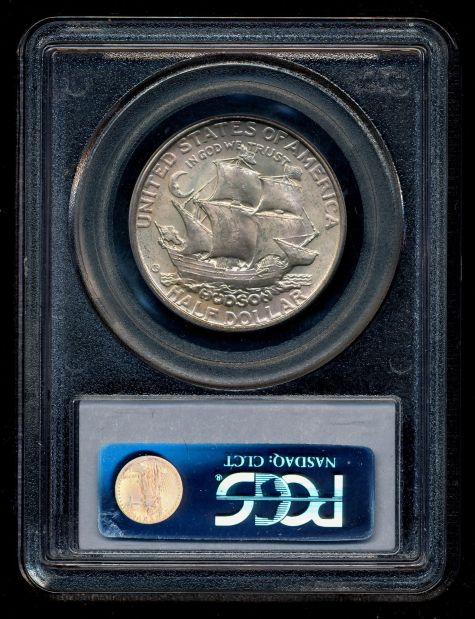
Multiple contemporary accounts, however, cited the Hudson Sesquicentennial coin as the trigger for FDR to "ban" future commemorative coins. The chronology of the Hudson's approval and FDR's letter appears to make such an argument somewhat plausible, but it must be realized that the effort to replace special commemorative coins with commemorative medals started years before (mid-1920s) and was pressed to center stage by the growing number of commemorative coin proposals being considered by Congress. The "local significance" of the Hudson half dollar may have pushed things over the edge, but it did not initiate the consideration of such a switch.
It's important to understand that FDR did not ban future commemorative coins, he merely presented a medals vs. coins bill (authored by the Treasury) intended to benefit the
US coinage system. Obviously, the Senate did not move forward with FDR's proposal as dozens of commemorative coin bills were introduced during Roosevelt's administration and more than two dozen were authorized by Congress and signed into law by FDR.
More details about the Medals vs. Coins effort can be found via the following:
-
Medals Vs. Coins-
Medals Vs. Coins - 1937 Attempt-
Medals Vs. Coins - 1947 Attempt-
1936 Hearing - Medals Vs. CoinsFor related stories about controlling the issue of US commemorative coins, see:
-
Regulating US Commemorative Coins-
Regulating US Commemorative Coins - Redux / Part I-
Regulating US Commemorative Coins - Redux / Part II-
Prohibiting Certain U S Commemorative Coins - RevisitFor other of my posts about commemorative coins and medals, including other Hudson coin stories, see:
Commems Collection.






 Posted 07/08/2025 10:59 am





