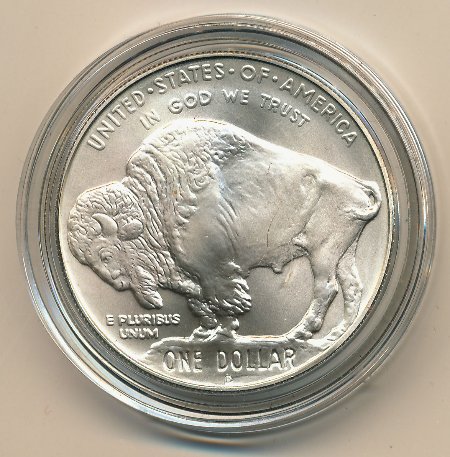
Many collectors are familiar with the 2001 American Buffalo Silver Dollar which was struck/issued in commemoration of the the National Museum of the American Indian of the Smithsonian Institution. It recreates
James Earle Fraser's iconic Indian Head and American Buffalo (OK, Bison) design used on the US five-cent coin from 1913 to 1938.
The coin was a modern US commemorative coin series success story, quickly selling out its entire authorized mintage of 500,000.
2001 American Buffalo Silver Dollar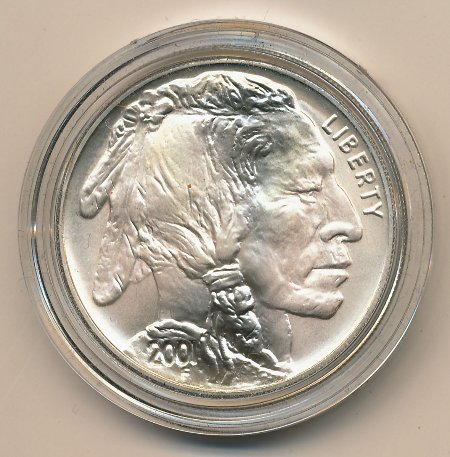
(If you'd like to read about the Coin and Currency Set produced for the American Buffalo Silver Dollar, check out:
2001 American Buffalo Coin And Currency Set)
But the Silver Dollar was not the only commemorative coin option being considered at the time. In July 1997, Ben Nighthorse Campbell (R-CO) introduced a bill in the Senate that sought coins "in commemoration of Native American history and culture." It was a three-coin proposal, but rather than a Gold Half Eagle, Silver Dollar and Copper-Nickel (CuNi) Clad Half Dollar, Nighthorse's bill sought three
silver five-cent pieces to be issued, one per year, in 2000, 2001 and 2002. Up to 1 million of the five-cent coins were to be issued each year.
Though 90% silver (vs. copper-nickel), the five-cent coins were to maintain the standard specifications of the denomination: Weight - 5.0 grams and Diameter - 0.835 inches.
The designs of the coin were to "be based on the original 5-cent coin designed by
James Earle Fraser and minted from 1913 to 1938. Each coin shall have on the obverse side a profile representation of a Native American, and on the reverse side a representation of a buffalo." The "based on" language suggests that a modern interpretation of Fraser's classic designs was a possibility, but I imagine that the new designs would have been quite faithful to the original coins considering the popularity of the original series with collectors.
Another novel aspect of the bill was its design approval process. As standard, the Secretary of the Treasury was to make the final decision but two Senate Committees were to be consulted (the Committee on Banking, Housing, and Urban Affairs and the Committee on Indian Affairs), along with the Commission of Fine Arts.
Note: Senator Campbell was the Chairman of the Committee on Indian Affairs at the time, he was also a member of the Committee on Banking, Housing, and Urban Affairs. So, it appears that the inclusion of these Committees in the design process was a way to ensure his voice/opinions would be heard.The Issue Price of each coin was to include a modest $1.00 surcharge, with collected surcharges being paid to the National Museum of the American Indian for the purposes of:
"(1) commemorating the tenth anniversary of the establishment of the Museum; and
"(2) supplementing the endowment and educational outreach funds of the Museum."
Upon its introduction, the bill was referred to the Senate Committee on Banking, Housing, and Urban Affairs. Based on feedback and the report he received from the Citizens Commemorative Coin Advisory Committee while his bill was still in Committee, Senator Campbell offered an amendment to his "nickel" bill by way of a substitution. The substitution replaced the three-year commemorative "nickel" program with a three-year Silver Half Dollar program, set the annual mintage at 500,000 and raised the per-coin surcharge to $3.00; surcharge funds continued to be directed toward the National Museum of the American Indian.
The amendment was referred to the Banking Committee but was not reported out for further consideration. Additional legislative attempts were later made to secure a Buffalo Half Dollar commemorative coin - I'll discuss them in a follow-up post.
For other of my posts about commemorative coins and medals, including more What If? stories, see:
Commems Collection.







 Posted 09/11/2025 1:57 pm


