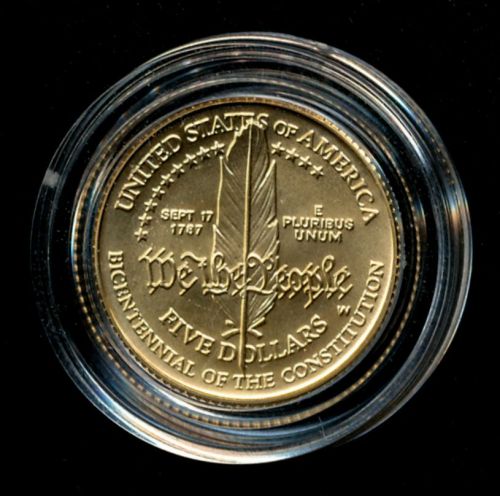
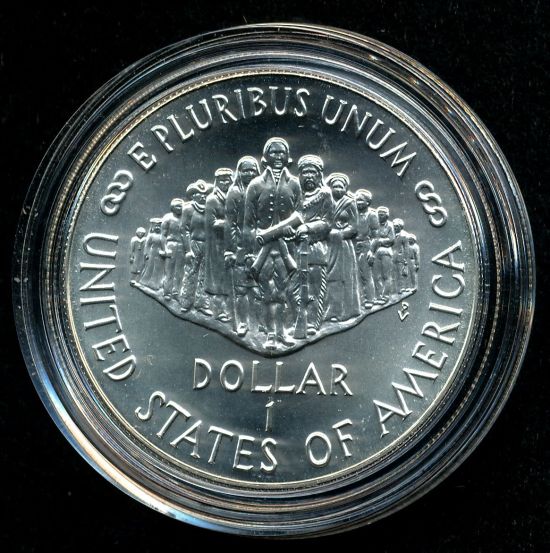
Collectors of the modern series of United States ("US") commemorative coins are likely familiar with the 1987 Gold Half Eagle and Silver Dollar that were issued to commemorate the 200th Anniversary of the US Constitution.
1987 US Constitution Bicentennial Gold Half Eagle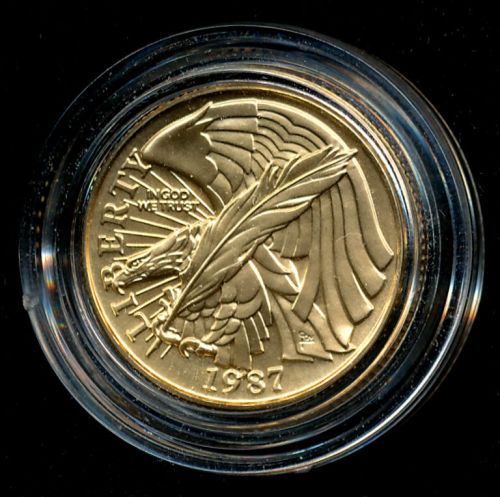
 1987 US Constitution Bicentennial Silver Dollar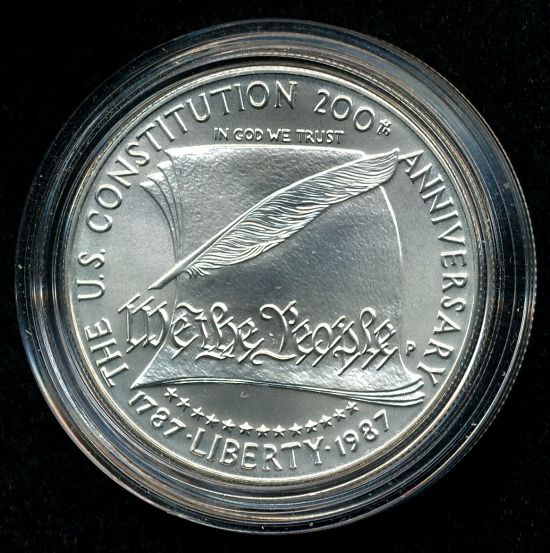
Less widely-known is that those two collector coins were almost joined by a circulating commemorative piece, the denomination of which was to be selected by the Secretary of the Treasury.
In February 1988, Peter H. Kostmayer (D-PA) introduced a bill in the House of Representatives ("House") that sought to establish the Delaware and Lehigh Navigation Canal National Heritage Corridor to assist Federal, State and local authorities in the development and implementation of an integrated resource management plan for the Corridor.
But I hear you ask - "What does a bill about a canal area have to do with a circulating commemorative coin for the US Constitution?" I ask your brief indulgence, as I type to reveal all! 
The canal bill was referred to the House Committee on Interior and Insular Affairs, with a further referral to its Subcommittee on National Parks and Public Lands. The Subcommittee held a Hearing on the bill, made a few amendments as a result, but reported the bill favorably. The amended bill was passed in the House in September 1988 and sent to the Senate for its consideration. At this point, it did not include coinage provisions.
In the Senate, the bill was subject to multiple proposed amendments. Upon receiving it, the Senate referred the bill to its Committee on Energy and Natural Resources, with a further referral to its Subcommittee on Public Lands, National Parks. The Subcommittee was subsequently discharged from further consideration of the bill, and the measure was taken up in the full Senate.
It was then that coinage amendments to the canal bill appeared.
Sensing the core bill had a good chance of approval, the Senate began amending the bill with unrelated provisions.
One amendment, sponsored by Senator Max Baucus (D-MT) and introduced in October 1988, proposed the issue of five-dollar palladium coins to commemorate the 100th anniversary of the Statehood of Idaho, Montana, North Dakota, South Dakota, Washington and Wyoming. (See
What If? 1989-90 Centennial States and
1989-90 Centennial States - 100th Congress / Part I) for a separate attempt at the same.)
Another amendment, sponsored by Senator Alan K. Simpson (R-WY) and introduced in October 1988, called upon the Secretary of the Treasury to redesign the current US circulating coinage (one-cent through fifty-cent pieces) - the order to be determined by the Secretary - with the provision that the first coin to be redesigned was to feature a commemorative reverse design honoring the 200th Anniversary of the US Constitution; it was to be struck for a period of two years.
Each of the coin-related amendments was passed in the Senate; the amended bill was then sent to the House for concurrence.
Note 1: The US Constitution was approved by vote of the Constitutional Convention on September 28, 1787. This enabled the Constitution to be sent to the States for their consideration and potential ratification.Note 2: The US Constitution needed to be ratified by 9 of the 13 original States to take effect. New Hampshire was the ninth State to ratify the Constitution, doing so on June 21, 1788. This served to "activate" the Constitution - it became the "law of the land."
The Constitution established the structure and powers of the US Government, which began formal operation a few months later on March 4, 1789.Note 3: Rhode Island, the last State to do so, ratified the Constitution on May 29, 1790.Note 4: The first 10 Amendments to the US Constitution - the Bill of Rights - were formally ratified on December 15, 1791 when Virginia ratified them. In doing so, Virginia became the 11th state to ratify them and thus the US Constitution's requirement that at least 3 out of 4 (>=75%) States ratify an amendment for it to take effect was met. (Remember, Vermont joined the Union as the 14th State on March 4, 1791, meaning ratification by at least 11 States was required to meet the Constitution's threshold.)Considering the introduction date of the amendments, it seems plausible that, had they been approved, the first redesign would not appear until at least late 1989. If this were to be the case, the specified two-year circulation period may have included 1989, 1990 and 1991. Based on the above chronology, marking the 200th Anniversary of the US Constitution at any time between 1987 and 1991 would be historically valid.
The House did not "rubber stamp" the Senate amendments, however. It removed the "non germane" coin amendments from the bill and proceeded with a version aligned with its original intent. The Senate accepted the House's changes and the bill was presented to the President. It was signed into law by US President Ronald Reagan on November 18, 1988, sans inclusion of a provision for coinage redesign or a circulating US Constitution coin.
I think it's too bad the coin measure didn't proceed, I think such a coin would have been popular.
For other of my posts about commemorative coins and medals, including more about proposed modern US commemorative coins, see:
Commems Collection









 Posted 01/21/2026 9:26 pm


 Uncirculated American Silver Eagles


