Coin Community Family of Web Sites
Shop for APMEX Bullion on eBay!300,000 items to help build your collection! Royal Canadian Mint products, Canadian, Polish, American, and world coins and banknotes. Specializing in Modern Numismatics Coin, Banknote and Medal Collectors's Online Mall Vancouvers #1 Coin and Paper Money Dealer Shop CCF Members on eBay!


Username:
Password:
Save Password
Forgot your Password?


This page may contain links that result in small commissions to keep this free site up and running.

Welcome Guest! Registering and/or logging in will remove the anchor (bottom) ads. It's Free!

Mysterious Academic Medal? American Or British?

To participate in the forum you must log in or register.
Author Previous TopicReplies: 9 / Views: 327Next Topic  
Pillar of the Community

Portugal
655 Posts
 Posted 02/07/2026  12:21 pm Show Profile   Bookmark this topic Add jecz79 to your friends list Get a Link to this Message Number of Subscribers
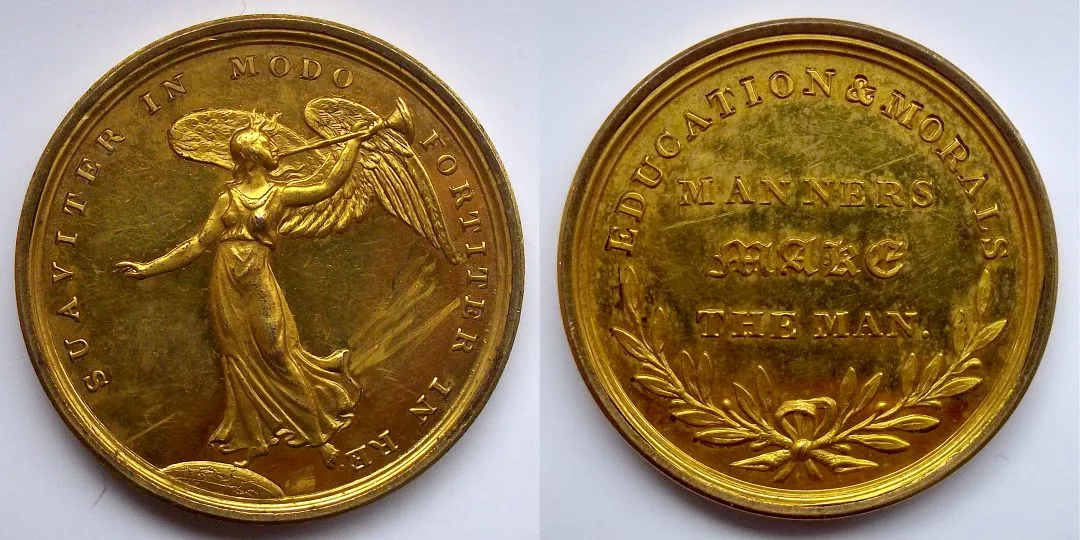
I am trying to identify a small medal.

Better image uploaded:
Mysterious-Academic-Medal?-American-Or-British?

The art style is a mix. The obverse has a figure that seems to be french inspired, from the second empire era. I recognize the figure of Renommee (Renown) from my medal of the 1867 Exposition Universelle de Paris. The reverse has neo-gothic letters over crossed olive branches. A style that was more used in Britain than the continent.

The build of the medal is unusual. It looks gold but is too light. I think it was struck on a base metal disc covered with gold foil. It may be copper underneath because it appears dark brown where it shows through the gold foil. In a breast where the strike must have deformed and thinned the foil, and near some leaves in the reverse.
Someone already tested it for gold and caused some deformation on the foil. No being solid gold must have saved it from being molten. I do not want to further damage the medal to inspect the build.

I believe the medal is american because of the legends.
The latin expression in the obverse was very popular in New England during the nineteenth century: 'Suaviter in modo Fortiter in re'.
The reverse has 'Education & morals' and underneath 'manners make the man' in neo-gothic style lettering. It may be related to some university or academic circle.

I could only find one, with the legend misread and no photos, in the British Museum. They say it is of english make but I think that is as wrong as their reading of the reverse.
https://www.britishmuseum.org/colle...ect/C_M-3969
They also have the diameter wrong, it is nearer 33 mm than 32 mm.
Edited by jecz79
02/07/2026 6:27 pm
Moderator
Learn More...
Spence's Avatar
United States
34393 Posts
 Posted 02/07/2026  4:23 pm  Show Profile   Bookmark this reply Add Spence to your friends list Get a Link to this Reply

Quote:
it is nearer 33 mm than 32 mm.


I'll dredge around to see what I can find, but I'm wondering if your example has been encased. I'm not positive, but your pics might be showing an extra rim, such as an encasement.
"If you climb a good tree, you get a push."
-----Ghanaian proverb

"The danger we all now face is distinguishing between what is authentic and what is performed."
-----King Adz
Pillar of the Community
Learn More...
tdziemia's Avatar
United States
7933 Posts
 Posted 02/07/2026  4:30 pm  Show Profile   Bookmark this reply Add tdziemia to your friends list Get a Link to this Reply
I would guess the figure is the Archangel Gabriel based on the iconography.
Though Gabriel is normally taken to be male.
Moderator
Learn More...
Spence's Avatar
United States
34393 Posts
 Posted 02/07/2026  4:37 pm  Show Profile   Bookmark this reply Add Spence to your friends list Get a Link to this Reply
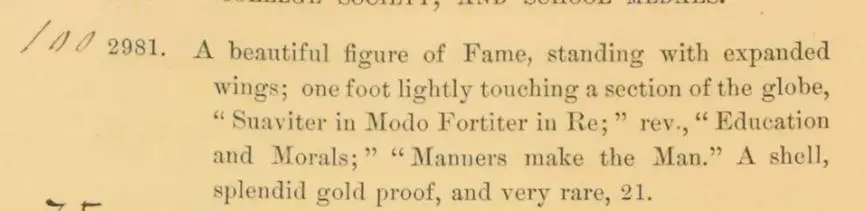
Ok I got a hit in the Newman Numismatic Portal and have a further thought. In the 1878 auction catalog, "CATALOGUE OF THE COLLECTION OF COINS AND MEDALS, FORMED BY HENRY W. HOLLAND, OF BOSTON, TOGETHER WITH THE CHADBOURNE COLLECTION OF STORE CARDS, AND A GREAT VARIETY OF AMERICAN AND FOREIGN COINS, MEDALS, NUMISMATIC WORKS, AUTOGRAPHS, PAPER CURRENCY, &C., &C.", one such piece is listed (and sorry about the all caps title). Lot #2981 is described as:


Mysterious-Academic-Medal?-American-Or-British?

It is the "shell" part of the description that is especially intriguing to me. I wonder if this piece (and yours) are two halves of gold foil stuck together--in your case with an encasement. Picture one of those chocolate coins from Christmas time, except without the inner yummy core and made from gold foil rather than gold-colored foil.

As an aside, it looks to me like someone handwrote the auction prices received to the left of the lot numbers. I wish they had made clear where the decimal point was. In any case, this piece might be worth holding onto.
"If you climb a good tree, you get a push."
-----Ghanaian proverb

"The danger we all now face is distinguishing between what is authentic and what is performed."
-----King Adz
Pillar of the Community
Learn More...
tdziemia's Avatar
United States
7933 Posts
 Posted 02/07/2026  4:38 pm  Show Profile   Bookmark this reply Add tdziemia to your friends list Get a Link to this Reply
Manners Maketh the Man is the motto of "New" College, Oxford.
That could fit with a British origin ...
Pillar of the Community
Learn More...
tdziemia's Avatar
United States
7933 Posts
 Posted 02/07/2026  4:40 pm  Show Profile   Bookmark this reply Add tdziemia to your friends list Get a Link to this Reply
Wow! That was an amazing hit... Though New England gives you an unfair advantage
Note to self: Gabriel can be mistook for Fame
(or vice versa)
Edited by tdziemia
02/07/2026 4:41 pm
Pillar of the Community
Portugal
655 Posts
 Posted 02/07/2026  6:00 pm  Show Profile   Bookmark this reply Add jecz79 to your friends list Get a Link to this Reply
Thanks Spence! I have been searching this afternoon and eventually found that same catalog after looking through all search results. Should have thought about searching for Fame instead of translating the french literally as Renown! 1878 makes sense for a sale, the style may be from the 1860s.

The description matches. I can understand the shell note. First I thought that the disk for the medal was covered with gold foil before being struck. I believed that because in the high portion in Fame's breast the foil was stretched and became thinner, with And it seemed like in the reverse the base metal could be seen along part of the rim. As it would be exposed under pressure when a foil covered disk was struck.

But now on closer examination, after seeing the description about the medal being a shell, I think it was created in a different way. It is made of three parts: two gold foils for obverse and reverse, and one all around making the rim, folder over and enclosing the obverse and reverse foils. The whole thing was sealed with pressure only on that third part, along the rim.

I had never seen such a construct before. A laborious way to save metal in crafting a gold medal? But effective. It must have looked perfect when new.
I have seen gold foil imprinted from medal dies before, that happened and it produces as fine a design as a struck medal. The collector who owned this medal before also owned an obverse in gold foil imprinted in a medal die from 1799. But that one was a loose imprint. Not mounted like this, obverse and reverse making a full medal.

As the medal is now, someone tested the gold on the obverse to the right of fame's legs and the pressure applied deformed the shell a little. Very unfortunate damage but it reveals how the medal was constructed.
In the reverse there is also deformation under the A of EDUCATION, where some sharp pressure was applied to that side.

The core may be not copper but some other material. It needed not support a strike. Could be lead, or even wood. The medal sounds hollow when tapped, and the whole thing weights 12,2 g. The weight is not far off from what a similar sized thin solid gold medal would weight. I estimate it would be 15 g if it were solid gold.

The only way to know for certain how it was made and what the core is would be to disassemble it. I am curious but I think the medal is historically relevant, worth preserving, and so will not indulge my curiosity.

I am now finding references to shell medals in other catalogues of collections sold in the same decade in the US: like William Clogston, of Springfield, Mass, 1881, and others. But not on later ones. It was something done in that region and time? Or a technique used by a specific manufacturer of medals?
From the auction of the collection of and Paul J., Mass., 1882: number 499, Clay, shell medal, gilt - presidential medal. Others for Clay and Frelinghuysen. If it was a single manufacturer using this technique they may allow for dating the production for the one I have. But I don't know who these
Clay and Frelinghuysen were.

This Newman Numismatic Portal is a wonderful resource!

Pillar of the Community
Portugal
655 Posts
 Posted 02/07/2026  6:03 pm  Show Profile   Bookmark this reply Add jecz79 to your friends list Get a Link to this Reply
A better photo of the medal. It suffered mistreatment but it remains a very interesting piece and the internet lacked a better photo. Lacked any photo at all as far as I could search today so I uploaded a better one. Placed in the first post.

I am now thinking that the shell may be like many medals of that age: copper shell produced by galvanoplasty, from a sculpted clay model, and then gilt. Hence the brown copper starting to show in the highest relief area of the obverse. No die necessary, the manufacture would be cheaper, and even less expensive in gold.

But I have also found description of shell medals made from imprints with dies, as described for lot 239 here.
https://archive.org/stream/american...tac_djvu.txt


Quote:
The piece was made from two round silver plates. One was struck by the obverse die and the other by the reverse die. The two
struck shells were then placed back to back, some supporting material was inserted between them (newspaper and solid
wood have been found inside large size shell medals), and then a rim was wrapped around the edge of the shells and
brazed closed, making a one piece medal. This complicated method was made necessary because at this time the Mint did
not have a press capable of striking a solid silver 76 mm medal.


So there could be two reasons for making shell medals. Cheapness, or technical limitations. But cheaper must have been the motive for the construction of this one as a shell medal.

Talking of cheaper, this may set a record for medal devaluation in auctions. From $100 in 1878 to €10 in 2026.
Edited by jecz79
02/07/2026 6:29 pm
Valued Member
Brummagem's Avatar
United States
128 Posts
 Posted 02/07/2026  9:08 pm  Show Profile   Bookmark this reply Add Brummagem to your friends list Get a Link to this Reply
Here's another version that sold on ebay UK in 2013 £8.99 ($14.26 at time of sale).

https://www.worthpoint.com/worthope...on-423490932

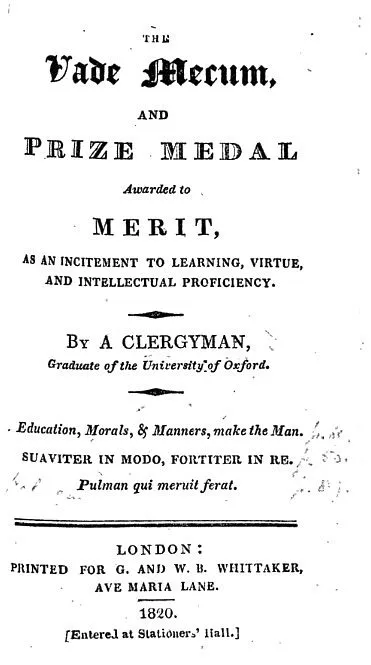
This 1820 Oxford associated publication may be a clue-----

https://www.google.com/books/editio...hl=en&gbpv=1

Mysterious-Academic-Medal?-American-Or-British?
Pillar of the Community
Portugal
655 Posts
 Posted 02/08/2026  11:54 am  Show Profile   Bookmark this reply Add jecz79 to your friends list Get a Link to this Reply
Thank you! That pulls the use of those expressions, together, back to 1820 in England. So the British Museum had motive to describe its medal as english. The copper medal is a good find, it is about the same theme: same expression and figure. Different craftsmanship, the wings of fame are different. May be older, or just made will less skill.

I think that the one I showed here in from the middle or second half of the nineteenth century. The art style is more elaborate. The Fame figure be from anytime between neoclassicism and the Napoleon III era mixing of old styles. But the neo-gothic lettering on the reverse would not be used during neoclassicism.
  Previous TopicReplies: 9 / Views: 327Next Topic  

To participate in the forum you must log in or register.


Disclaimer: While a tremendous amount of effort goes into ensuring the accuracy of the information contained in this site, Coin Community assumes no liability for errors. Copyright 2005 - 2026 Coin Community Family- all rights reserved worldwide. Use of any images or content on this website without prior written permission of Coin Community or the original lender is strictly prohibited.
Contact Us  |  Advertise Here  |  Privacy Policy / Terms of Use

Coin Community Forum © 2005 - 2026 Coin Community Forums
It took 0.3 seconds to rattle this change. Forums