| Author |
 Replies: 17 / Views: 1,936 Replies: 17 / Views: 1,936 |
|
Valued Member
United States
104 Posts |
I got this token a while ago. I'm trying to find info about this token, but I can't seem to find any. I have found similar tokens online, but the obverse is always different and the reverse has a different set of numbers. Can anyone tell me where and when this token was made? I'm also wondering what the meaning of the numbers are. If possible, can you also tell me what the composition is, and tell me what this token was used for? Thanks! 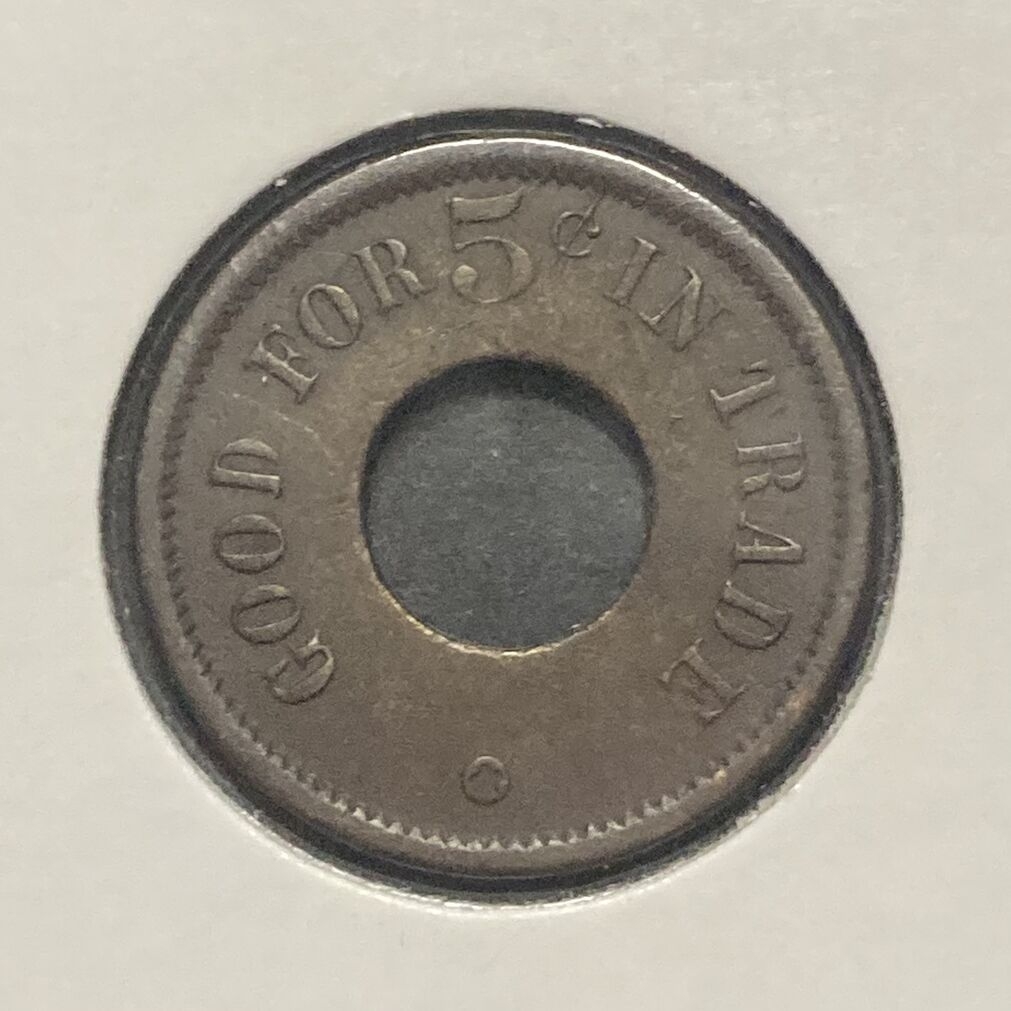 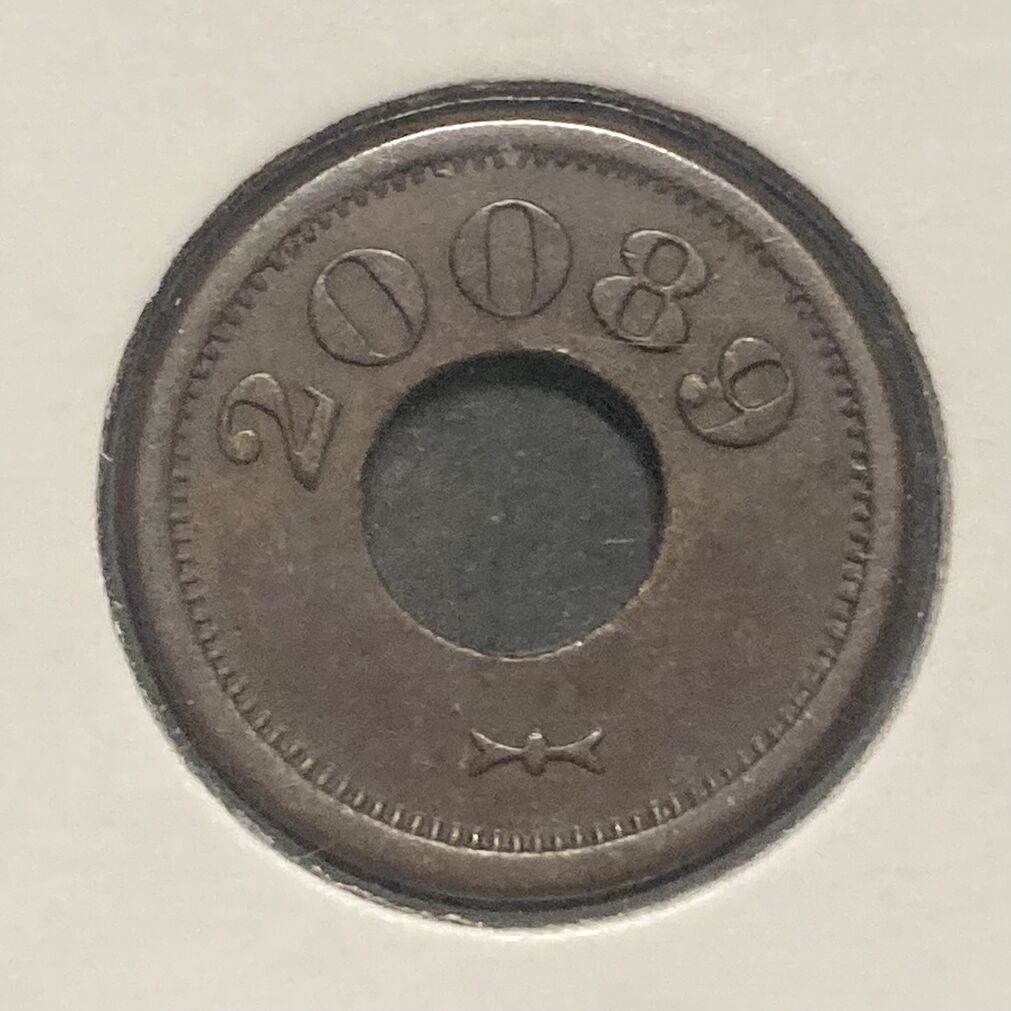 Edited by ANAcoincollector
02/08/2025 10:10 pm
|
|
|
|
Pillar of the Community
 United States
1503 Posts |
Could not really find much about your particular token, but some sort of business, trade token. Found a listing on a token catalog website which provides little information about the origin of a token that appears to be exactly like yours: TC-163477 20089 GOOD FOR 5¢ IN TRADE {GF5¢IT-SC1-tb-star5pt-20c} (round-center cutout, bowtie ornament overse, star in circle ornament reverse) Link to external site: https://tokencatalog.com/token_reco...ord_offset=3Sorry, can't be of much help, but apparently it's not the only one out there. Pretty neat token though. Thanks for sharing and perhaps someone with expertise can assist. Good luck! |
|
Pillar of the Community
United States
1147 Posts |
|
|
Valued Member
 United States
104 Posts |
Edited by ANAcoincollector
02/09/2025 12:50 am
|
|
Bedrock of the Community
 United States
27514 Posts |
ANAcoincollector, this type of token was used in various gambling and skill machines such as slot machines, trade stimulators, pinball machines, arcade games,etc. in gambling dens, pool halls, taverns, and bars. They probably date from the 1940s and 1950s. Gambling was illegal so these were used to circumvent the law. Here is a representative selection of them. I've tried looking them up but for the most part there's not much information about them. 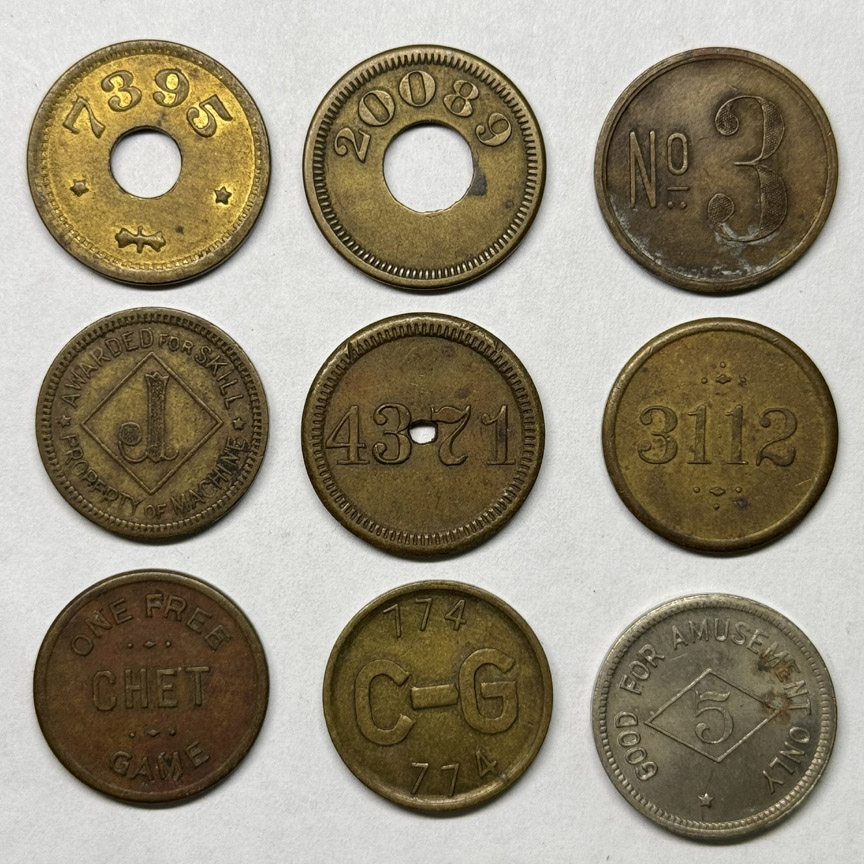 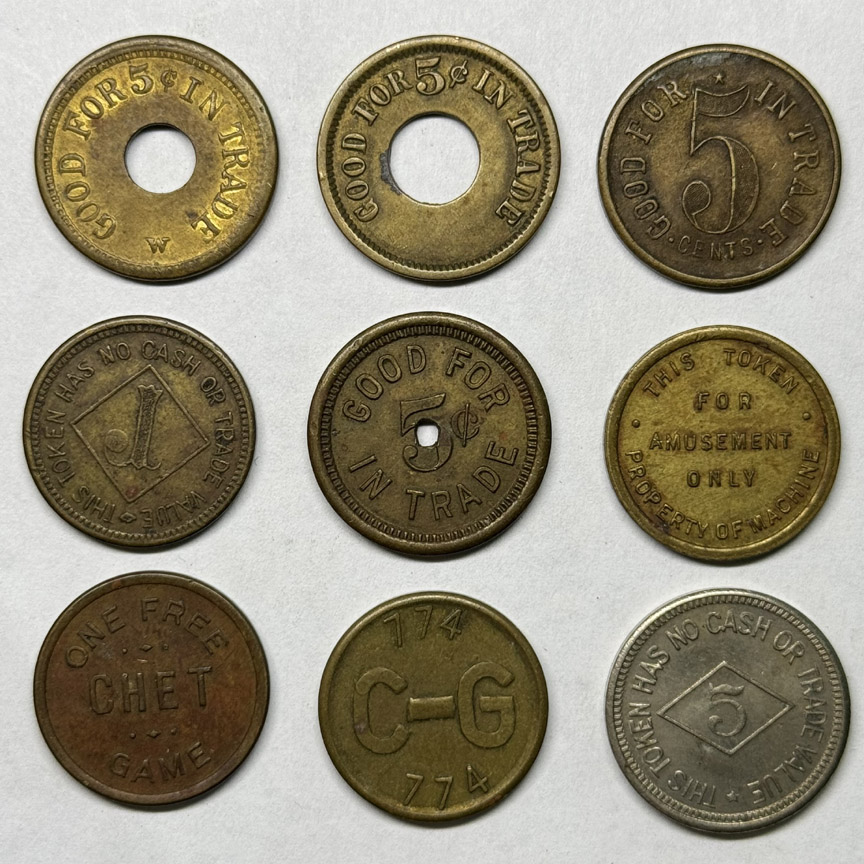 Inordinately fascinated by bits of metal with strange markings and figures
|
|
Valued Member
United States
104 Posts |
That's interesting. What do the numbers mean?
|
|
Bedrock of the Community
United States
27514 Posts |
As far as I can tell, the numbers don't mean anything. Possibly maker's codes or some such. I have several more and the numbers are all over the place.
Inordinately fascinated by bits of metal with strange markings and figures
|
|
Pillar of the Community
United Kingdom
2145 Posts |
I had a few, all 4 digit numbers.
I wonder if they're licensee numbers to prevent defrauding the licensee.
Just so that staff check that the number is correct before accepting them in part payment.
My local pub had a notice saying "Only counters won in these machines will be accepted for drinks".
What puzzles me is that if that's correct, the stamping company will need a new die each time and that's inefficient and presumably costly.
|
|
Moderator
Australia
17022 Posts |
The number-codes were essentially manufacturer ID numbers. A customer who used token 20089 would contact them and order 100 more Number 20089 tokens, and the manufacturer would know which dies, which blanks, how much were charged, etc - all the information to they'd need to know to either whip up a fresh batch of tokens, or to pull some out of the generic token stockpile they already had on hand.
Finding out where "generic" tokens such as these might have been actually used is complicated, for two reasons. First, there's no customer-made die identifying the establishment. Second, because they're generic, anyone could order some tokens of that type and use them - therefore many of the numbers were most likely used in more than one place. Finally, the main reason such anonymous tokens were used is, as mentioned above, in quasi-legal or downright illegal gambling establishments. In this latter case, the establishment is deliberately trying to hide, to not be easily traced and certainly not publicize themselves via the tokens. So finding records of token use is very scarce, unless you've got an "insider" in the bar or club who knows which tokens they used, and/or a manufacturer releases their customer records.
Don't say "infinitely" when you mean "very"; otherwise, you'll have no word left when you want to talk about something really infinite. - C. S. Lewis
|
|
Pillar of the Community
United Kingdom
2145 Posts |
Quote:
Finally, the main reason such anonymous tokens were used is, as mentioned above, in quasi-legal or downright illegal gambling establishments. I apologise for not agreeing, but I'm not convinced in the case of the tokens shown above. I would expect that gambling tokens would have denominations of 1, 5, 10, 50, 100 (with or without a dollar sign), or pictures to represent those amounts (for example, doll for $5, teddy bear for $10). 5c in trade wouldn't be a worthwhile return to gamblers. 5c US was about 1 UK penny in 1900, buying in England a pound loaf of bread, a portion of ice cream, or a soft drink (soda). |
|
Valued Member
United States
104 Posts |
If it was made to stay anonymous, why does the numista token that I linked have the proprietor's name on it including the name of the city? The Reverse seems to have been made from the same entity. Also, do you think the star on the obverse and the bowtie on the reverse were also used to Id the token? Thank you for the replies!
Edited by ANAcoincollector
02/09/2025 12:11 pm
|
|
Bedrock of the Community
United States
27514 Posts |
I imagine that the 5¢ denomination had a legal basis - they were skirting some law with it. Also, there was probably a "wink wink nod nod" understanding as to what it was truly worth, and establishments had a schedule for payouts based on the number of tokens a customer wanted to redeem.
The tokencatalogue listing does mention association with that tavern, ANAcoincollector, but it almost certainly is not an exclusive one.
Bowties, stars, propellers, and various ornaments are common devices found on many tokens. It's possible that the manufacturer used a particular combination for each establishment that ordered them. But it's also possible that these were supplied by the owner/seller of the machine that used them. Very frequently slot machines and such were not owned by the bar but earned a share of the winnings by allowing them space in their establishment.
Inordinately fascinated by bits of metal with strange markings and figures
|
|
Valued Member
United States
104 Posts |
That makes a lot of sense, thank you! One more Question, I've been seeing threads about tokens similar to this one. Do you think they punched a hole on this token after use?
|
|
Pillar of the Community
United States
1147 Posts |
Early gambling machines had mints that were used as trade stimulators. No one took the mints that happened to be five cents as they tasted awful. It was a way to circumvent the laws against gambling.
The hole was likely there as they were placed on a rod which made them easier to count and sort. Transportation tokens often used a hole for sorting and storage.
What I did not know anything about was the number though it makes sense that might be a number associated with this token used in ordering them.
Edited by cointagous
02/09/2025 7:04 pm
|
|
Bedrock of the Community
United States
27514 Posts |
Sorry it's not a better picture. All Quality Mints - 5¢ Package 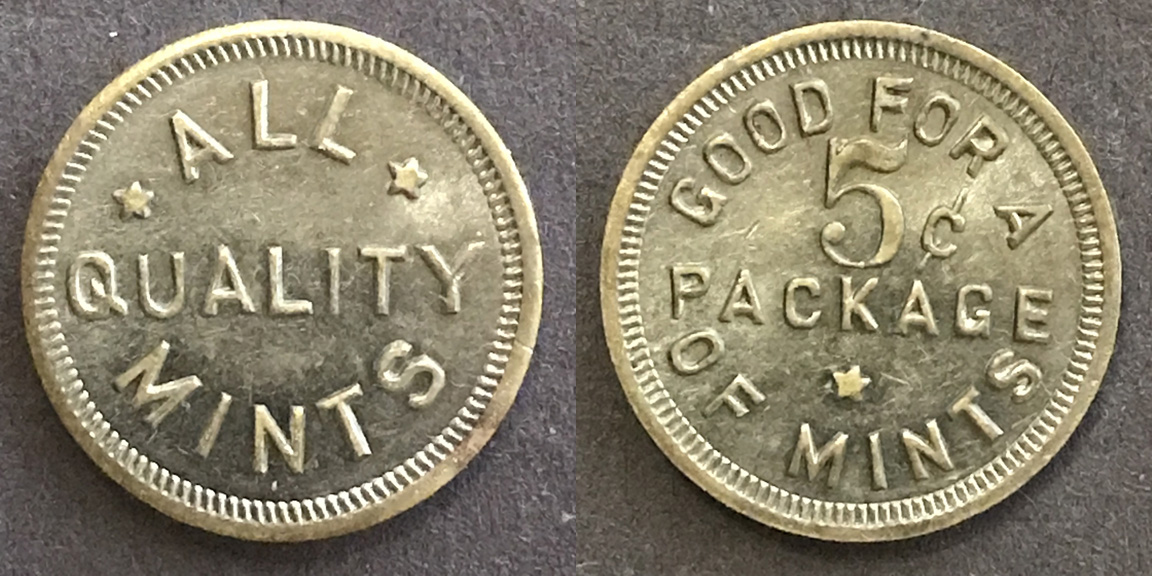 Inordinately fascinated by bits of metal with strange markings and figures
|
|
Moderator
Australia
17022 Posts |
Quote:
If it was made to stay anonymous, why does the numista token that I linked have the proprietor's name on it including the name of the city? The Reverse seems to have been made from the same entity. Also, do you think the star on the obverse and the bowtie on the reverse were also used to Id the token? Thank you for the replies! Some tokens were "generic", and could be used anonymously. Some tokens,such as the one in that Numista site, the proprietor paid extra money to have a die made, advertising and proclaiming ownership of the tokens. It's much the same with ordering modern-day tokens. Suppose you want to buy a bulk lot of tokens today. So you go to a company like TokensDirect. They give you three options: - Buy some generic stock tokens which they've already made. This is the cheapest and quickest option, if you need tokens RIGHT NOW and don't care what they look like. - Order some tokens made using generic dies they already have on hand. In which case, you'd pick your size, pick your material (nickel, brass, aluminium, etc) , pick to designs that you like, and say "I want 5000 tokens made with die 0021 on one side and die 0034 on the other". They'd make them using those requested dies and ship them to you; this would be the medium-cost option. - Finally, if you want personalized tokens made, you can give them a blueprint for a design for one or both sides of your token, and ask them to make that die for you. Such a die might advertise your business or really, whatever design you want (so long as it's not replicating a legal tender US coin). This is the slowest and most expensive option, since they'd need to design and make a die, strike some trials, get your final approval from you for the design, then strike them and ship them. You'd obviously only go to this trouble and expense if naming yourself on your tokens was a high priority for you, and you weren't in a real big hurry. And for many token users, it simply isn't a priority. Don't say "infinitely" when you mean "very"; otherwise, you'll have no word left when you want to talk about something really infinite. - C. S. Lewis
|
| |
Replies: 17 / Views: 1,936 |




 Posted 02/09/2025 12:05 am





