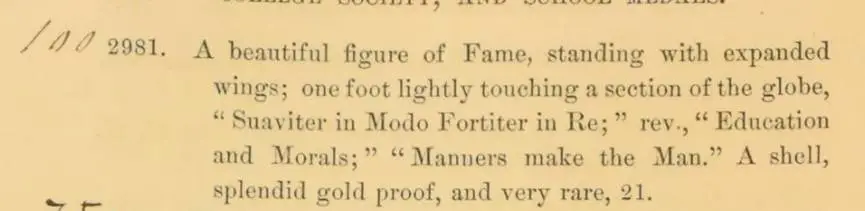
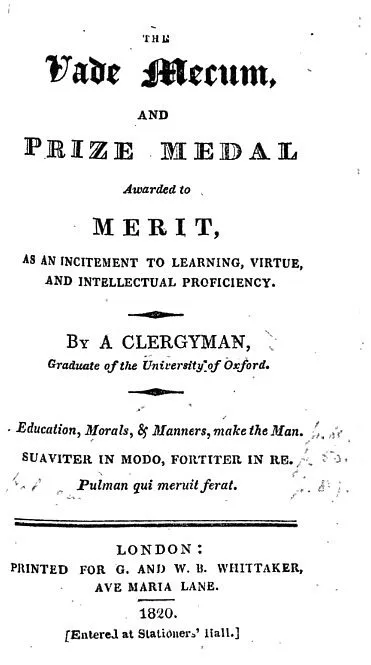
Thanks Spence! I have been searching this afternoon and eventually found that same catalog after looking through all search results. Should have thought about searching for Fame instead of translating the french literally as Renown! 1878 makes sense for a sale, the style may be from the 1860s.
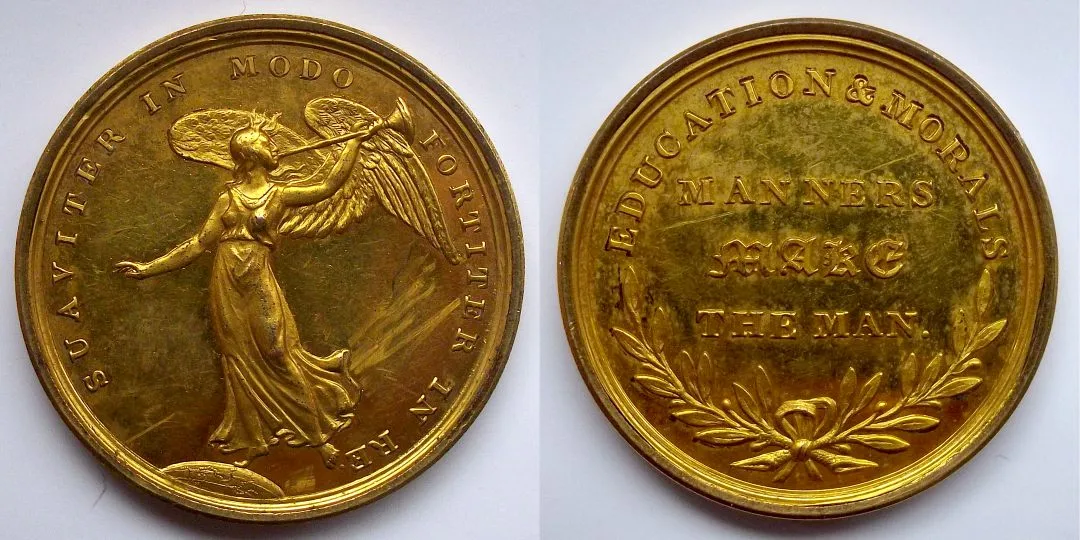
The description matches. I can understand the shell note. First I thought that the disk for the medal was covered with gold foil before being struck. I believed that because in the high portion in Fame's breast the foil was stretched and became thinner, with And it seemed like in the reverse the base metal could be seen along part of the rim. As it would be exposed under pressure when a foil covered disk was struck.
But now on closer examination, after seeing the description about the medal being a shell, I think it was created in a different way. It is made of three parts: two gold foils for obverse and reverse, and one all around making the rim, folder over and enclosing the obverse and reverse foils. The whole thing was sealed with pressure only on that third part, along the rim.
I had never seen such a construct before. A laborious way to save metal in crafting a gold medal? But effective. It must have looked perfect when new.
I have seen gold foil imprinted from medal dies before, that happened and it produces as fine a design as a struck medal. The collector who owned this medal before also owned an obverse in gold foil imprinted in a medal die from 1799. But that one was a loose imprint. Not mounted like this, obverse and reverse making a full medal.
As the medal is now, someone tested the gold on the obverse to the right of fame's legs and the pressure applied deformed the shell a little. Very unfortunate damage

but it reveals how the medal was constructed.
In the reverse there is also deformation under the A of EDUCATION, where some sharp pressure was applied to that side.
The core may be not copper but some other material. It needed not support a strike. Could be lead, or even wood. The medal sounds hollow when tapped, and the whole thing weights 12,2 g. The weight is not far off from what a similar sized thin solid gold medal would weight. I estimate it would be 15 g if it were solid gold.
The only way to know for certain how it was made and what the core is would be to disassemble it. I am curious but I think the medal is historically relevant, worth preserving, and so will not indulge my curiosity.
I am now finding references to shell medals in other catalogues of collections sold in the same decade in the US: like William Clogston, of Springfield, Mass, 1881, and others. But not on later ones. It was something done in that region and time? Or a technique used by a specific manufacturer of medals?
From the auction of the collection of and Paul J., Mass., 1882: number 499, Clay, shell medal, gilt - presidential medal. Others for Clay and Frelinghuysen. If it was a single manufacturer using this technique they may allow for dating the production for the one I have. But I don't know who these
Clay and Frelinghuysen were.

This Newman Numismatic Portal is a wonderful resource!






 Posted 02/07/2026 4:30 pm