In a previous topic, I discussed a proposed commemorative coin program for the 50th Anniversary of the Marshall Plan (see it here:
What If? 1997 Marshall Plan Commemoratives.)
But before the Marshall Plan coin proposal, there were a pair of efforts - one in the House of Representatives ("House"), one in the Senate - to secure a Silver Dollar "in commemoration of the 50th anniversary of the end of World War II and General George C. Marshall's service therein."
General George Catlett Marhall, Chief of Staff - Circa 1940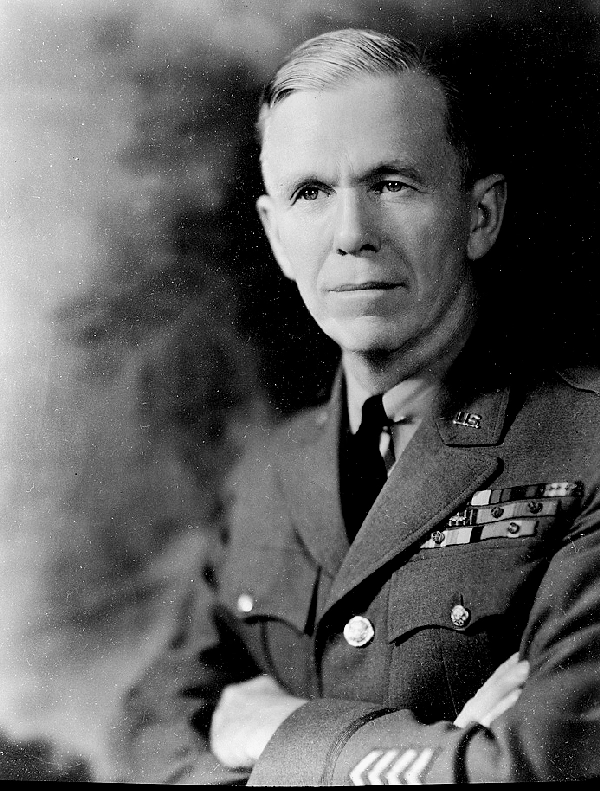
A few highlights of General Marshall's World War II ("WW II") service:
- U.S. Army Chief of Staff from 1939 to 1945 - selected by United States ("US") President Franklin Delano Roosevelt ("FDR")
- Expanded US Army in anticipation of war in Europe and the critical role the US would play in such a conflict
- President Franklin Delano Roosevelt's primary military advisor throughout WWII
- Advocated for cross-channel invasion of Europe to attack/defeat German forces
- Capable and qualified to lead D-Day invasion, but was kept in Washington, DC by FDR, being considered to important to leave
- Considered by many to be the architect of the Allied victory in WWII
- Promoted to the rank of Five-Star General of the Army in 1944
Each of the bills called for the minting of up to 500,000 Silver Dollars for the benefit of the Friends of George C. Marshall (more below).
The House bill was introduced in November 1993 by Austin J. Murphy (D-PA) and was immediately referred to the House Committee on Banking, Finance, and Urban Affairs with a subsequent referral to its Subcommittee on Consumer Credit and Insurance. The Senate bill was introduced by Harris Wofford (D-PA) in April 1994; it was referred to the Senate Committee on Banking, Finance, and Urban Affairs.
Though not strictly companion bills, each of the two proposals mirrored the coin requests of the other: 500,000 Silver Dollars of standard US specifications, all coins dated "1995", a $7 per coin surcharge, the Friends of George C. Marshall ("Friends") as the surcharge beneficiary and collected funds to be used "solely for the construction of the George C. Marshall Memorial and Visitor Center in Uniontown, Pennsylvania."
The obverse of the Silver Dollar was to feature a likeness of George C. Marshall; no reverse design requirement was specified. Each coin was to include an inscription for the coin's value, date of issue "1995", and the legally-required "Liberty", "In God We Trust", "United States of Amnerica" and "E Pluribus Unum" inscriptions.
The final designs for the coin were to be selected by the Secretary of the Treasury after consultation with the Friends of George C. Marshall and the US Commission of Fine Arts. The Citizens Commemorative Advisory Committee was to serve in a design review capacity..
The US Mint was to strike the coins in Proof and Uncirculated qualities during Calendar Year 1995.
Neither of the bills moved beyond its respective Committee, however, and died for lack of action when the 103rd Congress adjourned. A new attempt was made in the 104th Congress with a change of "direction" - the focus was on the Marshall Plan vs. General Marshall himself. (See link to previous post above.)
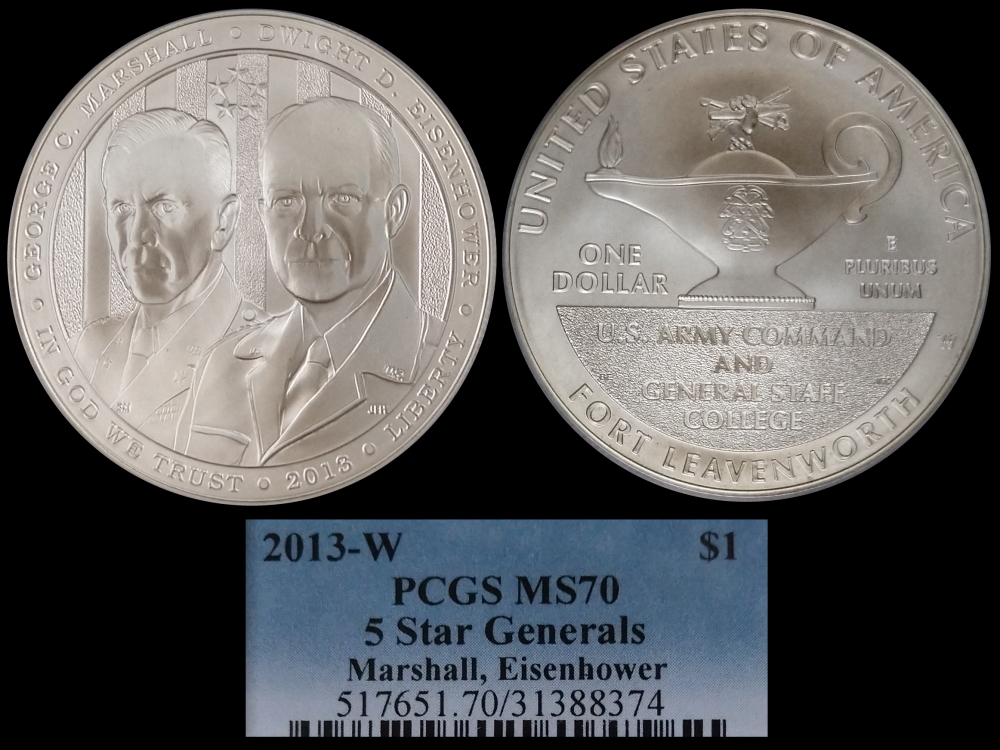
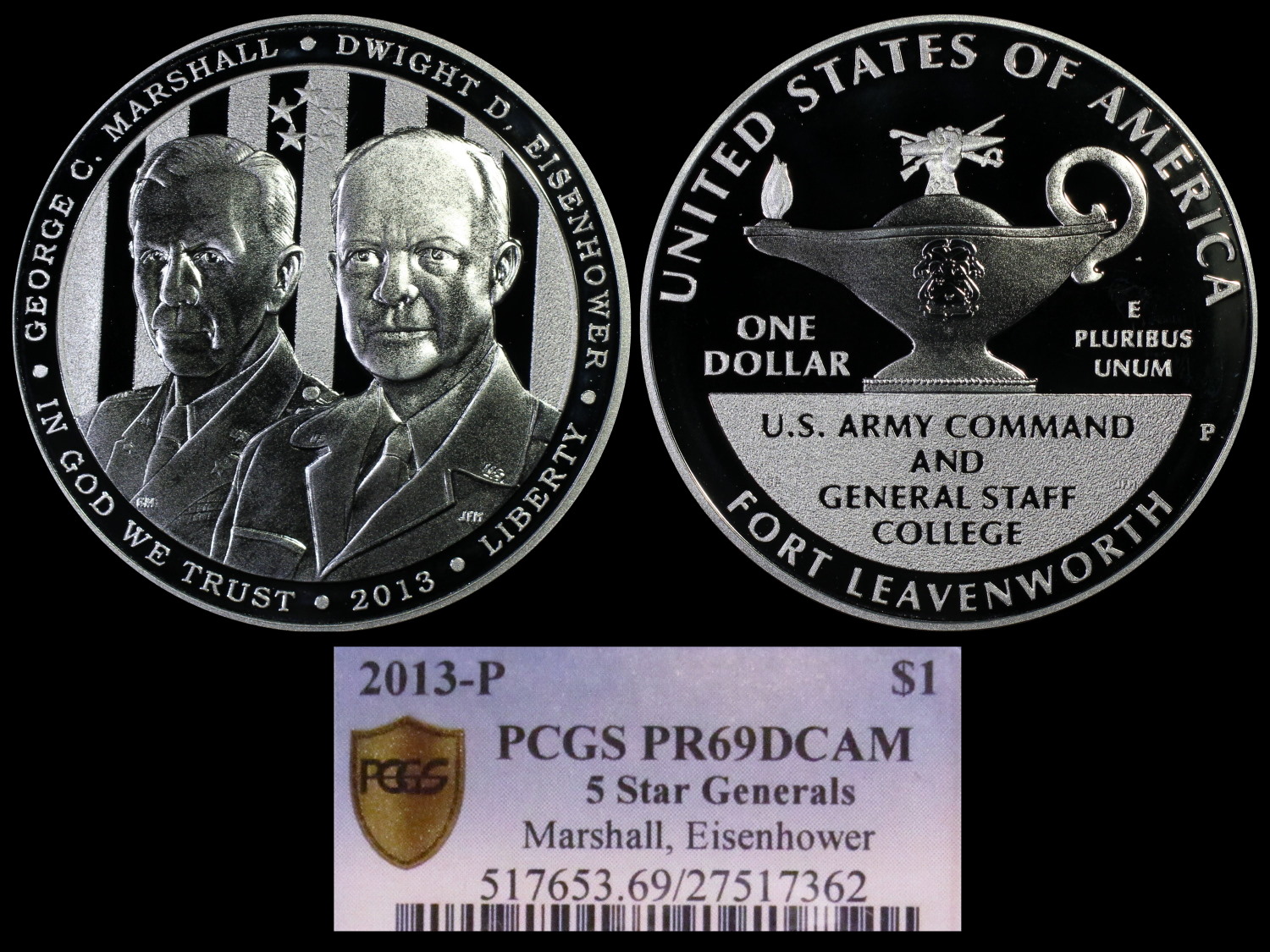
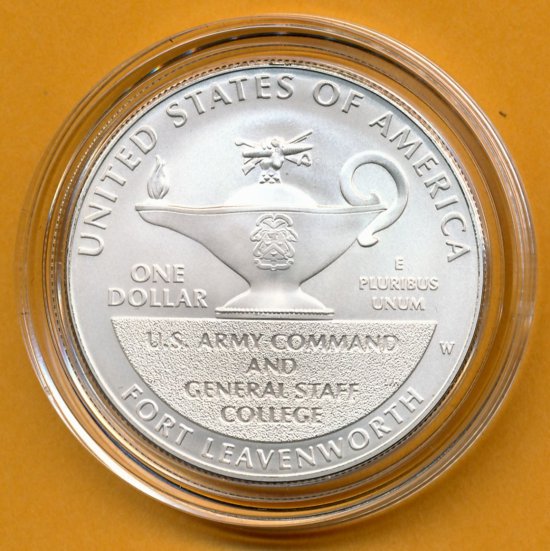
It would take more than a decade, but General Marshall was recognized on the Silver Dollar of the 2013 Five-Star General commemorative coin program.
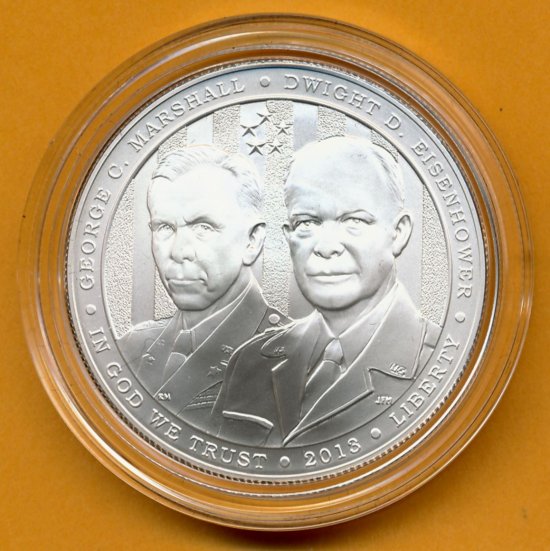
It does not appear that the George C. Marshall Memorial and Visitor Center was ever constructed in Uniontown, Pennsylvania. There is a George C. Marshall Memorial Plaza in Uniontown (near Marshall's birthplace), it was dedicated in 2003. It was funded by local contributions/private donations and targeted fundraising, however, not the Friends of George C. Marshall. The core of the landscaped Plaza features a statue of Marshall, multiple narrative plaques regarding Marshall and his service to the nation plus flags of the WWII Allied nations.
The Friends did, however, install a statue of a WWII soldier ("GI") across from the main plaza where it is accompanied by a World War I "Doughboy" statue.
In short, no commemorative coin surcharges equals dramatic scaling back of memorial plans! (For the record, had the Silver Dollar program been approved and had it registered a sell out, $3.5 million in surcharge would have been collected.)
For other of my posts about commemorative coins and medals, including more What If? stories, see:
Commems Collection









 Posted 02/11/2026 05:16 am