The 1995 Special Olympics World Games commemorative Silver Dollar was authorized as part of the Riegle-Neal Interstate Banking and Branching Efficiency Act of 1994 (a bill that was initially unrelated to commemorative coinage). It, along with the coin programs for the 1994 World Cup USA, 1996 National Community Service, 1998 Robert F. Kennedy, 2002 United States Military Academy Bicentennial, 1997 United States Botanic Garden and changes to the surcharge distribution model for the 1991 Mount Rushmore, was amended onto the Interstate Banking bill via Conference Report.
But the original proposal for a Special Olympics Silver Dollar began with standalone companion bills in the House of Representatives ("House") and Senate. The bills were introduced on the same day in February 1994. The House bill was sponsored by Rosa L. DeLauro, (D-CT), the Senate bill by Christopher J. Dodd (D-CT).
Note: The bill, as originally introduced, includes terminology that is, today, considered obsolete and potentially offensive to some. I have presented the bills as originally framed without any intent for offense.Upon introducing her bill, Representative Delauro commented:
"Mr. Speaker, while many Americans watch with pride as our talented athletes compete in the World Olympic Games in Lillehammer, there are a great number of athletes here and around the world that are still in training. For all athletes, the rigors of training are universal: hard work, long hours, and true dedication. So are the payoffs: self-confidence, pride in achievement, and friendships that last a lifetime. Around the world and across our Nation each year, athletes with mental retardation train for Special Olympic competitions. Each holds the ultimate hope of qualifying for the World Games.
"In July 1995, New Haven, West Haven, and Hamden, CT will host the 1995 Special Olympics World Summer Games. We are honored and excited to have 6,500 athletes travel to Connecticut from over 120 countries to participate in the ninth Special Olympics World Summer Games. It is for these athletes that I rise today to introduce the 1995 Special World Summer Games Commemorative Coin Act."The House bill was referred to the House Committee on Banking, Finance, and Urban Affairs, with a further referral to its Subcommittee on Consumer Credit and Insurance.
Senator Dodd also offered introductory comments for his bill:
"Mr. President, many of us over these last 10 days have been transfixed, spellbound - you could use a variety of different adjectives to describe our wonderment - at the performance of athletes around the world as they compete in Lillehammer in Norway, watching the winter Olympics. This evening I suspect millions of Americans and others around the world will be watching the figure skating for a variety of reasons, not necessarily because they wish to watch figure skating, but we have all been moved by the competition of our athletes.
"We are impressed with those who compete but not necessarily who are able to win a medal at the winter Olympics. We will have a wonderful event in Atlanta, GA, when the world comes to the United States to compete in the summer Olympics in 1996.
"It is that spirit, I suppose, of striving, the tremendous dedication, the work, the desire that moves all of us to watch these young people from around the globe spend 2 weeks with each other in the spirit of the Olympic games. We learned that this spirit of striving can be equally noble, whether it leads to a gold medal or even a last place finish. In fact, sometimes we are moved more just by the effort of an individual rather than the particular moment of glory and victory.
"Mr. President, I am very proud to tell my colleagues that next year, Connecticut will host a similar exhibition of the human spirit. These are the world summer games of the Special Olympics. It is in honor of this event that I am today introducing the 1995 Special Olympics World Games Commemorative Coin Act. "Dodd's bill was referred to the Senate Committee on Banking.
Each of the bills called for 800,000 Silver Dollars to be struck by the US Mint - in Proof and Uncirculated qualities - beginning no later than January 15, 1995, and discontinuing on December 31, 1995 - essentially, Calendar Year 1995.
The designs for the coin, to be selected by the Secretary of the Treasury after consulting with the 1995 Special Olympics World Games Organizing Committee, Inc. and the US Commission of Fine Arts., was to "be emblematic of the 1995 Special Olympics World Games." - design details were not specified in the bills.
The Issue Price of each Silver Dollar was to include a surcharge of $10. Collected surcharge funds were to be paid to the 1995 Special Olympics World Games Organizing Committee, Inc. to:
"(1) provide a world class sporting event for athletes with mental retardation;
"(2) demonstrate to a global audience the extraordinary talents, dedication, and courage of persons with mental retardation; and
"(3) underwrite the cost of staging and promoting the 1995 Special Olympics World Games."Neither the House nor Senate version of the coin bill was acted upon by its respective Committee, but, as noted above, the Silver Dollar proposal was added to the Interstate Banking bill which was passed into law via the signature of US President William "Bill" Clinton on September 29, 1994.
The coin sold 441,065 units (351,764 Proof; 89,301 Uncirculated); this represented ~55.1% of the authorized limit of 800,000.coins. Total sales generated ~$4.4 million in surcharge funds.
1995 Special Olympics Silver Dollar - Uncirculated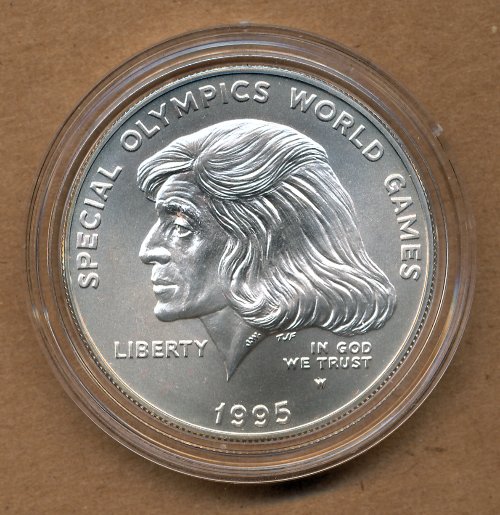
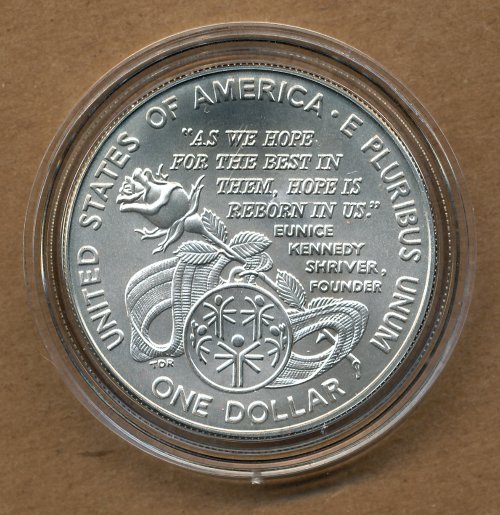
I've discussed the coin's somewhat controversial obverse design here:
-
Quick Bits #36 - A Modern Artist's StoryFor additional details regarding the coin and its designs, as well as at an interesting "Special Edition" Set that features the Special Olympics Silver Dollar, see:
-
1995 Special Olympics Kennedy SetFor other of my posts about commemorative coins and medals, including more modern-era commemorative coin stories, see:
Commems Collection









 Posted 02/14/2026 5:13 pm


 Uncirculated American Silver Eagles


