The target has been acquired!It's been a journey with twists and turns, but the end is in sight! The path is not totally straight, however, so I've decided to split the story into "Pre-Conference" and "Post-Conference" to make it more manageable...
The story begins in the United States ("US") Senate in March 1973 - a busy time for Bicentennial coinage proposals in Congress. John Jackson Sparkman (D-AL), on behalf of himself and John Goodwin Tower (R-TX), introduced a bill that proposed "To provide a new coinage design and date emblematic of the bicentennial of the American Revolution for dollars and half dollars." (I've discussed similar bills before.)
Upon its introduction, the two-coin bill was referred to the Senate Committee on Banking, Housing, and Urban Affairs. Things were soon to change, however.
The House initiated its own run at a US Bicentennial coinage in June 1973. John William Wright Patman (D-TX), on behalf of himself and Leonor Kretzer Sullivan (D-MO), William Beck Widnall (R-NJ) and Chalmers Pangburn Wylie (R-OH), also introduced a bill proposing "a new coinage design and date emblematic of the bicentennial of the American Revolution for dollars and half-dollars, and quarters." (You might recall this group of sponsors from an earlier House bill:
What If? 1973 American Revolution Bicentennial - The Evolution Continues.)
Key provisions of the bill:
1. It included Dollars, Half Dollars and Quarter Dollars in its call for coins with US Bicentennial-themed designs - three coin redesigns, not just two!
2. Coins issued between July 4, 1974 and January 1, 1977 would feature the dual date of "1776-1976".
3. At the discretion of the Secretary of the Treasury, coins issued after January 1, 1977 could continue with a Bicentennial-themed date (TBD), but would also need to include the year of issue. (Perhaps significant milestone dates of the American Revolution beyond 1776?)
Battle of Cowpens -- Conflict between American Colonel William Washington and British Lieutenant Colonel Banastre Tarleton (January 1781)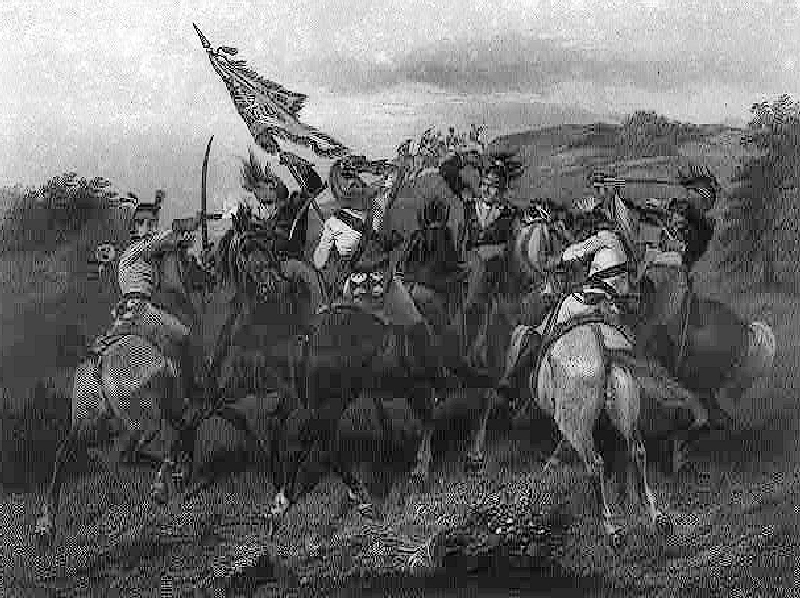 (Image Source: Library of Congress, Prints and Photograph Division. Public Domain.)Note: Original print circa 1858.
The House bill was referred to its Committee on Banking and Currency. The Committee reported the bill favorably, without amendment, and recommended that the bill pass. The Committee issued a fairly extensive Report that provided background on the coinage proposal along with "Supplemental and Individual Views" - i.e., statements about the proposed coinage from a variety of figures within the numismatic community (more later).
I want to revisit the May 1973 Hearing that was held to review the prior Patman, et al., bill as it included a key element of actions in the House and Senate. The House Report recalled the previous testimony of John J. Pittman, president of the American Numismatic Association ("
ANA").
While the
ANA, through Pittman, made a case for redesigning all denominations of
US coinage, it was his testimony regarding the
Washington quarter that proved most impactful to the Committee:
"The greatest single personality of our American Revolution was George Washington, the Father of our Country, who served as Commander-in-Chief of the Army. The bicentennial of Washington's birth was commemorated in 1932 when his portrait was placed on the obverse of the 25-cent piece, which is one of our most widely circulating coins. Since Washington is on the obverse, of this coin, it could be made a true commemorative of the American Revolution by placing a bicentennial design on its reverse. We feel that a bicentennial design change should occur at least on the reverse of the 25-dent piece, if on no other coin. Therefore, we ask that [our bill] be amended to include a change in design on the reverse of the Washington quarter."
...
"I do think since the Washington quarter is a true commemorative of the birth of Washington, that at least we should have the Washington quarter included among bicentennial coins."Pittman's testimony caused the Subcommittee that held the original Dollar/Half Dollar coin bill Hearing to instruct the Treasury to explore the feasibility of changing the design on the
Washington quarter. Subsequently, the Treasury reported that it could produce the proposed quarters if it was granted flexibility in the production facilities used. This led to the new Patman, et al. Bicentennial coinage bill referenced here.
It also impacted the thinking of the Senate Committee on Banking, Housing, and Urban Affairs.
In late June 1973, the Senate Committee reported the bill in the form of a substitution. Gone was the redesign of just the Dollar and Half Dollar, it was replaced with a bill that also included the Quarter Dollar! It was similar to the House bill under consideration at the time (referenced above), but it added a provision giving the Secretary of the Treasury ("Secretary") the authority to strike a Gold coin (specifications TBD).
The Gold coin provision became the subject of significant debate in the Senate. Some Senators believed the Gold coin provision should be left as is - i.e., at the discretion of the Secretary - vs. amended such that the Secretary was "directed" to strike the Gold coin to ensure it was produced; the Treasury did not support the issuing of a Gold coin at that time, so, unless made mandatory, many Senators believed such a coin was not likely to be struck.
Peter Hoyt Dominick (R-CO) offered an amendment to the Senate bill that removed the Secretary's discretion from the equation, and
directed him to strike a Gold coin for the Bicentennial.
Before a Senate vote could be taken on Senator Dominick's amendment, however, Robert Taft, Jr. (R-OH) offered a substitute amendment for Senator Dominick's amendment. In Taft's version, the Bicentennial Gold coin was not discussed. The amendment focused on the private ownership of gold in the US and that such would be allowed beginning on January 1, 1975. At that time, the Secretary could sell gold to the public, as long as it was at the current private market price (i.e., not at an artificial price set by the US Government).
Ultimately, after much debate, Taft's amendment was defeated and Dominick's was passed. the Committee-amended bill was further amended so that the discretion element was removed and the Secretary was
directed to strike a Gold coin. The Secretary was still given the discretion to determine the specifications for the coin to ensure it could succeed in whatever precious metal market it faced at the time of issue.
Before the overall bill could be passed, however James Albertus McClure (R-ID) offered a further amendment regarding the design provisions for the Dollar, Half Dollar and Quarter Dollar. McClure sought change to the both sides of each coin (i.e., obverse and reverse) vs. just the reverse. He sought a "more meaningful gesture" for the Bicentennial commemoration.
McClure's amendment was not adopted, however, and the Senate proceeded to consider its bill, as amended by its Committee on Banking, Housing, and Urban Affairs and further amended by Senator Taft, without McClure's amendment included.
The amended bill was passed and sent to the House for its consideration - it proved not to be a simple matter of quick concurrence.
Next up, the House considers, a Conference is called and a Bicentennial coin bill finally becomes reality!For other of my posts about commemorative coins and medals, including more "What If?" stories, see:
Commems Collection 






 Posted 04/06/2026 5:19 pm





