In 2004, as multiple nations issued commemorative coins to mark the 60th Anniversary of the Allied forces landing on the beaches of Normandy, France on June 6, 1944 (i.e., D-Day), the Royal Canadian Mint issued a special commemorative Set to mark Canada's participation in D-Day. It features a Proof Sterling Silver, dual-dated replica of Canada's 1944 five-cent coin, a copper medallion that features the portrait of George VI and an informative CD of D-Day related history.
For historical context, an excerpt from the Juno Beach Centre web site page on the D-Day invasion:
"On June 6th, 1944, the 3rd Canadian Infantry Division and the 2nd Armoured Brigade were tasked with establishing a bridgehead on the beach codenamed "Juno". This was an eight-kilometre long stretch of beach bordering Saint-Aubin, Bernières, Courseulles-sur-Mer and Graye-sur-Mer. Assault troops were then to move towards the Carpiquet airfield, 18 kilometres inland. The 3rd Infantry Division, under Major-General R.F.L. Keller, was under command of the Second British Army. It was flanked on the left by the 3rd British Infantry Division that was to land on Sword beach (Lion-sur-Mer, Langrune-sur-Mer). To the right, the 50th British Division had as its target "Gold Beach" (La Rivière, Le Hamel, and Arromanches)."I recommend visiting the Juno Beach Centre web site for much more on D-Day and the role played by Canada in it.
Juno Beach Centre.
Thomas Shingles (b. 1903; d. 1984) was the Master Engraver of the Royal Canadian Mint for more than two decades - 1943 to 1965 (when he retired). He was responsible for the design of the original "Torch and V" five-cent coin that was struck between 1943 and 1945. The original coin features a left-facing portrait of King George VI; the 2004 commemorative piece presents Susana Blunt's portrait of Queen Elizabeth II.
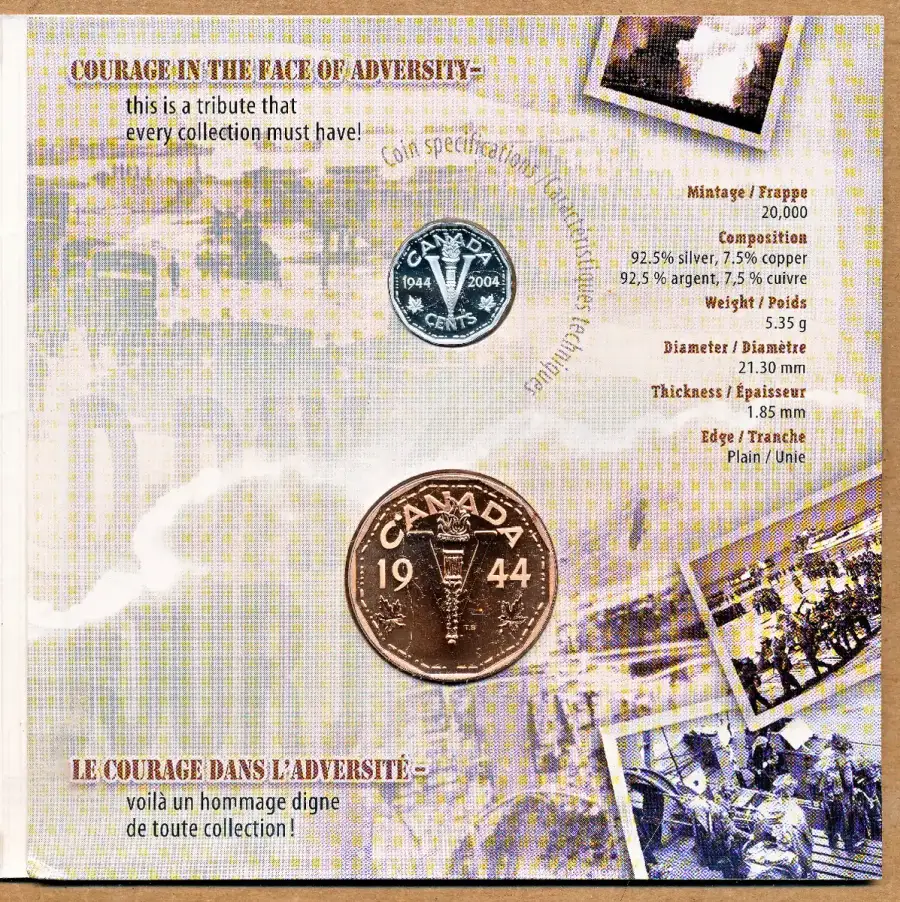
The 2004 commemorative piece brings back Shingles' WWII era design, adding the dates "1944" and "2004" as flanking elements for the "V" . Winston Churchill's "We Win When We Work Willingly" quote is presented in Morse code near the rim of the commemorative/tribute coin - as it appeared on the original coin.
The Sterling Silver five-cent piece has a diameter of ~21.3 millimeters ("mm") and a weight of 4.54 grams ("g"). (Note: The coin's diameter varies slightly due to its 12-sided shape.)
The Set's copper medallion recreates the five-cent coin's original obverse and reverse designs with a King George VI portrait on its obverse - designed/engraved by Thomas Humphrey "TH" Paget - and the "Torch and V" design with "1944" by Thomas Shingles on the reverse.
The Copper medallion is 35 mm in diameter and weighs 26 g.
Note: Some references about the Sterling Silver piece make a connection to a 1944 'tombac' heritage. Canada used the tombac composition (88% copper, 12% zins) for its five-cent coins in 1942 and 1943 - aan extremely small mintage of 1944 tombac strikes are known but do not represent the standard composition for the year - they are very rare. In 1944, the Canadian Mint had switched to chromium-plated steel planchets for the circulating five-cent coin.The Set is presented in a full-color four-panel folder with an interior flap (interior left panel) for the CD. The coin and medal are embedded in the interior right / back panel.
Per the 2004
Annual Report of the Royal Canadian Mint, the Set had an issued total of 19,977 (the published Maximum for the Set was 20,000). The Set was a "Sell Out" with the small difference between 'Issued' and 'Maximum' likely the result of damaged/returned Sets vs. unsold product.
D-Day Anniversary Set Folder - Front Panel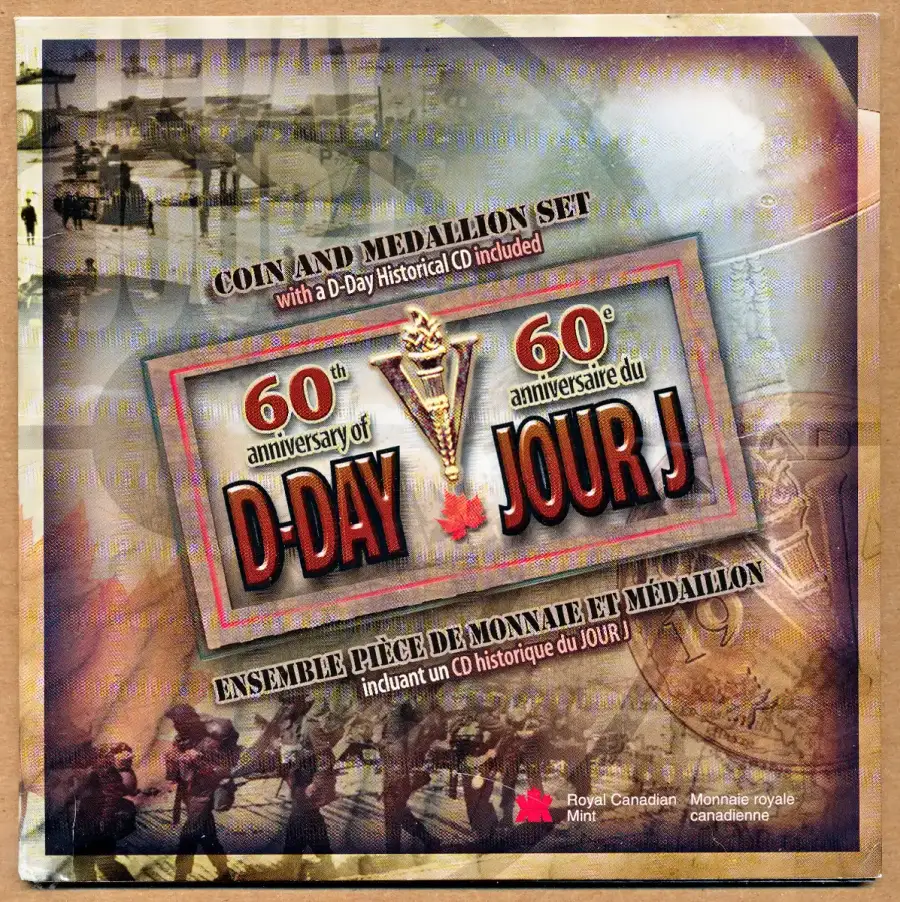 D-Day Anniversary Set Folder - Interior / Left Panel & CD Pocket
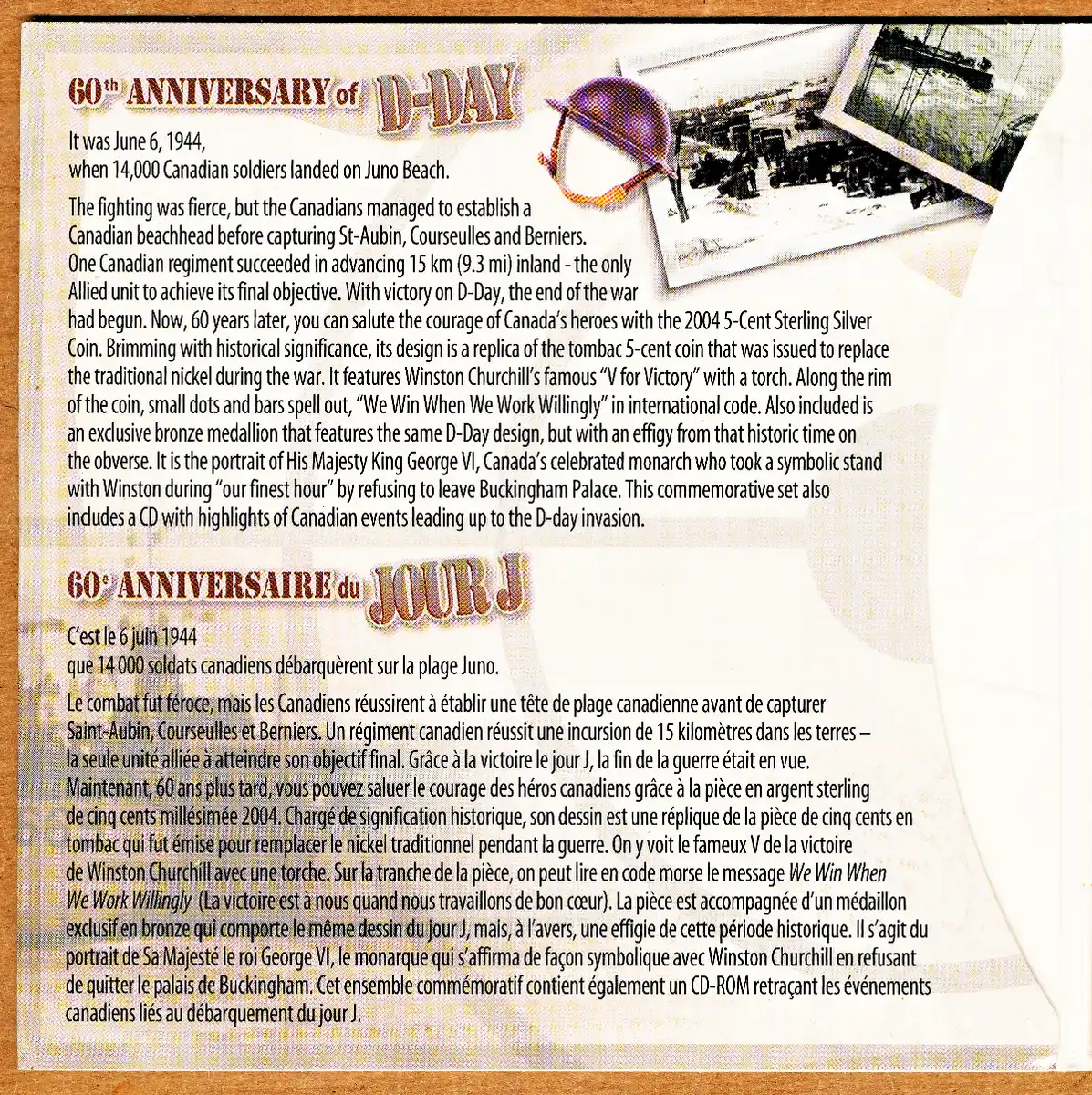 D-Day Anniversary Set Folder - Interior / Right Panel
 D-Day Anniversary Set Folder - Back Panel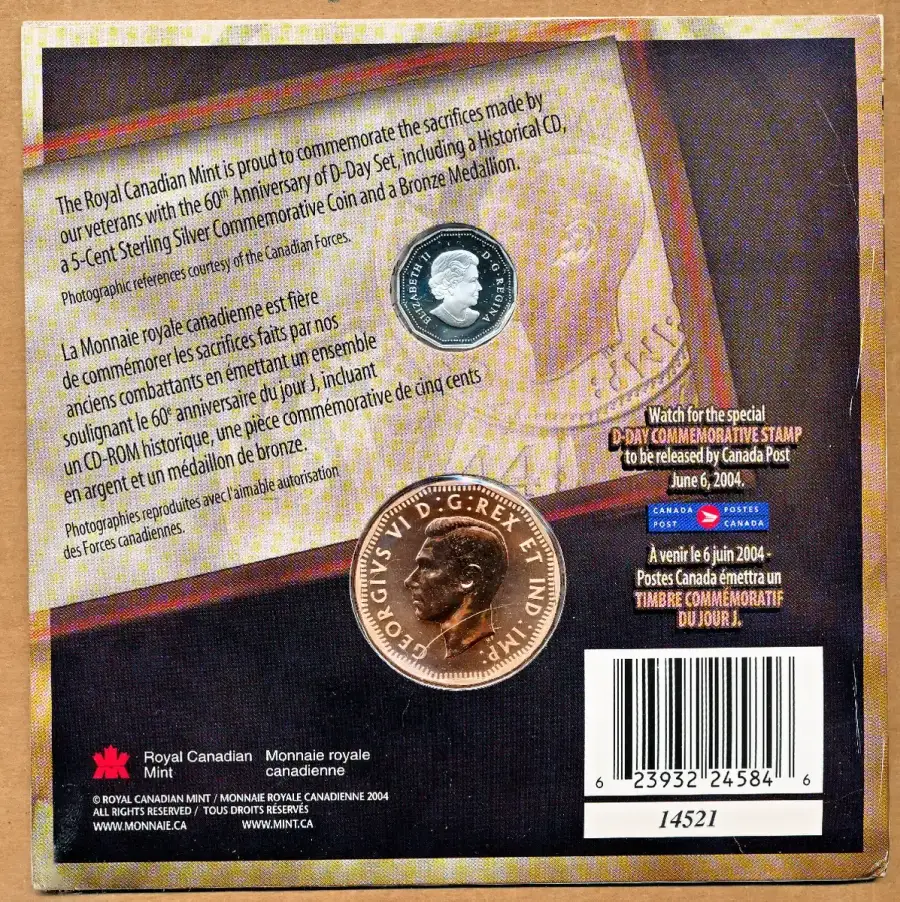
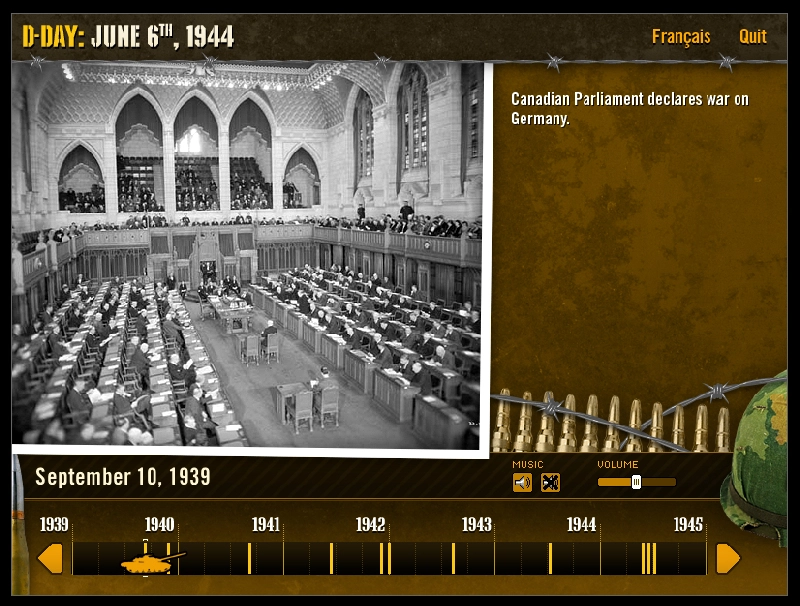
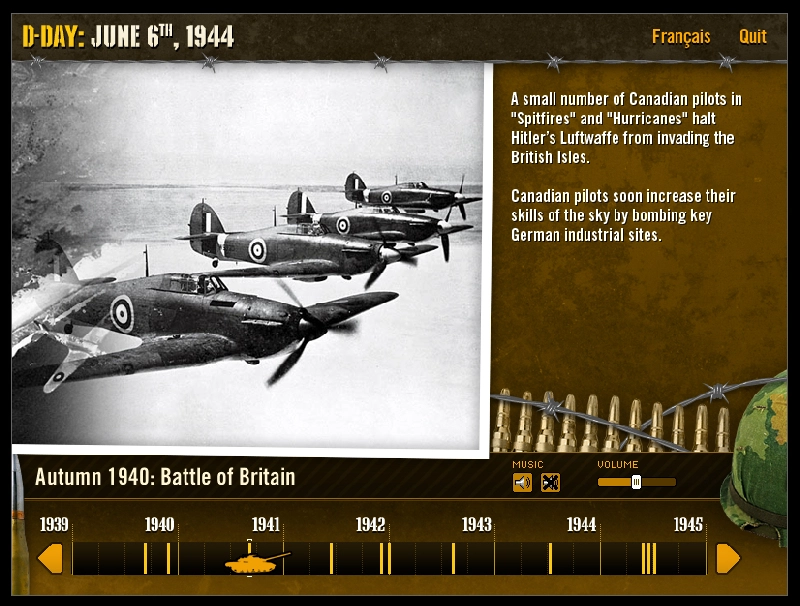
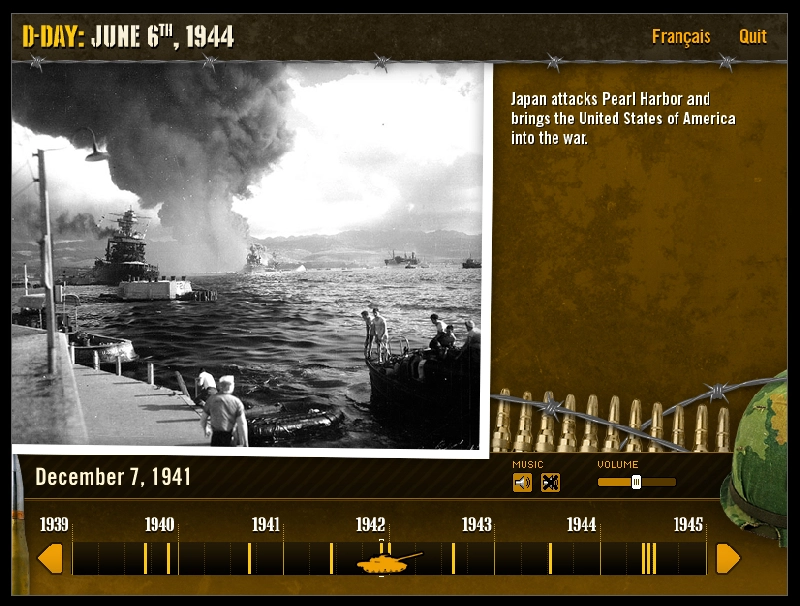
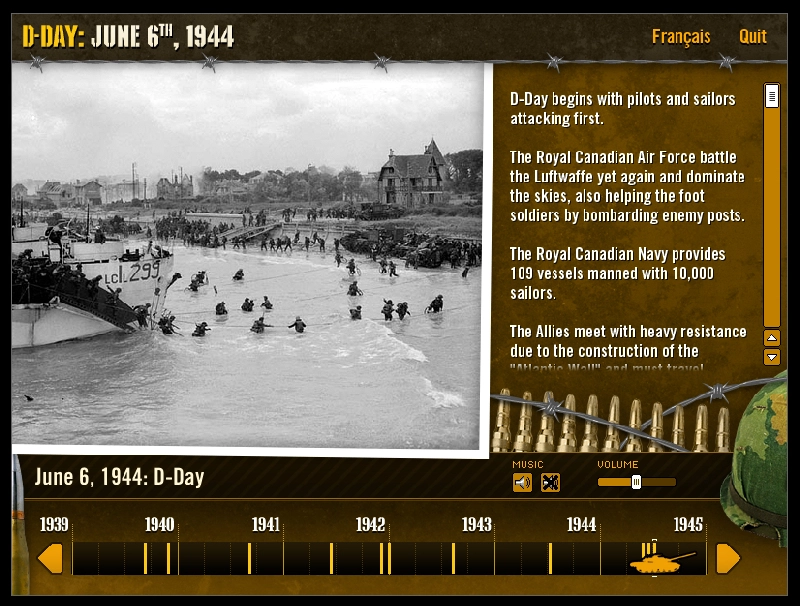
Here are a few screens captured from the CD:
D-Day CD: Opening Screen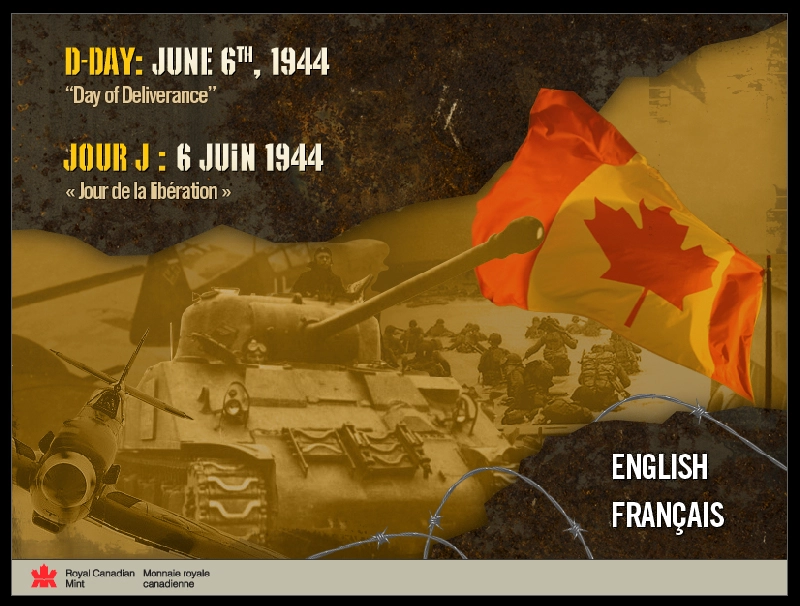 D-Day CD: Canada Declares War
 D-Day CD: Battle of Britain
 D-Day CD: Japan Attacks Pearl Harbor
 D-Day CD: D-Day Invasion
 D-Day CD: Exit Screen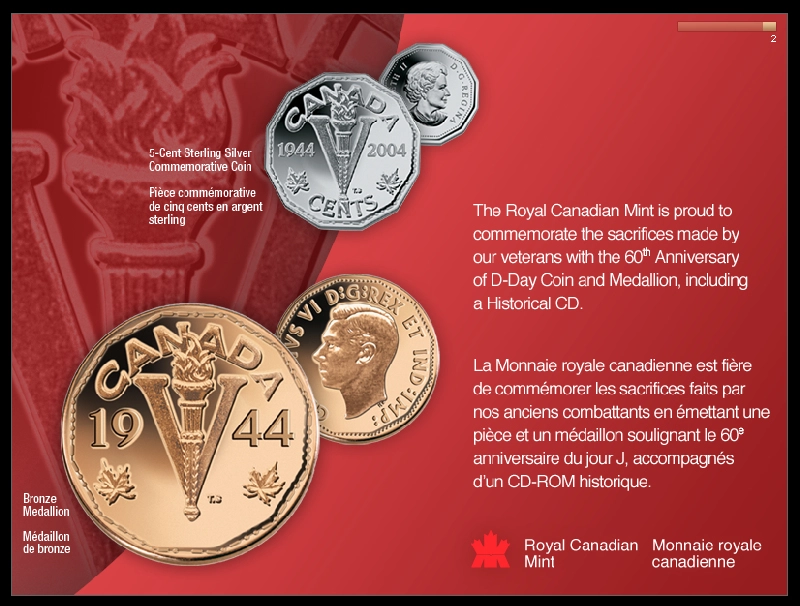
I've always enjoyed the history behind the coins I collected, and think this D-Day Set is a great blend of numismatics and history. I also think it could spur the interest of a new collector - young or older.
For other of my posts about commemorative coins and medals, including more Canadian coin stories, see:
Commems Collection






 Posted 05/02/2026 10:03 am


