Here's a Phantom What If? that, if it had been authorized, would have altered the contents of pockets and pocketbooks from coast to coast!In November 1945, it was reported that Mary Jester Allen, a niece of William Frederick Cody (aka, "Buffalo Bill" Cody) contacted the Casper, Wyoming Chamber of Commerce to ask them to assist with an effort to get a United States ("US") postage stamp issued to mark the centennial of Cody's birth and to secure the re-issue of the Indian Head/Buffalo nickel.
Cody is known to have referred to the "Buffalo" nickel as the "All-American coin."
Note: The US five-cent coin had somewhat recently (in 1938) been re-designed to feature Thomas Jefferson (Obverse) and his Monticello home (Reverse) vs. James Earle Fraser's design of a Native American (Obverse) and an American Bison (Reverse) that was struck from 1913 to 1938.[Buffalo Bill Cody, Full-Length portrait, Circa 1903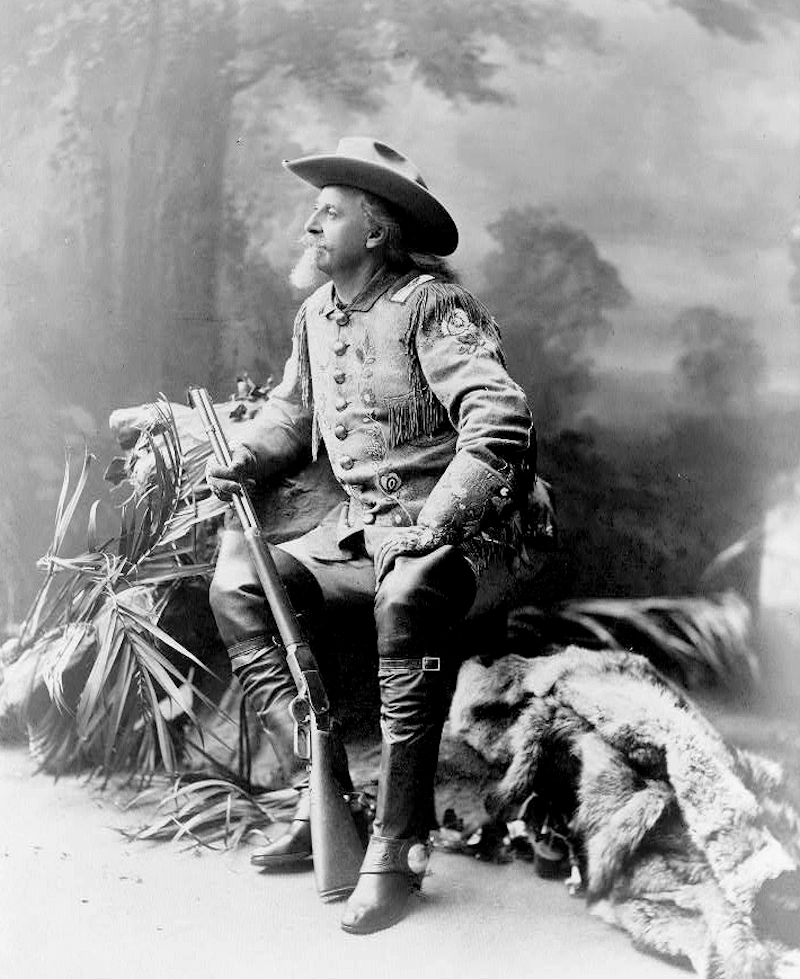 (Image Credit: Library of Congress, Prints and Photographs Division. Public Domain.)
Cody lived an exciting, multi-facted life. He was born February 26, 1946 in the Iowa Territory, but later moved to Kansas with his family. He left home at 11, and worked several different jobs including cattle herder and wagon driver. At just 14 years old, he was a Pony Express rider, covering a segment of the route near Casper, Wyoming.
During the US Civil War, he served as a civilian scout for the US Army. He also served in the Seventh Kansas Cavalry from 1863 to 1865. He continued to serve the US Army as a civilian scout after the Civil War during the Plains Wars.
Cody earned the nickname "Buffalo Bill" after the Civil War by hunting thousands of bison ("buffalo") in 1867-1868 to provide meat for workers of the Kansas Pacific Railroad.
Cody gained national (and eventually international) fame after Ned Buntline wrote romanticized stories of Cody's life. The growing fame led to the creation of "Buffalo Bill's Wild West Show" in 1883. The Show included western-themed acts such as battle re-enactments, rodeo acts and Native American performances. The Show also featured the famous sharpshooter, Annie Oakley. The Show traveled extensively in the US and Europe; it continued for 30 years. The Show elevated Cody to the status of (arguably) the most famous man in the world.
In 1896, William Cody (with local entrepreneur George T. Beck and multiple business partners) founded Cody, Wyoming; the City continues to celebrate his legacy to the present day and hosts the Buffalo Bill Center of the West - a museum complex dedicated to his life and legacy.
Buffalo Bill died in Denver, Colorado on January 10, 1917); he was 70 years old.
In February 1946, Senator Frank Aloysius Barrett (R-WY) offered extended remarks in the Senate upon the Centennial of Cody's birth - Cody was born on February 26, 1846. As part of his remarks, Barrett quoted from a tribute printed in a Special Edition of the
Cody Enterprise,
Here's an excerpt:
"Col. William Frederick Cody - "Buffalo Bill" in the hearts of every citizen of this and other countries - is gone, but his deeds, words and many accomplishments will never die. During the month of February the world salutes the memory of three great Americans. Washington, the founder of our Nation; Lincoln, the savior of our Nation; and Cody, the great frontiersman"I'm not sure I would place Cody on par with Washington and Lincoln in the annals of American history, but I understand the intent of the piece.
Senator Barrett did not, however, introduce legislation regarding a commemorative stamp or for the re-introduction of the "Buffalo" nickel.
Though not issued for his birth centennial, Cody has been the subject of a large number of privately-struck medals - he has a numismatic legacy that forms a specialized interest for some collectors. He has also be commemorated on multiple US postage stamps
Fraser's Indian Head ("Buffalo") five-cent coin design was brought back on a US commemorative Silver Dollar in 2001, though in support of the National Museum Of The American Indian vs. Buffalo Bill Cody.
2001 American Buffalo Silver Dollar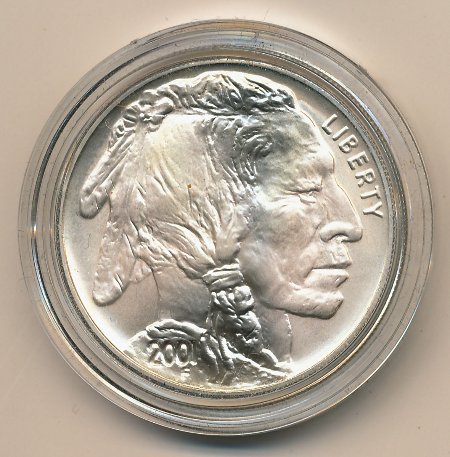
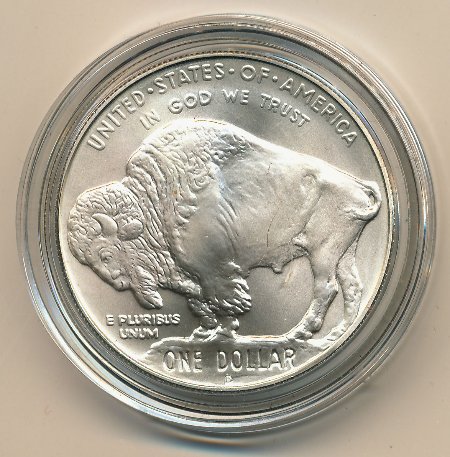
You can more about the 2001 coin here:
-
2001 National Museum Of The American Indian - Congress / Part I-
2001 National Museum Of The American Indian - Congress / Part II-
2001 National Museum Of The American Indian - The CoinFor other of my posts about commemorative coins and medals, including other What If? Phantom stories, see:
Commems Collection 






 Posted Today 9H 2M ago


