Great Collections - California in 1850 was awash in raw gold and almost entirely without federal coin, and Congress answered not by building a mint but by authorising the Treasury to contract with a California assayer. Augustus Humbert, a New York watchmaker and metallurgist, was appointed United States Assayer of Gold and began work in January 1851 through the contractor Moffat & Co. The octagonal $50 pieces he issued were the largest gold pieces of the Gold Rush and were known to everyone as slugs. They were legally ingots rather than coins, which is precisely why the fineness is stamped on the face: 887 THOUS. means .887 fine, the natural purity of California placer gold, and Humbert raised the weight to keep the intrinsic value correct. Charles Cushing Wright cut the dies - an eagle on a shield resting on a rock, over an engine-turned target reverse.
https://www.greatcollections.com/Coin/2199770 Check out Certified California Gold on ebay
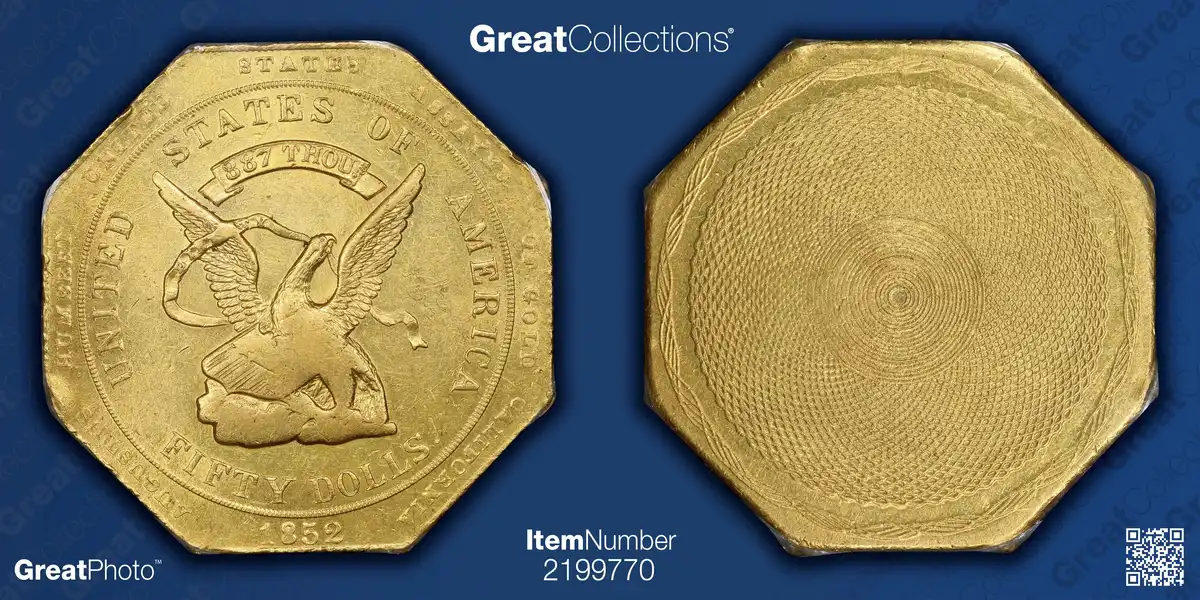
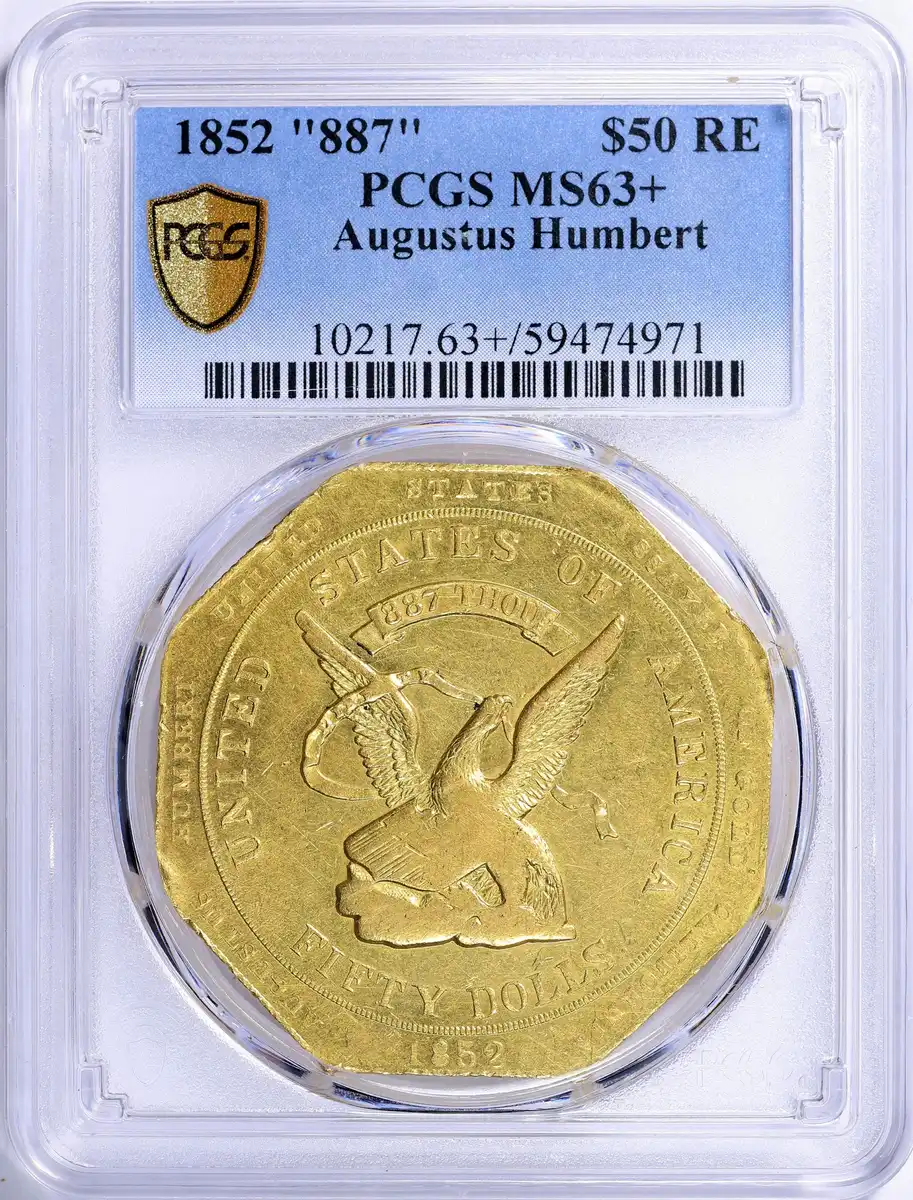

Single finest by two grade points.
Rarest variety of the three Humbert Reeded Edge "slugs"
Plate coin of America's Golden Age: Private & Pioneer Gold Coins of the United States 1786-1862 by Donald H. Kagin Ph.D. and David McCarthy
These were settlement pieces for merchants, banks, and customs payments rather than money anybody carried, so most circulated hard, and most were redeemed and melted once the San Francisco Mint opened in 1854. Roughly two hundred of the 1852 887 THOUS. Octagonals survive in all grades, the great majority of them well below Mint State. This example is quite the opposite - the finest known by a wide variety - and a trophy for territorial collectors...as well as type, gold, and general "grail" collectors.
Check out Certified California Gold on ebay Check out Books on California Gold on Amazon









 Posted Today 2H 13M ago


