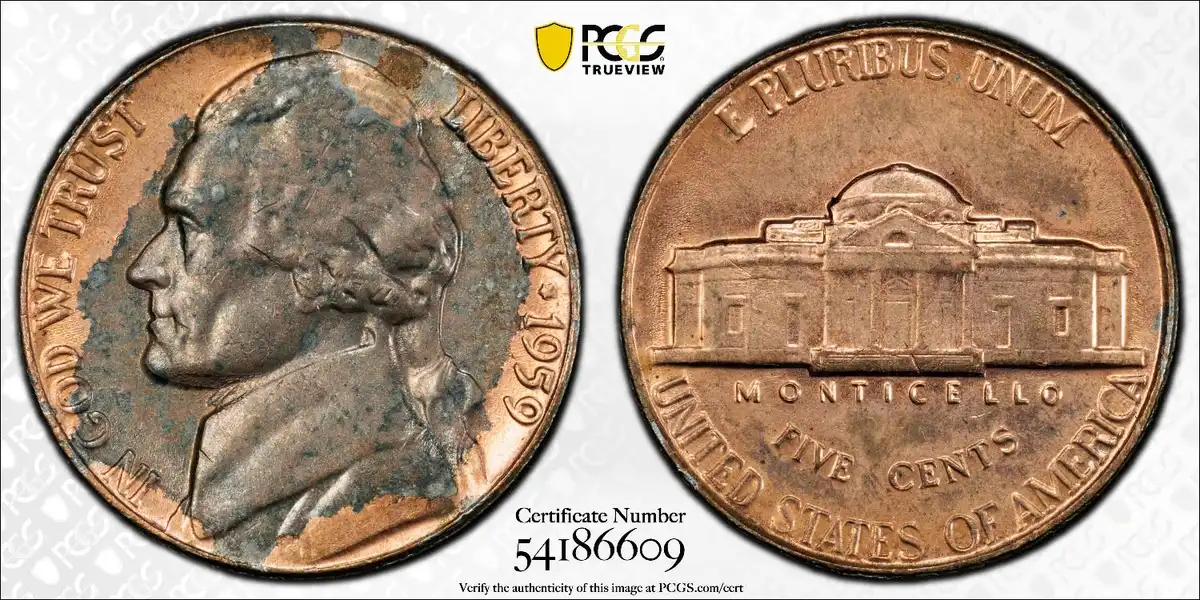
Unfortunately its no good since its PCGS slabbed. Here is my proposed analytical methodology at this point in time = Black Beauties require both a surface shot and a polished edge shot because the phenomenon is entirely a surface chemistry result of improper annealing, not a structural defect. During 1958 and 1959, the nickel feedstock supplied to the U.S. Mint likely carried elevated cobalt impurity levels—possibly even above 0.1%!?, which would have altered how the cupronickel alloy responded to annealing heat. When overheated, this cobalt bearing alloy forms a blue black, glossy oxide layer that is visually distinctive on Uncirculated coins. A surface shot preserves this unaltered skin so SEM/EDS can document the cobalt&-influenced oxidation chemistry, while XRF captures the surface&-biased readings that differ from the interior. Because the Black Beauty effect exists only in the outer few microns, the surface shot records the metallurgical signature responsible for the color.
A polished edge shot is equally important because it demonstrates that the interior alloy remains completely normal with the exception of Cobalt (Co). Probably. Polishing removes the cobalt enhanced oxide layer and exposes a flat, uniform surface for XRF to measure the true bulk composition and also to take a non-corrosion layer SEM/EDS target shot. This confirms that the cobalt impurity influenced only the surface oxidation behavior during overheating, not the interior matrix. SEM/EDS at the polished edge also verifies that Black Beauties are annealing driven surface anomalies, not structural errors. Together, the two geometries establish the complete picture: normal interior alloy + cobalt influenced annealed surface = Black Beauty, providing the contrast needed for analytical work comparing these coins to standard 1958-59 -P
Jefferson nickels. These are not sintered errors which are dark gray and porous. Any connotation to a sintered planchet is a
TPG error. Additionally - Improper alloy mix is the wrong classification for Black Beauties because their interior metal composition is completely normal for 1958-59 -P
Jefferson nickels, with no evidence of abnormal bulk chemistry or mixed metal contamination. The blue -black appearance comes from surface oxidation behavior during overheating, not from an alloy level mistake. The most plausible metallurgical cause is that the nickel feedstock delivered to the Mint in 1958 and 1959 in Philadelphia contained elevated cobalt impurity levels—likely above 0.1%?. Cobalt at this level does not alter the bulk alloy enough to qualify as an "improper mix," but it does change how the surface oxide forms when the planchets are annealed too hot. This produces the glossy, bluish&-black skin characteristic of Black Beauties while leaving the interior alloy completely standard. Because the core composition remains correct and only the surface oxide is abnormal, the proper classification is improper annealing, not improper alloy mix at this time (in theory). It seems also in this study to add a fourth specimen - a so-called sintered
Jefferson nickel outside of 1958/1959 Philly group which has that BB glossy blue black look. JPL
Edited by colonialjohn
Today 5M ago








 First Page
 Previous Page
 Replies: 293 / Views: 79,533


 to the


 Posted 04/25/2026 09:35 am