| Author |
 Replies: 15 / Views: 470  |
|
|
Pillar of the Community
United States
7008 Posts |
|
|
|
|
Bedrock of the Community
United States
81061 Posts |
Good question, Brandmeister.   Might just be me, but the second Mercury dime looks circulated to me. My only other thought is it was weakly struck. Errers and Varietys.
|
|
Bedrock of the Community
United States
12035 Posts |
1945 Mercury dimes, especially the Philadelphia mint coins are typically weakly struck because the U.S. Mint was operating at maximum wartime capacity under extreme production pressures. The Philadelphia Mint produced over 159 million Mercury dimes in 1945. To keep up with massive demand near the end of World War II, the mint reused dies and hubs far past their optimal lifespan, causing fine details like the central bands on the reverse fasces to soften or flatten out. Wartime production demands created operational bottlenecks in the planchet preparation and annealing processes. If planchets were not properly prepared or slightly underweight, the metal failed to fully flow into the deepest recesses of the coining dies. The rush to churn out hundreds of millions of coins meant less quality control over die spacing and pressure calibration across high-speed presses. I think that this is why your first two 1945-P examples lack detail and still grade gem. Happened to a lesser degree in SF but still happened. It doesn't have to do with toning, but the special war time circumstances in 1945. Still slightly over graded imho but probably weakly struck uncirculated examples produced by overused dies. IN NECESSARIIS UNITAS - IN DUBIIS LIBERTAS - IN OMNIBUS CARITAS THE MAN IN THE ARENA, Theodore Roosevelt at the Sorbonne Paris on April 23, 1910: " It is not the critic who counts; not the man who points out how the strong man stumbles or where the doer of deeds could have done better. The credit belongs to the man who is actually in the arena, whose face is marred by dust and sweat and blood, who strives valiantly, who errs and comes up short again and again, because there is no effort without error or shortcoming, but who knows the great enthusiasms, the great devotions, who spends himself in a worthy cause; who, at the best, knows, in the end, the triumph of high achievement, and who, at the worst, if he fails, at least he fails while daring greatly, so that his place shall never be with those cold and timid souls who knew neither victory nor defeat." My coin website: https://fairfaxcoins.comEdited by numismatic student
11/01/2026 7:19 pm
|
|
Bedrock of the Community
United States
19731 Posts |
Nice breakdown, numismaticstudent!
|
|
Moderator
 United States
16050 Posts |
Great input by NS - thank you for sharing your scholarship.
Take a look at my other hobby ... http://www.jk-dk.art |
|
Bedrock of the Community
United States
81061 Posts |
Great information numismatic student, thanks!  Errers and Varietys.
|
|
Bedrock of the Community
United States
37354 Posts |
For circulated coins, look for small breaks in the luster on the highest points. Weakly struck coins are often thought of as being lightly circulated.
|
|
Pillar of the Community
 United States
7008 Posts |
Very educational. On Mercury dimes, I am accustomed to loss of detail on the cheekbone and helmet feathers as an indicator of circulation wear. So for these coins, that's to be interpreted as die wear? |
|
Moderator
United States
199130 Posts |
|
|
Bedrock of the Community
United States
12035 Posts |
Quote:
So for these coins, that's to be interpreted as die wear? Sometimes it is circulation wear, sometimes it is die wear. As IGE points out, the coin has to be examined carefully to determine what it is. I would avoid the worn die uncs with poor detail unless you wanted a representative example of the typically poor products from busy war time production. Maybe focus on finding well stuck examples for 1945 even if it does not have full bands. I own a 1945-P gem FB example and purchased it for its rarity. IN NECESSARIIS UNITAS - IN DUBIIS LIBERTAS - IN OMNIBUS CARITAS THE MAN IN THE ARENA, Theodore Roosevelt at the Sorbonne Paris on April 23, 1910: " It is not the critic who counts; not the man who points out how the strong man stumbles or where the doer of deeds could have done better. The credit belongs to the man who is actually in the arena, whose face is marred by dust and sweat and blood, who strives valiantly, who errs and comes up short again and again, because there is no effort without error or shortcoming, but who knows the great enthusiasms, the great devotions, who spends himself in a worthy cause; who, at the best, knows, in the end, the triumph of high achievement, and who, at the worst, if he fails, at least he fails while daring greatly, so that his place shall never be with those cold and timid souls who knew neither victory nor defeat." My coin website: https://fairfaxcoins.com |
|
Pillar of the Community
United States
5918 Posts |
Finding a 45 P with full band is nearly impossible out in wild, like needle in a haystack.  |
|
Bedrock of the Community
United States
37354 Posts |
Quote:
Finding a 45 P with full band is nearly impossible out in wild, like needle in a haystack. As the price indicates. NumisMedia (retail price) 1945-P Full bands MS-61 $2,220 MS-62 $4,230 MS-63 $6,000 MS-64 $8,220 MS-65 $15,310 NumisMedia (retail price) 1945-P no FSB MS-61 $11 MS-62 $12 MS-63 $13 MS-64 $16 MS-65 $23 |
|
Pillar of the Community
United States
2514 Posts |
Those coins listed above will command more money because of the surface tone colors, even without full bands. For example, this Mercury dime cost me a little more than the price you show for MS65 in the No FB list; I'd say it's what the buyer is willing to pay for toned coins. I'd paid a little too much, but I wanted this Mercury dime.  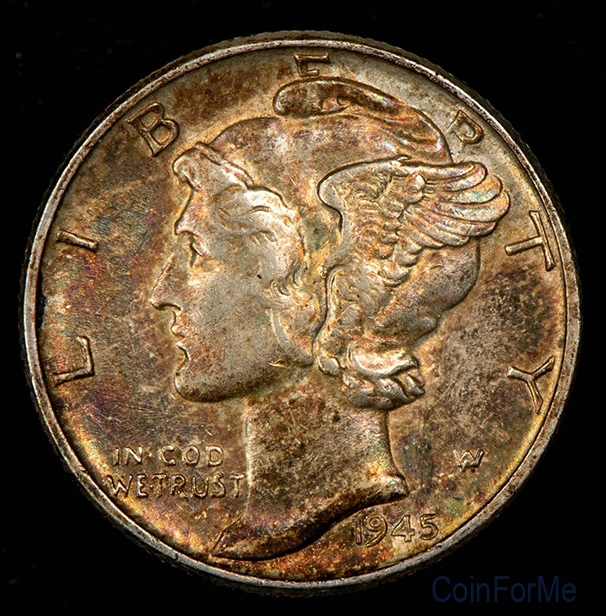 |
|
Pillar of the Community
United States
6461 Posts |
My understanding has been that a coin needs a good strike to deserve any grade higher than MS-65. Weakly-struck coins usually have substandard eye appeal and the assigned grades should reflect this. The MS-67 and MS-66 dimes linked by the OP do seem overgraded.
|
|
Bedrock of the Community
 United States
18994 Posts |
PCGS and other TPG's as well just love that blotchy ugly toning. I dont get it. I would never pay that kind of money for one. obviously eye appeal is only component of grading. according to PCGS they have three levels of toning that can affect the grade. Toning can be positive, neutral, or negative depending on its appearance. according to PCGS, spotted, splotchy, or uneven toning can reduce eye appeal and lower the grade within its range, however, I dont see that happening in the real world. i find it extremely difficult to assess the surfaces and always wondered how a grader determines what is under it when a coin is heavily toned. this really shows the subjectivity of grading a coin and the value of a coin is what someone would purchase it for. |
|
Pillar of the Community
United States
5918 Posts |
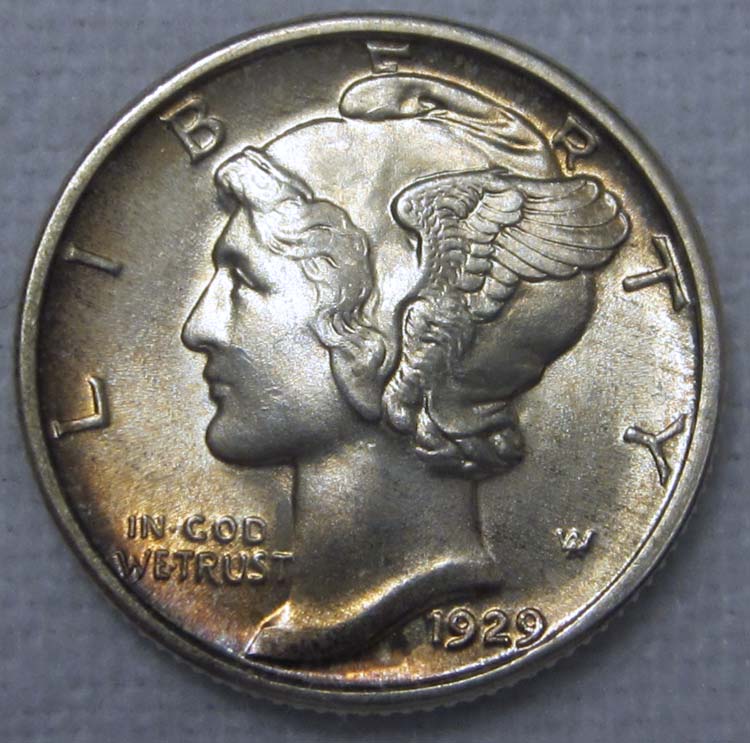 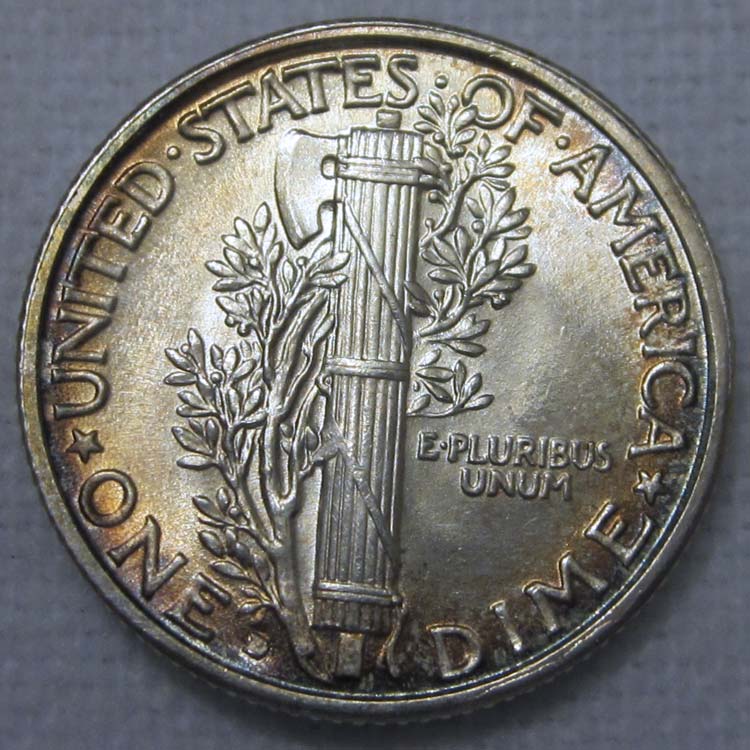 Here's one that I preferred and owned, it is more of a champagne toning but doesn't distract the strike and its appearance. |
| |
Replies: 15 / Views: 470 |
|







 Posted 11/01/2026 7:03 pm


