| Author |
 Replies: 796 / Views: 104,784 Replies: 796 / Views: 104,784 |
|
|
|
Pillar of the Community
United States
731 Posts |
@dave - i'll post some tomorrow
|
|
Pillar of the Community
United States
1436 Posts |
|
|
Pillar of the Community
United States
731 Posts |
|
|
Pillar of the Community
United States
1436 Posts |
CheetahCats, As always, beautiful tokens!  Thanks for sharing! Question about the Broas Pie Bakers token in XF... I have one that's pretty much identical to yours. W/ the die sooo shattered, would it be possible to obtain a much higher grade than XF or AU? |
|
Pillar of the Community
United States
731 Posts |
Thanks Dave. As to the Broas Brothers, I don't think I've seen any higher myself. That said, I'm sure they exist.
|
|
Pillar of the Community
United States
1436 Posts |
CheetahCats,
Do you use a special program to put your pictures & descriptions together ? They are always so professional looking. I will hopefully be in the market for a digital camera for my collection in the near future and wasa wondering what you use...
|
|
Pillar of the Community
United States
731 Posts |
Dave, the technique entails the following:
I photograph each specimen using a copy stand.
The copy stand's stage is covered in black paper, the specimen is placed atop, and the camera is pointed downward at the specimen.
In between is a paned clear sheet of glass, angled at 45 degrees. Perpendicular, a light source is aimed at the glass.
The light ricochets off the glass and onward atop the specimen, while still allowing the camera to shoot through the glass. The camera's timer and macro features are used.
The resultant raw photos are cropped using graphic software that has a circular lasso tool.
Once cropped, each coin image is placed atop a white background layer template, with text typed in another layer.
It sounds more complicated than it is. The processes just require a lot of practice. Once mastered, the specimens can be assembly-lined through quite quickly.
Edited by CheetahCats
12/12/2012 7:56 pm
|
|
Pillar of the Community
United States
1436 Posts |
Well, I think it is a great way to photograph them. VERY professional looking.
|
|
Pillar of the Community
United States
731 Posts |
|
|
Pillar of the Community
United States
1436 Posts |
CheetahCats, I am well aware of the "SPOOT" variety of this CWT, but have never noticed this die before. Can you shed any light? Almost looks like the original said SCHOOT? 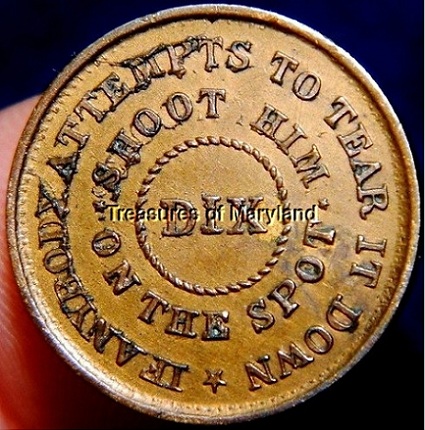 Edited by Dave H
12/16/2012 08:36 am
|
|
Pillar of the Community
United States
731 Posts |
That is a 416 reverse. It is only paired with the 210 or 214 obverses in copper (a) or brass (b).
Both the 210 and 214 are 'THE FLAG OF OUR UNION'
The 210 obverse includes the date '1863' at 6 o'clock.
The 214 obverse does not include any date.
210/416a - R5
210/416b - R4
214/416a - R1
214/416b - R5
Clearly the 416 is a recut die. As to its original motto, I'm not sure, and Fuld doesn't provide any additional guidance.
|
|
Pillar of the Community
United States
1436 Posts |
Awesome. Thanks CC. What does the recut die do for the value, if anything?
|
|
Pillar of the Community
United States
731 Posts |
I would say that it's negligible; Recut dies are common for CWTs. As with most CWTs, I would say its value is most determined by rarity (see above post for R value) and grade.
|
|
Pillar of the Community
United States
1436 Posts |
|
|
Pillar of the Community
Canada
1411 Posts |
a little editing will go a long way for those pictures!
|
| |
Replies: 796 / Views: 104,784 |








 First Page
 Previous Page


 Posted 12/11/2012 2:42 pm


 I've wanted this one for a while.