| Author |
 Replies: 13 / Views: 23,459 Replies: 13 / Views: 23,459 |
|
|
Valued Member
Australia
51 Posts |
In an attempt to sort out the differences between coins from the three mints that made the Australian 1981 20c, I have found that many of the characteristics that supposedly separate the coins from Wales (Llantrisant Mint) & Canberra (RAM) are too subtle for me to determine. Actually, many of the characteristic for the Wales & Canberra coins are identical (they both have flat based obverse lettering, 4 claws on the platypus & both are reputed to have a concave obverse field although how one determines this last point is beyond me at the moment). Conversely, the coins from Canada (Ottawa Mint) are easily distinguished by having curved base obverse letters & only 3½ claws on the platypus. Again I'm stumped by how one would determine the supposedly flat obverse field on these coins but if anyone knows how to do this, could they please let me know.For the reasons explained below, I have assigned mints to the images of the following coins as per their labels with the Welsh coin's designation being provisional.  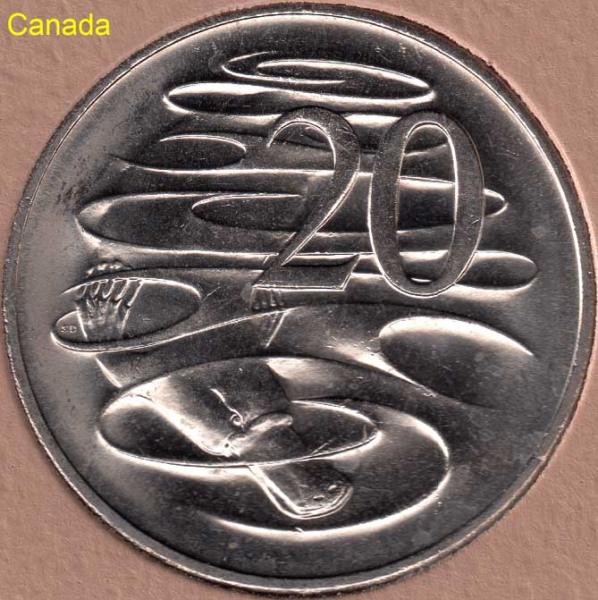 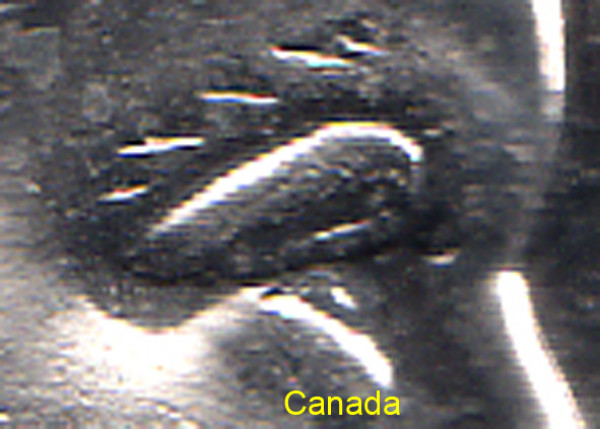 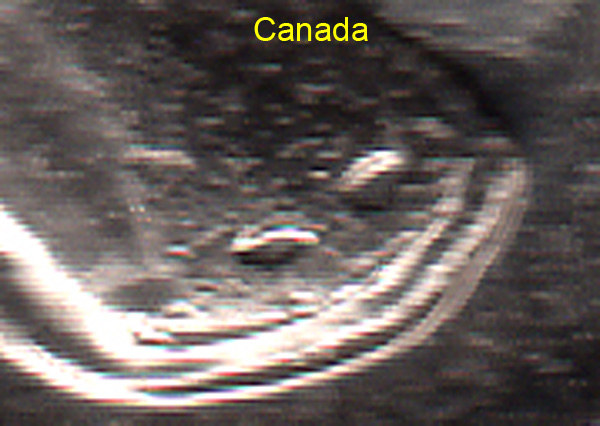 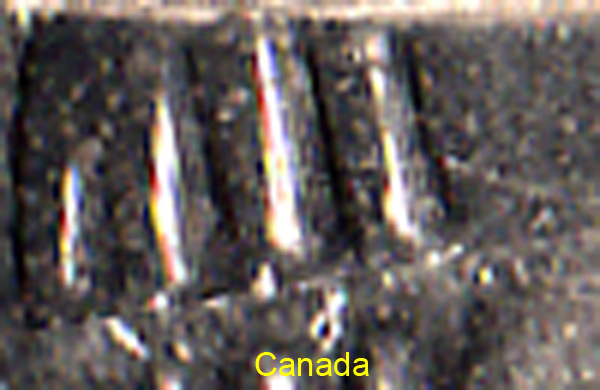 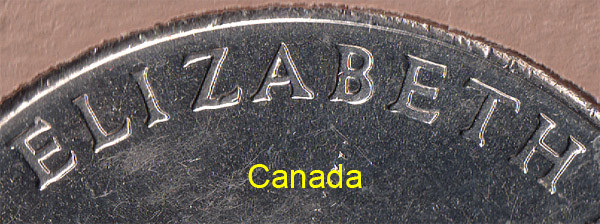 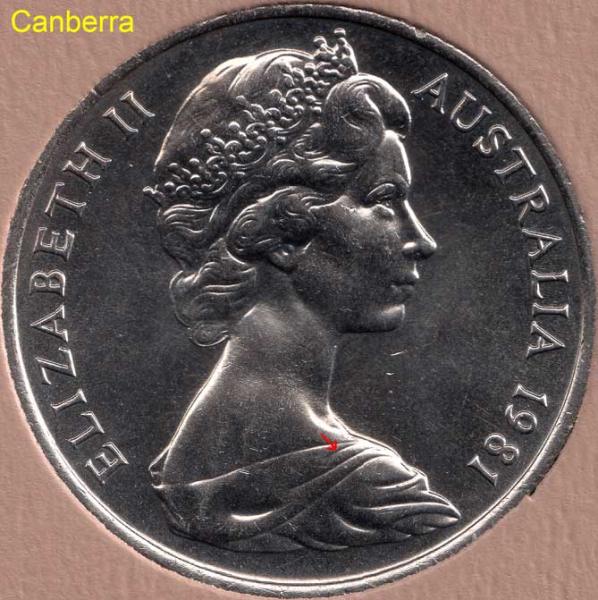 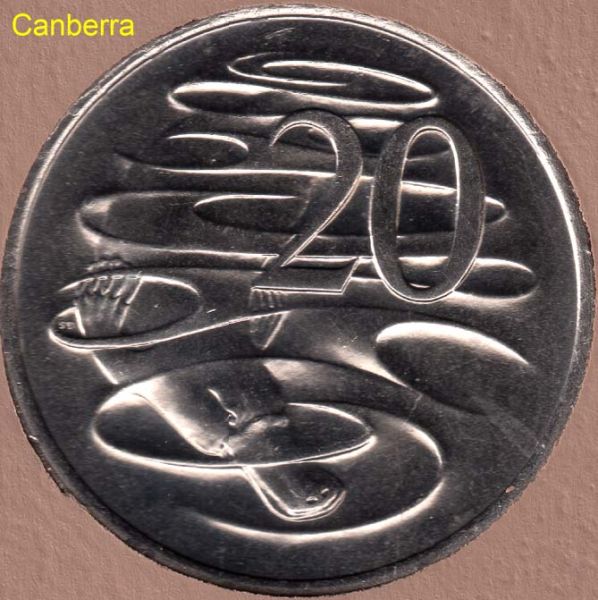 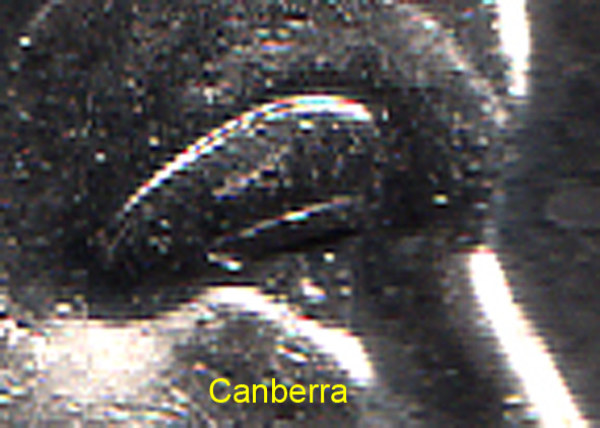 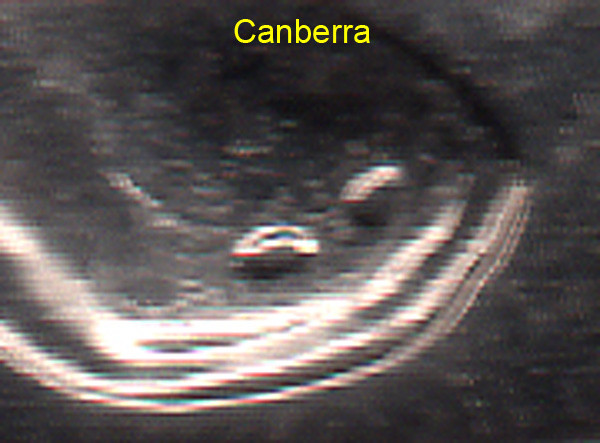 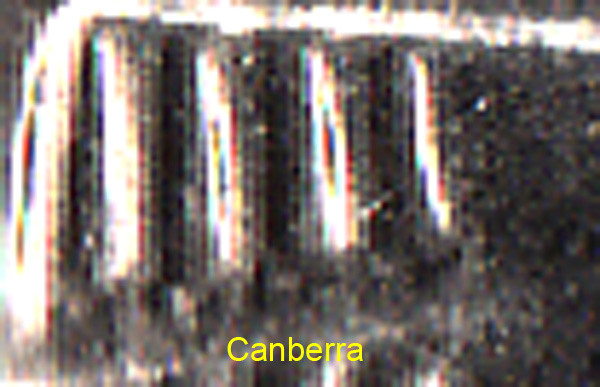 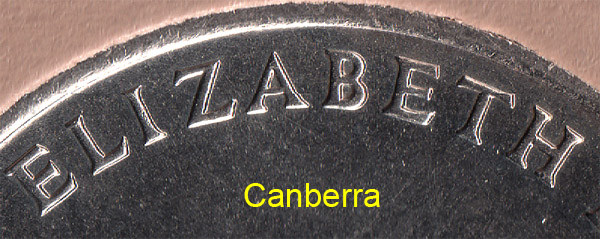 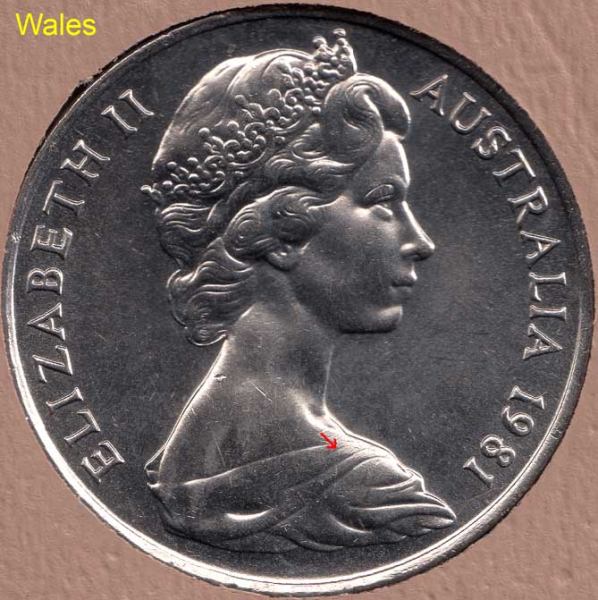 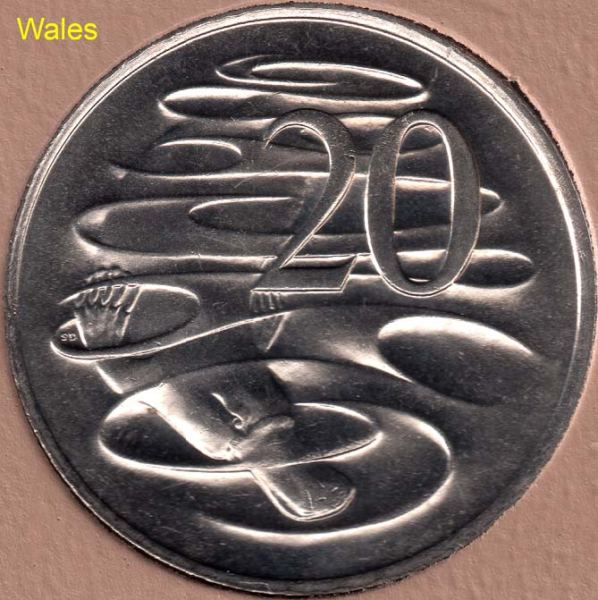 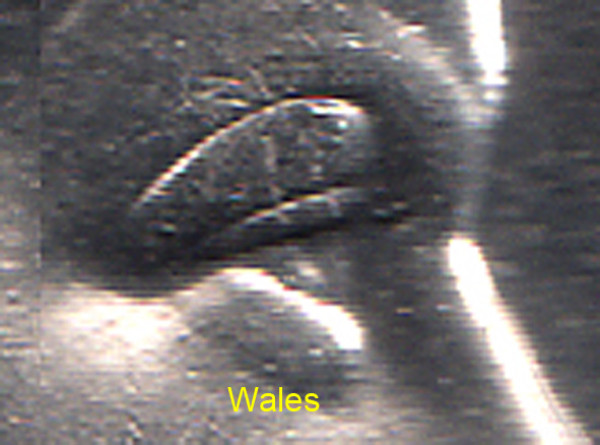 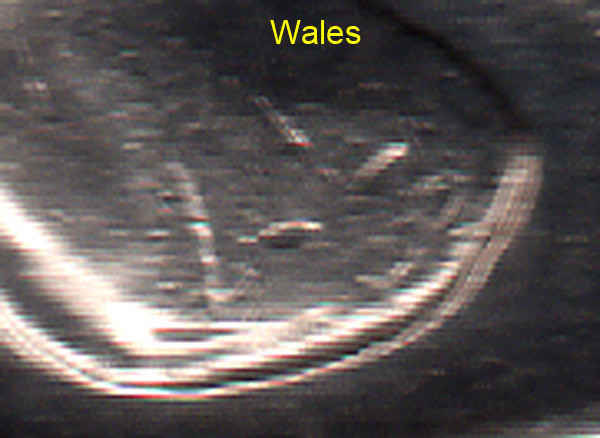 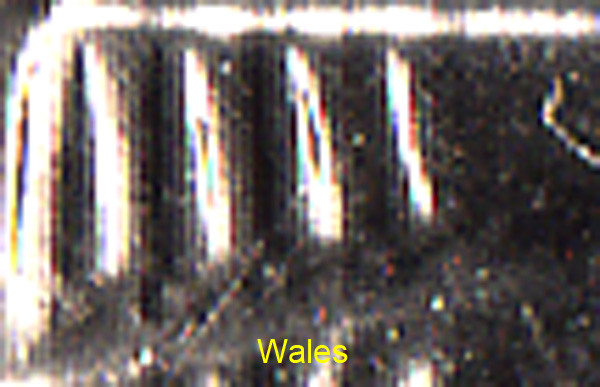 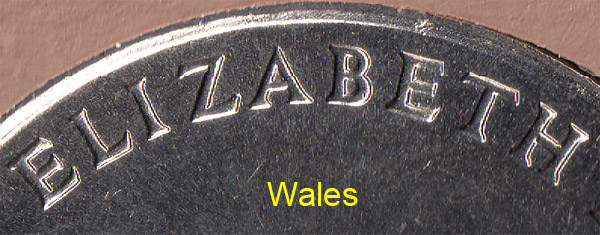 From the examples that I have access to, it seems that the coins originating in Canada also have about 4½ deeply cut eyelashes above the Queen's eyebrow whereas the Canberra coins only have about 3 or 4 weak eyelashes & in the coins that I've tentatively assigned to Wales they're very weak -- so weak in fact that they're only readily seen in relatively uncirculated coins. Just to clarify what I mean by the difference between eyelashes & eyebrow, I've included an image of a close-up of the Queen's eye on the coin from Canada where I've coloured the eyebrow yellow & the eyelashes, red. 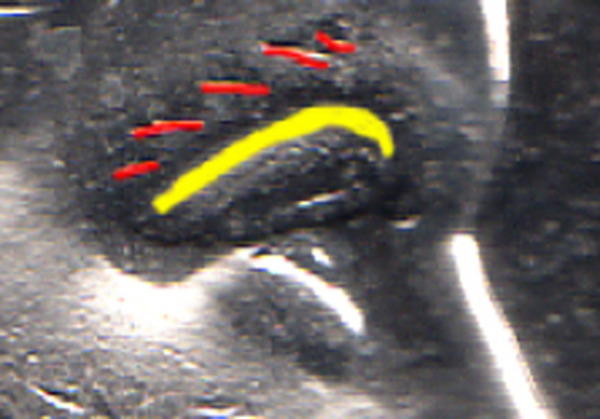 As a matter of fact the Queen of Australia only acquired a decimal eyebrow in 1968 (along with more deeply cut folds in her robes & curls in her hair) as in the previous two years her eyebrows were apparently shaven rather like the fact that she was seemingly naked on coins (et non fidei def) for the first few years of her reign but thereafter acquired a dress with shoulder straps along with taking up Henry VIII's cudgels to defensor the fidei again. In the coins I have that are definitely from the Canadian mint (3½ claws & curved base letters), it seems that the folds in the Queen's robes are even more deeply cut than in the other two mints with those supposedly from the Welsh mint being even less distinct compared to those from the Canberra mint but this might just be a factor in my samples. The red arrow in the obverse images above, points to the equivalent fold on each mint's coin. I think I can also see that the text on the coins from Canada is flatter than the text on the coins from Wales & Canberra which looks more rounded. As for the distance of the text from the rim, when I measure it on my scans between coins from different mints, which I've shown in the images below as the red line between the inner part of the rim & the letter "B" in "ELIZABETH", I find that Photoshop tells me that the distance is 10.36 units for Canberra coins, 10.10 units for Welsh coins & 8.94 units for Canada coins but I find it difficult to see any significant difference without magnification. (I'm not sure what these units are but there seems to be about 10 of them in ½ mm.) There has also been suggestion of the rim itself being different for the different mints but for me these points are too subjective or difficult to be useful as authoritative points of distinction. 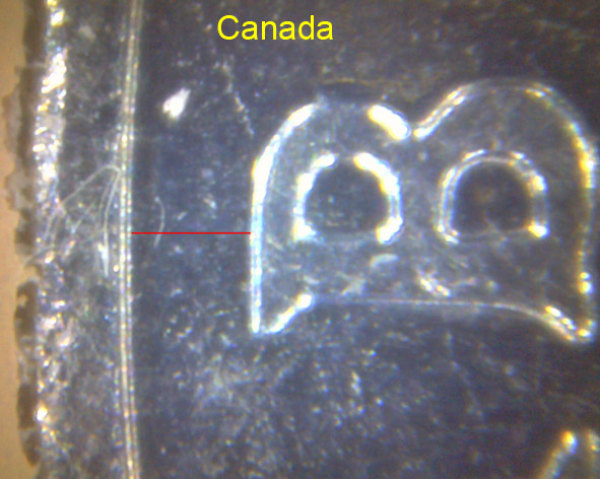 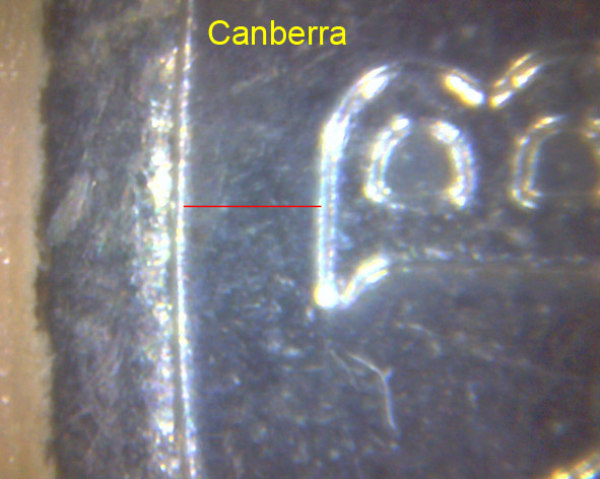 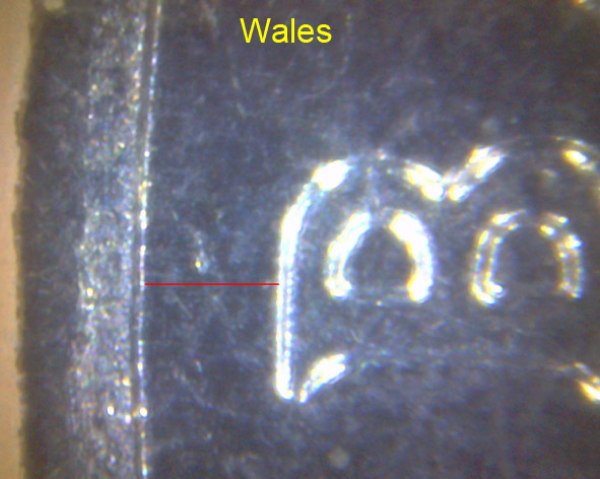 Differences between the coins from Canberra & Wales such as the sharpness of the 4th claw & variation in the SD designer's initials are also difficult for me to determine because I have very few coins that might be from the Welsh mint. I do note that eccentric's images in the "1981 20c varieties" thread found at https://goccf.com/t/93658&whichpage=3 make some of these issues clearer but I still have difficulty in determining them in the coins in front of me. So for me the only definitive point of difference to distinguish between coins from Canberra & Wales is the nostrils on the platypus. However, I can't really tell if the Welsh mint used dies that didn't have as high a relief as those used in Canberra or if the Welsh mint used a weaker striking pressure than the Canberra mint or if my so called Welsh coins are really just weak strikes from the Canberra mint. Does anyone have a better method of distinguishing Canberra coins from Welsh coins? |
|
|
|
Pillar of the Community
Australia
552 Posts |
Very nice expose I must say
My notes on 1981 20c as follows:
Canberra:
No Gap. 4 Claws. Large Open Nostrils. Text is Rounded. Strong Eyebrow Hair Lines.
Wales:
4 Claws. Small Nostrils. Text is Rounded. Weak to No Eyebrow Hair Lines.
Canada:
3.5 Claws. Large Open Nostrils. Obverse Flat Field. Obverse Lettering with Curved Bottoms. Strong Eyebrow Hair Lines.
Threfore the only diferences b/w Canberra + Wales are the nostrils and eyebrow lines
|
|
Pillar of the Community
Australia
877 Posts |
3½ claws is fairly obvious but 4 claw (Canberra) and tapered claw (Wales) differentiation is hard. A tapered claw is definitely Wales.
I first look at the claws and sort out 3½; then I view the claws on the others against the light and rock the coin in my fingers. A 4 claw will always look like 4 claws. A taped claw will look like 4 claws at one angle and 3½ at a slightly different angle -the sudden variation with the movement is quite distinct.
If you can borrow some high grade examples for practice then that makes it easier to get familiar. If the coins are too worn to be sure then set them free for, they are not worth keeping.
That's my take on one of the distinguishing features.
Jeff
Edited by Jeff
04/11/2012 02:10 am
|
|
Pillar of the Community
Australia
653 Posts |
Interesting  . I think there is an example of a "Wales" 1981 20 cent coin in my collection. The infamous "3.5 claw impostor" at https://goccf.com/t/114610Squire |
|
Valued Member
Australia
465 Posts |
<---- watching with interest. (and will be going for change 2mrw at bank)
|
|
Valued Member
 Australia
51 Posts |
Squire & Jeff,
I have a few of those "3.5 claw impostor" coins that on closer inspection really have 4 claws but I won't have a chance to look at them for a few days. I'll be interested to see the size of the nostrils on those coins. Mind you, the coin with small nostrils that I used in the post above definitely has 4 claws so probably not all Wales coins are 3.5 claw impostors & that leaves open the possibility that not all 3.5 claw impostors are Wales coins & if that's the case then we would have a non-distinguishing characteristic.
I'll let you know what I find in a few days.
|
|
Valued Member
Australia
262 Posts |
thanks for these systematic information.
|
|
Valued Member
Australia
148 Posts |
Hi great post, The eye lashes information was enlightening, It' good to distinguish the eye lashes from the eye brow line.
Just with regards to the flat vs concave planchet, It's a bit of an art but I seem to be able pick the difference pretty quickly on first sight and then verify by looking for the 3.5 claws. Because you have a flat reflective surface vs a concave reflective surface if you move the coin around while looking at it under a light there is a distinctive difference in the way the light is reflected . I can't quantify the difference but the concave planchet appears brighter at certain angles. As I said it is an art but seems to work for me.
|
|
Valued Member
Australia
51 Posts |
Thanks for that wollvend, I'll try it when I get my '81's out. Hopefully, I'll find it as easy as I do the ring test for silver coins or the cartwheel test for uncirculated coins.
|
|
Valued Member
Australia
51 Posts |
Re wollvend's test for flat VS concave planchet.I wasn't able to detect a difference in the reflectivity of the obverse fields of coins that were definitely either Canadian mint or non-Canadian mint so I guess that this is an art that must remain occult to me. BTW The wikipedia article "Australian twenty-cent coin" notes that since 1976, the Ottawa Mint only produced precious metal commemorative coins, rather like our Perth Mint, meaning the coins may have been produced at the Royal Canadian Mint's Winnipeg facilities. Also, the article states that due to differences in the milling and annealing process, the Canadian variety of the 1981 20 cent coin is distinctive because the top and bottom edges of the milling are rounded over, not squared like the other varieties, and despite being in circulation for well over 25 years, even when well worn, the fields remain shiny, and not dulled like those produced at the other mints. However, these points only help to confirm the already easily differentiated Canadian coin & don't help with my major problem which is how to irrefutably tell the difference between the Wales & Canberra coins. Re Jeff's test for 4 claws VS 3½ claw impostor to distinguish between Wales & Canberra mint.I examined 9 coins that appeared to have 3½ claws when viewed from one direction but 4 claws or a line representing a 4th claw when viewed from a different direction. These coins all had weak eyelashes & flat based obverse letters so they were definitely not from the Canadian mint. On 2 of the above 9 coins, the nostrils on the platypus had worn off but of the other 7, 6 appeared to have small nostrils but at least one definitely had deep nostrils. So from my small sample I would conclude that statistically, 3½ claw impostors may be more likely to originate in Wales but it is not a definitive characteristic & other attributes would be needed to confirm this diagnosis. You've got to ask "Why didn't they use a distinctive mint mark or feature for the Welsh coins like they did for the Canadian coins?"
|
|
Valued Member
Australia
148 Posts |
Sorry the "art" of detecting the flat vs concave planchet did't work for you. It could be just dumb luck that it works for me. I go through lot of 1981 20 cent coins and I check for flat planchet first, then the 3.5 claws and then the curve based lettering. I might start recording my hit miss ratio for the flat planchet check. It may not be the optics of the reflective properties of the different planchets I'm seeing, it could be different wearing patterns, maybe the concave planchet is a little more protected from wear and therfor has better reflective properties.
I'm guessing a bit here but will post my hit miss ratio when I compile it.
Has anyone else got a way of picking the flat vs concave planchet?
|
|
Valued Member
Canada
109 Posts |
Gents;
I found this expose and albeit very interesting I feel I must comment. In 1996 when I first found these coins I noticed them being rejected in a coke machine at Wynyard station in Sydney Australia. I took the rejected coins home and found that all 4 were 1981's. I collected several more 1981's and then noticed differences in the obverses. As they were rejected the magnetic signature is definately different. I surmized that the "Flatfield/3 1/2 claw" (as I originally called them when they were authenticated by the ACGS in Australia in 1996) variety was produced in Winnipeg but to this day can't prove it. Yes , 50 million 1981 20 cents were produced there but Can't prove the obverse dies were those that produced this coin.
J.H. From Beecroft
|
|
New Member
Australia
1 Posts |
Mate although a great post, must have taken a while, but unfortuaney you are totally wrong in identifying the mint marks/privy marks on a 1981 20c coin.
The Queens shoulder has nothing to do where the coin was minted, it actually the wave near the Platypus's nose and the gap between the nose and the wave determines where it was minted, not the queens shoulder.
Likewise with ware, the crease has nothing to do with fineness
Sorry
|
|
Moderator
 United States
196100 Posts |
14 year later. Better late than never.   to the Community, SpyCraft3r! |
| |
Replies: 13 / Views: 23,459 |
|








 Posted 04/11/2012 02:08 am


