Tonight we have a look at the 1923 half-dollar that was struck to mark the centennial of the US policy regarding European rights in the Western Hemisphere that would become known as the
Monroe Doctrine. The coin is presented via a PCGS MS-64 example.
During his annual address to Congress in December 1823, President James Monroe laid out a US policy that declared the American continents were off limits to further colonization attempts by Europe and that Europe was not to interfere in the affairs of the now independent former Spanish American colonies. At the time, the policy was not referred to as the
Monroe Doctrine, this name would only be ascribed two decades later after the policy was popularly used to support US expansion.
Read More: Commems CollectionThe coin was sponsored by the Los Angeles Clearinghouse Association and was to be a fundraiser in support of the American Historical Revue and Motion Picture Historical Exposition being held in 1923. The LA Clearinghouse Association acted on behalf of the financial backers of the Exposition.
If you are wondering about the connection between a movie exposition and one of the pillars of US policy, don't wonder too hard -- it was mostly a matter of coincidence and convenience. The Motion Picture Industry in California was in need of an image overhaul so it planned an exposition for 1923. Someone connected with the Exposition suggested a commemorative coin to help raise funds (i.e., cash in on the growing popularity of commemorative coins). An historical link of some significance would be needed to get Congress' approval of a coin. 1923 was the centennial anniversary of the
Monroe Doctrine. The rest, is history...
The coin's design features the conjoined portraits of James Monroe (rear) and John Quincy Adams (front) on its obverse and two allegorical females contorted a bit to resemble the North and South American continents of the Western Hemisphere. Adams was the Secretary of State under Monroe and played a key role in ensuring that the policy outlined above was independently declared by the US for its own interests vs. in partnership with Britain. I do find it interesting that Adams is in front while the Doctrine's namesake President takes up the rear!
There was a bit of contemporary controversy regarding the design of the coin. Chester Beach is credited with the coin's design, but, though there are differences in execution, it does appear that he may have "borrowed" the concept for the reverse from a prize-winning design by Ralph Beck which was used as the emblem for the 1901 Pan American Exposition held in Buffalo. Here's a link to nice image of Beck's design:
http://panam1901.org/panamlogo.htmBeck wrote letters to try and get credit for the reverse design, but neither the Commission of Fine Arts nor the US Mint took meaningful action on Beck's claims.
Of an authorized 300,000, the US Mint at San Francisco struck 274,000 coins for the LA Clearinghouse Association in May/June 1923. To say that sales were underwhelming would be a gross understatement. Sales through local banks and at the Exposition amounted to roughly 27,000. Rather than send the balance back to the Mint for melting, the unsold coins -- all 247,000 of them -- were released into circulation. This accounts for the large number of circulated Monroe half-dollars that can be found at every US coin show!
In hand, the coin presented is snowy white with luster that gives it an "electric" look when it is rocked back in forth. It is on my upgrade list, but as with several of my other 64's, a special coin will be needed in order for me to replace this one.
Enjoy!
1923 Monroe Doctrine Centennial -- Obverse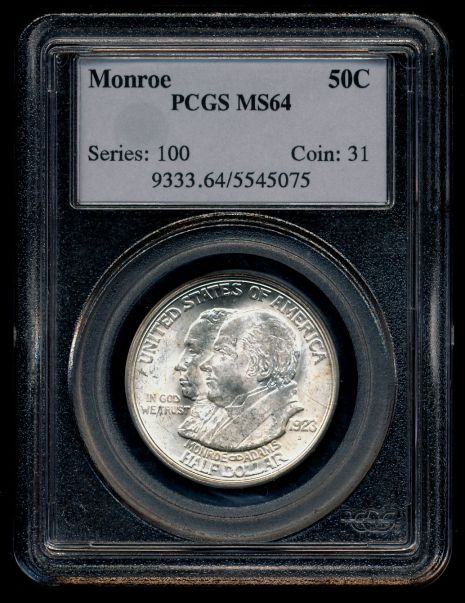 1923 Monroe Doctrine Centennial -- Reverse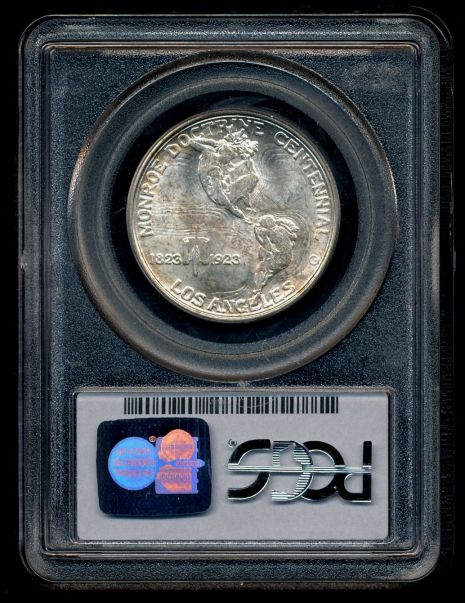







 Posted 04/23/2012 6:16 pm





