| Author |
 Replies: 273 / Views: 40,460 Replies: 273 / Views: 40,460 |
|
|
|
Bedrock of the Community
United States
10045 Posts |
Doug, that's very interesting! Probably no one on ancients knows, but I specialize in collecting overdates, but from a much later period. That is the earliest overdate I've ever seen!  I don't see many owl fourees either, but I hope to get one sometime.  |
|
Pillar of the Community
United States
3229 Posts |
Doug that is a very nice Ptolemy! Good eye appeal with an over-date! Great thread!  |
|
Pillar of the Community
United States
5010 Posts |
I'm certainly enjoying this thread.  |
|
Pillar of the Community
 United States
1549 Posts |
#13 Tiberius imitation of denarius found in India Twenty or thirty years ago I started noticing coins like #13 showing up on the market from a number of different dealers. I don't have an exact count but believe I have seen at least a dozen or maybe 20 of them. All were from the same die set but they were struck individually so the borders differ. These are not cast fakes. The silver fineness and weight are as good or better than most Tiberius denarii. The legends were copied onto the new die from, I am rather certain, one original coin that was off center losing the lower obverse legend. The cutter assumed that the border of dots went all the way around so his die has that feature but he had no idea what the missing letters should be. I prefer the theory that Indian merchants grew fond of Roman denarii received in trade but the demands for use exceeded the supply. When Nero debased the real Roman denarii, it probably became common knowledge that Tiberius coins (common because he used the type for so long) were trusted silver and this was selected as a prototype. There are many levels of imitation denarii found in India. This is the most barbarous style but among the best in terms of manufacture and silver quality. The coin was made to be spent and not to deceive.  After the initial flurry of these seen years ago, I still have seen one hit the market every five years or so. I assume those coins are resales by people who, like me, bought one of the original group. I would appreciate receiving links to any online discussions showing this coin. I have long since forgotten where I saw the others but probably still have some of the catalogs in my attic. I do not know who originated the Indian attribution and can prove nothing of the story that is related here. Barbarous coins are interesting to me but more so when they are better metal than the real thing as is this coin. It was one of my first unofficial coins and still one of my favorites (#13 or so) whatever its story. |
|
Pillar of the Community
3352 Posts |
Hmmmm, I'm not 100% positive, but I'm pretty sure that I made a similar coin in my grade three craft class? 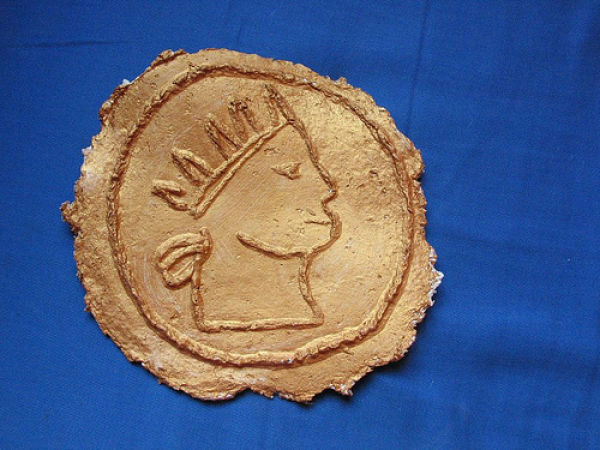 |
|
Moderator
 United States
23731 Posts |
One neat looking coin. The face looks double struck.
|
|
Pillar of the Community
United States
4253 Posts |
|
|
Bedrock of the Community
United States
10045 Posts |
 That's very interesting--I always seee something new here. |
|
Valued Member
United States
422 Posts |
Man! Doug you are a wealth of information when it comes to ancient coins. Been busy with life and haven't been keeping up with the thread. Just got back in touch and the last three coins have been totally educational and instructive! Very nice! |
|
Rest in Peace
United States
45 Posts |
" Trash is trash; if you buy it at all pay trash prices."
|
|
Pillar of the Community
United States
1549 Posts |
Yes, Randy, that is my philosophy of collecting. I see a major problem in the hobby that too many beginners get cheated by so-called dealers who take advantage of the mindset that anything 1700 years old has to be valuable. When they later discover that detail deficient slugs are not worth $19.95 + postage they might just drop the hobby or at least have the idea that the lot of us are crooks rather than firends with similar interests. When I was new to the hobby in the 1960's it was common to find dealers who were willing to give information freely and coins priced fairly rather than what the overfunded uninformed masses might pay. I'm all for paying good money for good coins but believe none of us benefit when new collectors are led to pay VF prices for culls.
|
|
Pillar of the Community
United States
1549 Posts |
#12 Hadrian fourree denarius brockage I promise this is the last plated coin in the group. I'm not saying the 11 remaining will be ordinary but they are all 'real' coins (just special and rare ones for the most part). We discussed what a fourree coin is back with #15 so we won't go through that again. However, the best reference on fourree coins (Campbell, William, Greek and Roman Plated Coins Numismatic Notes and Monographs No. 57, American Numismatic Society, 1933) discusses several techniques for the production of fourrees and introduces the idea that some fourrees were made with silver/copper eutectic (mixture of 72% silver and 28% copper) sprinkled between the copper core and the silver foil. Eutectic is that mixture of two metals which has the lowest melting point so it serves well as 'glue' making it less likely that the coin will peel. Eutectic added coins should wear through the silver rather than having the bond fail. This coin shows that well. On the reverse is a diamond shaped spot (lower inset) that shows the eutectic as a lighter silver color between the red pit and the silver surrounding silver.  A brockage is a striking error where a coin sticks in a die and is used to strike the next blank positioned between the dies. Usually the coin will stick in the upper die (usually the reverse) since it would be noticed more easily and removed from the anvil die. The result is a coin with an incuse reversed portrait instead of the normal reverse type. Brockages are not rare. We see them all the time. Fourrees are not rare either. What makes this coin special is that it is both at the same time. I have seen three or four others but this is the one I own and the one that ranks #12 on my list. |
|
Bedrock of the Community
United States
10045 Posts |
That's a very cool ancient error! It looks like the brockage of Hadrian spread out--possibly from multiple hammer strikes?  If you don't mind, I flipped the brockage to suggest how the coin spread out.  |
|
Pillar of the Community
United States
1549 Posts |
Coin metal is softer than die metal so using them as a striker will cause them to squish out an be larger and lower relief. Some show this more than others but there is usually at least some squash.
|
|
Pillar of the Community
United States
1549 Posts |
#11 Syracuse AR hemilitron 10mm 0.3g 440-430 BC (and friend) That last coin obviously bombed with the group showing that my favorite coins are not everyone's cup of tea. We will see if #11 meets more general approval. Silver coins of 5th century Syracuse are among the most popular of all 'Greek' issues (Syracuse was a Greek colonial city in Sicily). Most common are the large silver tetradrachms. I like the couple I have but they are really nothing special and did not make the top 25. Most popular are the huge decadrachms but they always sell for more than I can pay for a coin (even in poor grade). My favorite coin here could be one of two coins but I am pandering to popular opinion and selecting the one in better grade even though it is relatively massive and I like little coins. While we call Syracusan silver by the Athenian denomination names I believe the man on the street would have thought of the decadrachm as a 50 litra piece and the tetradrachm as a 20. The base unit was a litra about the same size as the Athenian obol (but, oddly, usually called litra in the trade rather than forcing the Athenian name on this one, too). Litra are relatively common.  Fractions of the litra is where things get interesting. Coin #11 is a half litra (hemilitron). It's value is clearly marked on the reverse by six dots. In several towns of the region a dot was used to indicate one uncia or 1/12 of the unit. Early Romans made them in bronze. Syracuse in the early years used silver until they finally realized that such small coins were not practical. Here we have a 6/12 piece. What makes the coin worthy of the #11 rank in my mind is the quality of the die engraving on such a small flan. The die was made in the same shop (by the same hands?) as the popular larger coins. This is 1/100 of a decadrachm. I consider the die work on the portrait truly wonderful. 6/12 coins are rather rare. I'll ask you to show me others you find illustrated online and ask how you consider mine in comparison. The difficulty you may have here might explain why I bought this coin when it became available in 2000. Its position as #11 id very precarious since all I'd have to do is get a coin of the series with finer art and smaller. Unranked but shown here is another coin of Syracuse that almost fits the bill. It is a few years earlier, several times more rare and, unfortunately, too ugly to tell just how good the die work once was. Two dots and 5mm makes it a hexas or 1/300 of a decadrachm. Unfortunately it has peeled quite a bit and fails to unseat #11 due to lack of beauty. Because of the peeling silver, the coin weighs only .05g but that is considerably less than it should in theory. On the other hand, just how exact do you expect the mint to be able to control a coin with a target weight of a hair under a tenth of a gram? While you are seeking comparison coins for the 6/12 coin, keep an eye out for other examples of the 2/12 type or anything Syracusan silver and dot denominated. I bought the hexas in 1992 and have since seen one other in a photo. I find it a bit amazing that even two coins of that size somehow managed to survive the two and a half millenia since their issue. Perhaps they do exist but are just not in demand like their big brothers. Perhaps they are all owned by people like me who like them just as small as they are so each will not be sold more than once in a generation. 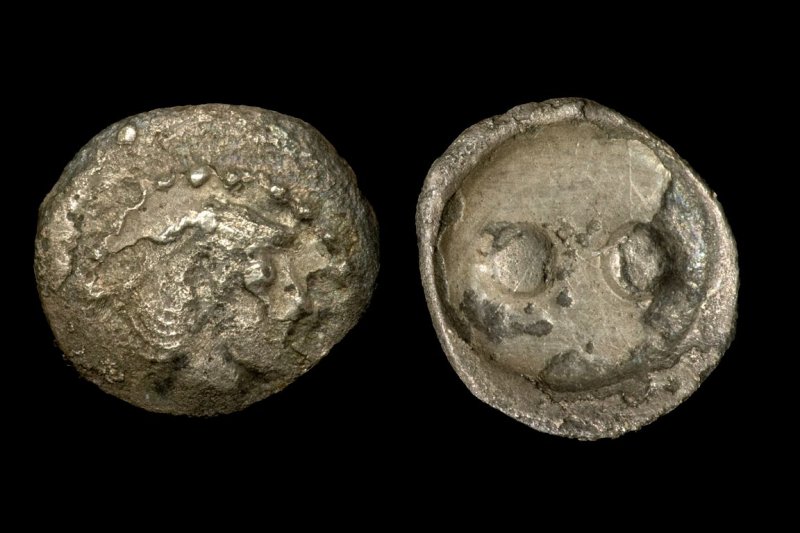 Edited by dougsmit
05/23/2012 7:21 pm
|
| |
Replies: 273 / Views: 40,460 |







 First Page
 Previous Page


 Posted 05/21/2012 10:30 am





