| Author |
 Replies: 273 / Views: 40,452 Replies: 273 / Views: 40,452 |
|
|
|
Bedrock of the Community
United States
10045 Posts |
That's quite a small coin to have that much detail. Do you suppose the portrait is of Artemis?
As we've discussed before, it's interesting to consider these small coins were carried in their mouths.
|
|
Pillar of the Community
United States
4253 Posts |
Now this is a coin I like very much. You are right about the quality of the artwork on such a small flan. Very nice Doug. This one, in particular, I am envious.  |
|
Pillar of the Community
 United States
1549 Posts |
The woman on silver of Syracuse is generally attributed to Arethusa, the nymph of the spring that brought fresh waster to Sicily. Exceptions here are coins copying Corinthian originals that show Athena.
|
|
Pillar of the Community
United States
1315 Posts |
Quote:
I find it a bit amazing that even two coins of that size somehow managed to survive the two and a half millenia since their issue It's amazing to me that the hair style on this coin is still with us today. It's really beautifully simple. I'm not sure what the Greeks called this style but I don't think it's a real common one on Greek coins. Another great coin, makes me want to collect ancients! More. Edited by Doucet
05/23/2012 8:39 pm
|
|
Pillar of the Community
3352 Posts |
dougsmit => man, you have so much coin-knowledge that nobody else can even come close to competing ... Ummm, so I thought I'd lighten it up a bit, by showing a bit of art => Alpheus in his attempt to capture Arethusa  Quote:
The myth of her transformation begins when she came across a clear stream and began bathing, not knowing it was the river god Alpheus. He fell in love during their encounter, but she fled after discovering his presence and intentions, as she wished to remain a chaste attendant of Artemis. After a long chase, she prayed to her goddess to ask for protection. Artemis hid her in a cloud, but Alpheus was persistent. She began to perspire profusely from fear, and soon transformed into a stream. Artemis then broke the ground allowing Arethusa another attempt to flee. Her stream traveled under the earth to the island of Ortygia, but Alpheus flowed through the sea to reach her and mingle with her waters |
|
Pillar of the Community
United States
3229 Posts |
Doug:) You and all of your coins rock:)  Keepem coming!  The Hadrian: Very cool! (sorry for the late comment) |
|
Pillar of the Community
United States
1549 Posts |
#10 Constantine I AE3 Roma Aeterna with R EPWC S mintmark and friend The top ten starts off with not so much a single coin but a series that appeals to me. I buy them whenever I find one with the hope someday of having the complete set. The series includes two reverse types: this unusual seated Roma and a very ordinary Vota wreath. The Roma reverses are more rarely seen. The coins were made in the name of Constantine I and Licinius I as Augusti and Caesars Crispus, Constantine II and Licinius II. What makes the series interesting to me however is the mintmark. 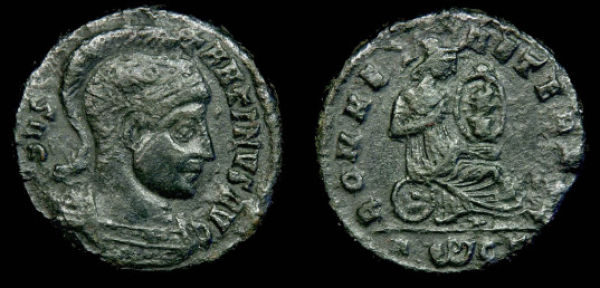 The coins were struck at Rome in 320-321 AD. The first letter of the mintmark is R for Rome. The mint then used initials P, S, T, Q for ordinals Primus. Secundus, Tertius and Quartus. The majority of these coins I have seen are a bit weak or missing on the ordinal letter. What makes the series interesting is the squiggles between the two sensible mintmark components. In Greek ligate script are the letters E (epsilon) P (rho) W (omega)and C (lunate sigma). That spells Eros - the Greek for Love. If you translate Eros into Latin you get Amor. Now if you spell Amor backwards you get Roma - the name of the mint city. Can you believe the mint officials had a sense of humor? Enough people do believe that these sell for a considerable premium over normal mintmark coins of the same types. The above would have been #13 according to my original plan but it got upgraded since I was waiting for the arrival of a coin purchased since I started this series. The Crispus below is the ordinary VOT V type so it does not supercede the Constantine but it is easily the best strike of the mintmark I have even seen. Oddly, its mintmark is supposed to end in T for Tertius but appears to be a gamma. Gamma would have the same meaning in a workshop series using Greek numerals but is out of place here. This may be an artifact of cleaning the sand patina? Selecting favorite coins is hard and it is harder to keep from being influenced by how much you had to pay for a coin. The Crispus was many times the cost of the Constantine (partly condition, partly the date acquired and partly the dealer who supplied them). I listed the Constantine first but I do really like Crispus. Be sure to post photos of your coins of this 'ERWC' series and trade me your Licinius II example (the one I'm missing). 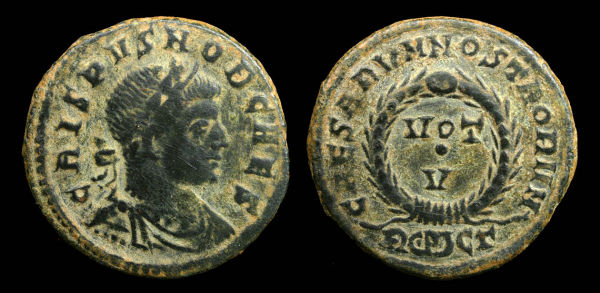 |
|
Pillar of the Community
United States
1316 Posts |
Hi Dougsmit, Great coin's, What a History lesson with every coin or coin's you post. How many coin's to make this collection and how many do you need?we have 3 guys with 500 years of experience in one of my coin clubs, you must be one of these.. great work..  |
|
Pillar of the Community
United States
4253 Posts |
Very nice Doug. I'm not certain that I've ever seen this mintmark, or, if I have, that I recognized it.
|
|
Pillar of the Community
United States
2596 Posts |
That's an interesting mint mark.
|
|
Pillar of the Community
3352 Posts |
Awesome coins ... and amazing coin-knowledge!!  => keep-up the good work!! Edit => it's not actually my dog Edited by stevex6
05/24/2012 8:12 pm
|
|
Moderator
 United States
23731 Posts |
I haven't come across this mint mark either. They must be difficult to find. I'm learning a lot from this thread.
|
|
Pillar of the Community
United Kingdom
2838 Posts |
Two very nice examples - stumbled across these mintmarks when researching other mintmark and field mark meanings a few years ago. Dont think I've seen any for sale at all in the time since! http://www.constantinethegreatcoins...NS_SPEAK.PdfAnother example in the above document, page 25 - it also talks about the temple of Venus and the temple of Roma being back to back in Rome. The author is responsible for this excelent Constantine site: http://www.constantinethegreatcoins.com/Edited by bobbyhelmet
05/24/2012 10:26 pm
|
|
Pillar of the Community
United States
1315 Posts |
That's cool bobbyhelmet. I couldn't understand the mint letters at first, especially the omega, but the link makes it clear.
Thanks for that link!
|
|
Valued Member
United States
422 Posts |
The Constantine I with the Roma reverse is very interesting. However, I really like the Crispus because of the sand patina and of course the very 'crisp' detail ... pardon the pun. Very interesting history lesson and coupled with bobbyhelmet's links, brings Constantine's reign alive. (book marked both links to study in detail)
Well done!
Keep 'em coming.
|
| |
Replies: 273 / Views: 40,452 |







 First Page
 Previous Page


 Posted 05/23/2012 7:32 pm





