| Author |
 Replies: 273 / Views: 40,450 Replies: 273 / Views: 40,450 |
|
|
|
Pillar of the Community
United States
2596 Posts |
That's good info to read.
|
|
Bedrock of the Community
United States
10045 Posts |
Quote:
That spells Eros - the Greek for Love. If you translate Eros into Latin you get Amor. Now if you spell Amor backwards you get Roma - the name of the mint city. Can you believe the mint officials had a sense of humor? Wow--that's interesting, and that's rather funny! Details like this are what make ancients so interesting.  |
|
Pillar of the Community
 United States
1549 Posts |
#9 Anonymous Pagan AE 14mm, 1.2g - Antioch/Apollo - Antioch mint workshop 9 c.311 AD I wish I were sure #9 deserves to be on this list but I can not even swear it is a coin. Part of the appeal of the Anonymous Pagan coins is how little we know about them. First, I love the fact that they did not rate coverage in either RIC, ERIC II or, for that matter, most works that are just derivative on other books. David Vagi did cover them appropriately in his book Coinage and History of the Roman Empire. Currently they are attributed to the time of Maximinus II which would place them in RIC volume VI but when that volume was written the prevailing opinion assigned them to Julian II in Volume VIII. By the time Volume VIII came out, the error was recognized but it was too late to put them in where they belonged so they do not appear in RIC. There are several rare types of Anonymous Pagan coins which will not be discussed here. There are two relatively common types (perhaps just scarce but nice ones are not easy to find) including my coin #9. The obverse shows the Genius of Antioch with a swimmer below while the reverse shows Apollo standing wearing a fancy robe. To the right of Apollo is the workshop ID Greek numeral one through ten (A-I). My coin is shop 9 which should be numeral theta but that was considered bad luck in the day so we get 5 (E) and 4 (delta) which adds up to 9. One strong argument against the Julian II attribution was that the unlucky theta replacement stopped being observed under Constantine I and other coins of Julian bear the theta. Whether or not the Maximinus II attribution is correct, the coins certainly date before theta became acceptable.  When I say I can not swear it is a coin, there has been some suggestions that the coin may have been issued with some connection to the Great Christian Persecution of c. 311 AD. Is it possible that they were tokens of compliance with the requirement for making a Pagan sacrifice? I can not see great merit in this theory (or understand it well enough to explain the though properly). For one thing, the types are hardly strong statements of Pagan positions as one might expect if the coin had been intended to be offensive to those who could not sacrifice to the emperor. I just do not know! The common types were issued from Antioch (mintmark SMA - some of the rare ones came from other Eastern mints). We do not have a certain knowledge of the denomination represented by the coin. We see suggestions like 1/4 nummus but I have not seen convincing arguments for any possibility. There is just too much about this coin we do not know. Why did I select this coin as a favorite? I like the story about why it is not in RIC showing us that experts sometimes make mistakes just like the rest of us. I like the fact that the coin does not have a portrait obverse. I have a fondness for coins with 9 (did you see question group 6 on my quiz?). http://www.forumancientcoins.com/do...th/quiz.html This example is rather nice for the type and has a much better than average strike of Apollo's robe details. Of my Anonymous Pagan coins, this is the best condition and is just plain pretty. I like the possible connection to the Great Persecution or the mystery as to why it was issued. Finally, I bought the coin from a $6 pickout junk box making this the cheapest coin in my 25. No one of these reasons could make a coin climb to #9 but when we all work together, great things are possible. For the record, the other common Pagan is Jupiter and Victory as shown below. Included in its mysteries is why the two common types from Antioch differ in the mintmark used. Here we see ANT while Apollo had SMA (sacred money of Antioch). We do not know which came first. If any of you are also collecting these, I would enjoy seeing your photos. 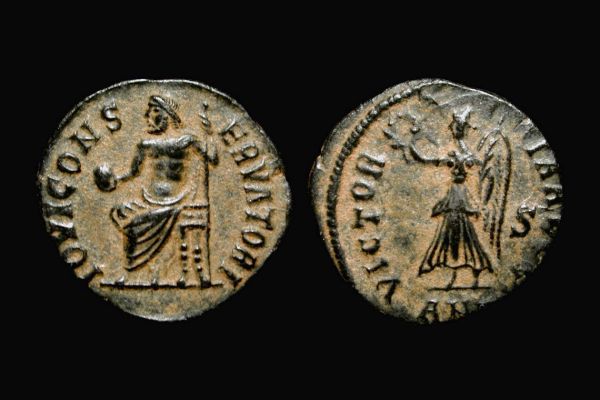 |
|
Pillar of the Community
United States
4253 Posts |
As you know I have a couple of these little gems and I'm always on the look out for others. These are very fine examples.
|
|
Pillar of the Community
United States
1549 Posts |
I was aware that this type has been discussed before here and hate to tell you that those who have known me a while either here or on another list I frequent will have seen the eight remaining coins. All 8 are on my website and 5 of them are in the head photo. After all my favorite coins should be things I have wanted to show before; or should we do "My 25 biggest mistakes?"
I'll finish the 8 for those who have not seen them but it is time for someone else out there to figure out where to go with the idea of the 'superthread' started by stevex6 and continued here if anyone really cares for the idea. The question is how this or any other group can keep it interesting and worthwhile for the regular posters and new folks that stumble in hoping to find something about their coins. Otherwise we will be down to standing around waiting for the next letter from a tourist returning from over there with fakes to show.
Who has something to show that will keep it interesting here? New thread time is coming soon.
|
|
Moderator
 United States
23731 Posts |
I am aware of the anonymous pagan issues but have never seen or come across any. Really nice to see these and to get some background on them.
|
|
Valued Member
United States
422 Posts |
There is certainly enough other threads on this forum Doug to make it interesting. But you must continue on to the end of this thread. Once again for me, the history is stellar! I look forward to your dissertation on each of the coins you present. Yes, some interest me more than others, but each on has a history lesson and the Anonymous Pagan coin you presented is no different. I know in other eras that if you just placed a pince of incense in a pot before the bust of the emperor as a god, you would be given a 'certificate' good for the year and you could go on with life. Devout Christians would not do that simply gesture and we're killed because of it. So who knows if this coin is somehow connected to that ritual? I find these threads extremely helpful to the newbies like myself and I for one would like to see the rest of the eight. Thanks for taking the time and putting the effort into this, just as Stevex did...although in a different way. Both these threads will be long remembered as something out of the ordinary! Just my opinion.
|
|
Pillar of the Community
United States
1315 Posts |
Those are both very beautiful coins. I have one similar to your Apollo except for condition of course. I looked at a number of these before I got this one and I don't think I saw any in the condition of yours. In fact I didn't know what the details on Apollo's robe were until now. The prices on these are pretty high too. This is the best one I could find for the price. I think the officina is Epsilon. I'm in awe of your #9. 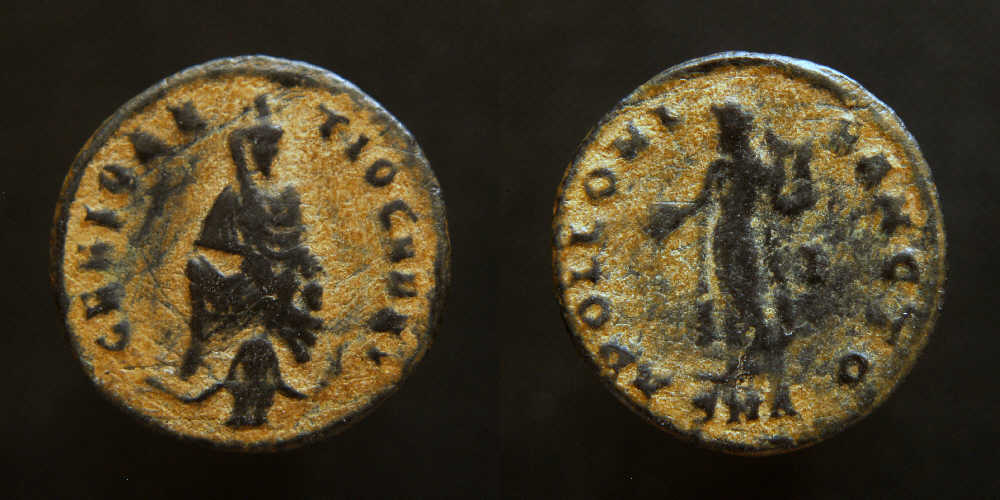 Edited by Doucet
05/26/2012 02:25 am
|
|
Pillar of the Community
United States
2044 Posts |
These coins seem to be hard to locate, even if the price is high. This is one coin that I'll be looking for later.
|
|
Pillar of the Community
3352 Posts |
Edited by stevex6
05/26/2012 08:28 am
|
|
Pillar of the Community
3352 Posts |
Quote:
A Genius has nothing to do with intellect but is rather a spirit or personal guardian Quote:
The Genius was originally one of the family spirits of the household who represented the male lineage, the 'manhood' of the family Quote:
... the Genius was seen as a spirit of some considerable importance to the household. Every man had a Genius which was given to him by birth and which stayed with him till the grave Quote:
The Genius always endeavored to guide him to happiness, because of this Romans spoke of indulging or cheating ones genius as one either enjoyed himself or failed to do so when the opportunity arose Quote:
Women had their own Genius, which was called a Juno. The Juno was the protector of women, marriage and birth Quote:
Later the Genius changed into a more general guardian spirit, the gods had a Genius and a Genius also came to protect groups of people and their places of activity such as theaters, baths, stables, streets, and markets
Example => Genio Antiocheni the Genius of the city Antioch Quote:
ORONTES was a River-God of Syria, in Western Asia.
The River Orontes flowed into the Meditteranean Sea near the city of Antiokhos (Antioch) => well, there it is, eh?
=> apparently dougsmit's coin shows the Genius of the city Antioch, with the river-god "Orontes" swimming below (that's my tid-bit of history gained due to dougsmit's thread!!) ... priceless!! |
|
Pillar of the Community
United States
1549 Posts |
Doucet: I think you are right about yours being E. That saddens me because it could be I which is one of the workshops I lack (I need S and I from Apollo and E, Z and H from Jupiter).
|
|
Pillar of the Community
United States
5010 Posts |
this coin is my favorite yet, love the obverse (couldn't figure out what in the world it was before I read the details) and love the patina...makes me think of a flavor I enjoy...  this coin just looks "delicious"! Edited by chrsmat71
05/26/2012 1:21 pm
|
|
Pillar of the Community
United States
1315 Posts |
Another picture of my coin. I never investigated the officina on this one because I didn't know much about them. It looks more like an I in hand. What do you think? 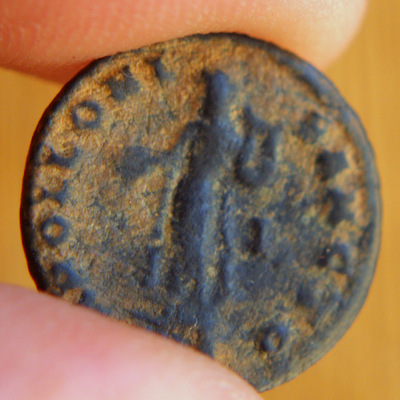 |
|
Valued Member
United States
422 Posts |
Love the sand patina on coins. This one is very sweet!
|
| |
Replies: 273 / Views: 40,450 |








 First Page
 Previous Page


 Posted 05/25/2012 12:32 pm


