| Author |
 Replies: 273 / Views: 40,464 Replies: 273 / Views: 40,464 |
|
|
|
Pillar of the Community
3352 Posts |
dougsmit => awesome turtle!! (I've never seen the turtle coin ... I love the big chunky-raised coins ... it is absolutely "beautiful") ... ... ummm, but I am a bit curious why the Greeks went for the quadripartite incuse square as a typical reverse? (it always seems like such a weak counter-punch, ya know?) For example => my previously viewed goose/lizard is also a fairly cool coin, but again the Greeks went and tossed-in a quadripartite incuse square as a chaser!! (does it have a significant meaning, or what?) ... 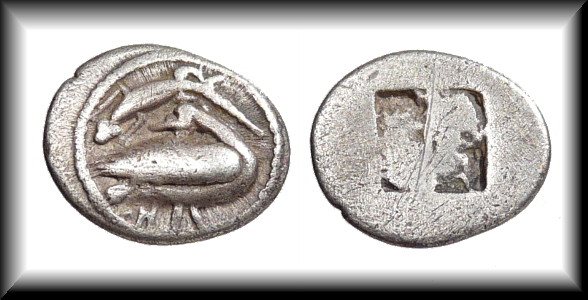 |
|
Pillar of the Community
United States
1315 Posts |
Please correct me if I'm wrong, but I think I read somewhere that the incuse on the reverse of these early coins was the mark from a devise used to hold the coin steady while the obverse image was stamped.
|
|
Pillar of the Community
 United States
1549 Posts |
We take for granted that coins have a design on both sides but in the earliest days coins had one design on one side only. The reverse was a punch designed to press the silver into the die. Some one had to 'invent' the idea of two sided coins. The Athenian owl was one of the early exceptions but many cities stuck with one sided coins probably in a 'what was good in the good old days is good now' mentality. One thing is that the punch idea made it less likely to have a weak obverse strike since the two sides were not fighting over the same metal to fill the design.
|
|
Pillar of the Community
3352 Posts |
Thanks guys => that makes good sense!!
|
|
Pillar of the Community
United States
2596 Posts |
Very nice looking silver nugget. What's the dimensions on this coin.
|
|
Bedrock of the Community
United States
10045 Posts |
The Aegina AR stater is really great!  The turtle looks part of the nugget. I had wondered about the reverse punch too, suspecting it had something to do with getting maximum relief. |
|
Pillar of the Community
United States
1315 Posts |
I was close, thanks for the clarification Doug .If only I could retain all of what I read! Poverb: 'Chelonai (turtles/tortoises) vanquish both excellence and bravery'. What the heck does that mean? Found it........ http://www.willamette.edu/cla/class...nfo/014.htmlEdited by Doucet
05/15/2012 10:59 pm
|
|
Valued Member
United States
422 Posts |
WOW! That is the most cool coin I've seen! I love the fact that it was built around a silver nugget. How do you get the value of these coins though? (ancient value) Because one would think that everyone of them weighs out differently?  Or would they just weigh several on a crude scale to get their value? Very cool coin! |
|
Pillar of the Community
United States
1549 Posts |
Just as today we have currency exchanges the ancients had the profession of moneychanger. My wife in currently on a trip in England and has paid someone to trade her some UK pounds for some (more!) US dollars. Every day the rate changes and there are people who offer different rates on the same day. I once bought a coin via email from a UK dealer and paid using a credit card. The dealer died and I never got the coin. A month later his estate returned payments on unfilled orders. Due to a change in the rates used by VISA, I ended up making $10 of the deal since the 'value' of the pound rose that month and they refunded the number of pounds I spent not the number of dollars. Locally we think of a dollar being a dollar but in a larger world sense there are changing 'values' and people who make a living keeping them in mind. If a coin was seen to be defective or light, it might be refused at full value but most were just staters.
|
|
Pillar of the Community
United States
1549 Posts |
#18 Caligula AE Sestertius 27.6g Condition is everything when it comes to pricing ancients coins. #18 is a very expensive coin in EF with well struck smooth surfaces. I feel lucky to have one in any shape. Almost all Roman sestertii have the obverse portrait of the ruler. This one does not. It is a commemorative honoring the dedication of the new temple of the divine Augustus (Caligula's grandfather). The obverse shows pietas seated while the reverse shows the temple behind a sacrifice scene with Caligula, a bull and attendants. The difference between a (relatively) bargain basement coin like mine and the best ones is in the fine details. I bought mine in 2000 because I thought it showed a lot of small details for a poor specimen that was beneath the notice of bidders in a more major sale than I usually frequented. The obverse detail of note is the small statue of a woman on which Pietas rests her elbow. The reverse temple has statues decorating the frieze and roof. If you look up this type in major sale catalogs, you will see a list identifying all those statues. On my coin you can see that something is there but you are not so sure what it is. That is the difference between a three digit and a four digit coin. It still outclasses my humble collection. High end Roman collectors often specialize in coins of the 'Twelve Caesars' but I have very few of their coins. In fact, this is the least popular sestertius of Caligula since most people would rather have his portrait and everyone wants the one honoring his three sisters. I am quite lucky to make this #18.  |
|
Pillar of the Community
3352 Posts |
Outstanding coin!!  total drooler!! ... I don't have a Caligula (yet) ... And you're correct, the super-cool part of this coin is the hidden gems (where's Waldo figures) ... extremely cool coin!!  |
|
Pillar of the Community
3352 Posts |
Curious => what is the "diameter/weight" of this gem?
|
|
Pillar of the Community
United States
1549 Posts |
I gave the weight of 27.6g but can not measure it since it resides in my bank box with most of my coins and I never found it necessary to record measurements for my catalog. I have not actually seen or touched the coin for several years. That is simultaneously the curse and the advantage of taking photos of all my coins. The only coins I actually measure are the ones that are cataloged by size (like AE26 is 26mm) or ones that are in some way odd (oval, super wide flans etc.). First century sestertii are generally pretty wide. The one below is listed at 37mm so I suspect mine is similar. http://www.acsearch.info/record.html?id=2593 |
|
Pillar of the Community
3352 Posts |
Thanks dougsmit => you gave me the basic answer => it's big heavy coin, rather than a wee lil' bit ...
|
|
Moderator
 United States
23731 Posts |
You don't see these much. Beautiful coin Doug.
|
| |
Replies: 273 / Views: 40,464 |







 First Page
 Previous Page


 Posted 05/15/2012 9:04 pm





