| Author |
 Replies: 28 / Views: 5,807 Replies: 28 / Views: 5,807 |
|
|
|
Valued Member
 United States
88 Posts |
coincollect1, glad you enjoyed the buck deer. I have to admit that I did not carve the master for that myself. I'm actually not that good... or if I was, it would have taken me a week or more. But I have managed to acquire a fairly extensive collection of vintage master hubs, the oldest dating to the late 1800s and the newest ones into the 1980s. Plus I'm learning to make them myself.
The buck deer was cloned from a hub that was probably originally created for making pocket knife scales. There's a whole series of them like that, including a horse, a bear, a wolf, and a dog. I can create a working die for one of those designs quite simply, by pressing or (as it's called in the trade) "hobbing" the master hub into a polished and annealed tool steel die blank. We're talking considerable pressure to get the steel to actually flow like that... maybe 150 tons or so. But the impression is perfect! So then the die blank is now horribly deformed from all that pressure... so the really time-consuming part of the whole thing is getting that die blank centered in the lathe such that the impression is on-center. Then cutting the collar neck, sides, and base around it. It's really a pain to get it perfect. In fact if you look at the Lincoln side of one of the bullion coins above, you can see that I didn't get it perfect, the rim is actually a little bit wider on the left side than on the right. There must be a trick that I'm not seeing.
But anyway, if that centering problem can be solved, I can hob a die like that buck deer in a matter of hours, instead of cutting it from scratch in what would end up being a matter of days. It is a hugely powerful technique, and it was this technique that permitted the explosion of coining technique in the mid 1700s, primarily radiating from the Birmingham shops of Matthew Boulton, where the technique was developed to a high level with new and more powerful presses. The so-called Conder tokens are fabulous examples of private minting from this period.
And it's this hobbing technique that is the hardest to learn because THERE ARE NO BOOKS! If I wanted to learn woodworking or machine tool design or knifemaking or blacksmithing or you name it, just about any other craft... I would be able to assemble a library on techniques and tools. But minting... not really! There's stuff designed just as background material for collectors, but nothing really geared for the hobby coinmaker! I fear that the trade secrets were kept longer in this trade than in most others, probably because most coiners are in government employ, and they don't really WANT a lot of folk knowing how easy it is!
Tom Maringer
Shire Post Mint
Edited by tmaring
05/27/2012 1:25 pm
|
|
Pillar of the Community
United States
1454 Posts |
tmaring,
I thought old Smaug died in Lake-town?
|
|
Valued Member
United States
88 Posts |
Ah yes, he DIED in Lake-town... but many townies were descended from Old Dale, which had lain in ruins for nearly two hundred years when Bilbo arrived and events were set in motion. Bard it was who slew the dragon with his last arrow as he stood upon the burning quay. And when the dragon had fallen the misery of the people was undiminished, for their town was destroyed. But as the reality of DOS settled upon them the idea came that the great treasure now lay unguarded in the mountain. But they were not the only ones to have that idea, and of course the Battle of Five Armies occurred upon the slopes of Erebor. The Dwarves were loathe to part with any of their treasure (being dwarves) but a one fourteenth share of silver wrought and unwrought was delivered unto Bard as his personal share, for being the dragonslayer. After arranging for the safety of the survivors of Lake-Town, Bard went north with those who would follow him to re-establish the old town of Dale at the foot of the mountain, the "Bardings they were later called. Now Smaug's trove was so great that even a one fourteenth share was a great hoard, so what does one do with such a wealth in silver bars? Well... Fire up the mint boys!
|
|
Pillar of the Community
United States
1454 Posts |
I just wasn't sure why Lake-town didn't get any mention since it played such a major role in The Hobbit. It's been years since I read it but I'm not sure Dale got more than a line or two in the whole novel.
|
|
Pillar of the Community
United States
511 Posts |
You make a nice looking product(love the buck design), but you're not going to get any takers if you want 45 percent of the .999 that comes in. Dealers buy odd fineness, foreign coins, sterling and scrap silver at below melt and send it off to be swapped or made into rounds and bars. Including the refining, they pay far less of a commission or fee than you want without refining the metal.
|
|
Valued Member
United States
88 Posts |
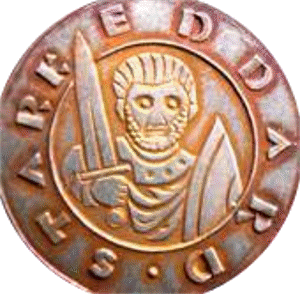
If that seems too high a cost, you can do what my friend Bill Turner does. He has a website he calls Blue Waters Mint. He comes up with really oddball fantasy places, and I make the coins for him. He sends me the silver and pays for dies, and I coin it up for him and all the coins belong exclusively to him. That way I'm not even involved in the silver except for my time, which he pays for. It comes out cheaper for him to do it that way. And it takes the risk out of it for me, so I don't have to charge extra for that. So if you check Bill's site at http://www.bluewatersmint.com/ you can see some of the pieces I've done for him... from the very ordinary modern looking Noweth Kernow silver, to the really unusual oval 22 gram silver 96 skilling from Puuviljakogursaar, and even that tiny little gold piece from Vilenjak. Then there's the pennyweight Eddard Stark pieces that I do that come in mint-sealed paper rolls of 20, so the whole little packet is one troy ounce. They're intentionally rainbow toned and styled after 13th century Germanic pfennigs of the same weight, which were in turn based upon the Roman denarius. (which is why the abbreviation for pennyweight is "dwt" not pwt. We are trying to take this premium as far as possible beyond melt value by adding a coolness factor. Edited by tmaring
06/05/2012 8:31 pm
|
|
Pillar of the Community
United States
3670 Posts |
Great relationship you guys have there an neat site.... This unique gold coin caught my eye, and the price $29.99 seems real fair for gold at first glance.... http://www.bluewatersmint.com/apps/...show/2915336Two grains. Two grains of gold for 30 bucks lol. I can buy .73 (or 3/4 a gram) Liberia 24k gold proof coins for sub 40 an free shipping sometimes on ebay so there is no way I can compute in my mind how that would be a wise purchase, but again to each their own.... That is just one example I am sure there are some better deals more accurate to the metal content.... Edited by Silverhawk74
06/05/2012 8:58 pm
|
|
Pillar of the Community
United States
3670 Posts |
Lets break that down for fun.....
So there is 480 grains in 1 troy oz., or 31.108 grams....
I would need to buy 240 of those gold coins at $30 bucks each (If the shipping was free of course), which would be 7200 bucks minus shipping again for 1 oz. of gold in that form....
Edited by Silverhawk74
06/05/2012 8:56 pm
|
|
Valued Member
United States
88 Posts |
I guess what I'm hoping to do is to understand better why coins seem so different than other items. You would never expect your clotheir to provide you a suit for the cost of the fabric, or an artist to paint your picture for the cost of paint and canvas, or to buy a car for the melt value of the metals, yet people expect to buy coins at very close to the maker's cost. As a maker-of-things this seems odd to me. In the case of the Vilenjak gold piece mentioned above. Bill sent me a one ounce Englehard bar of gold, which I then rolled out to gauge and cut up into blanks for striking. I cut the dies myself, 1/4" square design. So the entire run of 200 totals just one ounce. (yes it's actually less than the theoretical 240 pieces because there was some scraps strips at the edges and corners) The price that he's showing is retail... and includes a printed insert and the story of Vilenjak. But he also sells to dealers at wholesale so that they can then resell at retail. So a pricing structure has to be created such that there's room for dealers. If you wanted to buy say, 50 of them, (if there are that many left, they were going fast last I heard) I'm sure he'd offer you a better price.
But I'm still trying to understand the way people are thinking about these things. I mean, let's compare to banknotes for instance. Because there you've got very very low costs in materials, and even those materials (paper and ink) are not recoverable in any menaningful way if the bill is recycled. So with essentially no intrinsic value whatsoever, the ENTIRE value of the bill is represented by 1. its legally mandated exchange value, 2. its scarcity/collector value, 3. its artistic beauty/thematic interest value. So the total value is the sum of these things. We can accept the legally mandated value as the price "floor" below which it cannot go. Circulating bills can be considered to have no value other than the mandate.
Now with bullion coins we substitute "melt value" in place of a mandated value to create the floor. And the scarcity/thematic interest values add to that. In addition smaller precious metal coins generally are worth more above their melt than larger. This is not just because somebody demands it, but because buyers are generally willing to pay it.
So for custom minters such as myself, scarcity is easy... it's a simple matter to create a scarce object. But if there's no interest then scarcity means nothing. Even if there's only one in the world, it matters nought if nobody wants it. So it really comes down to the thematic content and beauty of the piece as to whether it has value above its melt. And that value will be more for some and less for others. Adam Smith's invisible hand will move some to purchase, while others will choose to allocate their resources in some other direction. Whether an item is "worth" its asking price is impossible to answer definitively... except that if people are buying then it is.
Edited by tmaring
06/06/2012 09:55 am
|
|
Pillar of the Community
United States
5904 Posts |
I would say it is the large volume Minter that have the advantage of having bought PM in wholesale prices, therefore reducing the overhead, at least that's part of the reason.
|
|
Valued Member
United States
88 Posts |
Yes exactly. Those guys are working probably in 1000 oz pours at minimum (I do 50 oz), and with rollers at least 18" wide (mine are 5"), and with feed table automatic punch presses (I feed and punch manually), and with hopper fed computer controlled hydraulic presses (mine is purely mechanical, a knuckle press modernized from steam line-shaft drive up to 10 hp. electric motor, all blank centering is manual). Those presses can run 300 strikes per minute. Mine do five to ten SPM.
But that also means that those guys don't like to change dies much. You gain in efficiency and productivity but (in general) you lose in terms of thematic authenticity and artistic appropriateness. It just depends what you want.
|
|
Pillar of the Community
United States
3670 Posts |
I don't know Tmar, why have people tried to get as much as 3K for this piece and now down less seen usually around 2 grand these days. This guy has six. Just an oz. of silver, why so special? Wolverines an endangered species people relate to, the crystal eyes, the old NY silver company style of RAISED craftsmanship with much detail is why perhaps an rarity.... Or is it just tulip in another form? Who know why one spends 2 grand for 1 troy oz., usually everyone wants it an there is not many of them as in this case. But when enough do it in masses, other feel comfortable enough to do the same an try an get a piece of the pie. This guy here may be wise to send these to 1600 starting auctions all 6 an get out while they can. The make offer is there an maybe they move them in an around that 1600 number from time to time perhaps.... http://www.ebay.com/itm/2007-MONGOL...em3cc72f3479Edited by Silverhawk74
06/06/2012 6:06 pm
|
|
Pillar of the Community
United States
5904 Posts |
There's that elegant coin with simple flow makes the Mongol crystal wolf attractive.
I find it otherwise when too many elements or symbols get into the small canvas space of a coin, it is distracting and loose point of focus. An art instructor I learned from once said: "Less is more". Very true when it comes to coin.
|
| |
Replies: 28 / Views: 5,807 |






 First Page


 Posted 05/27/2012 3:58 pm





