First Page



 Posted 06/21/2012 2:10 pm


1997 two hundred escudos.
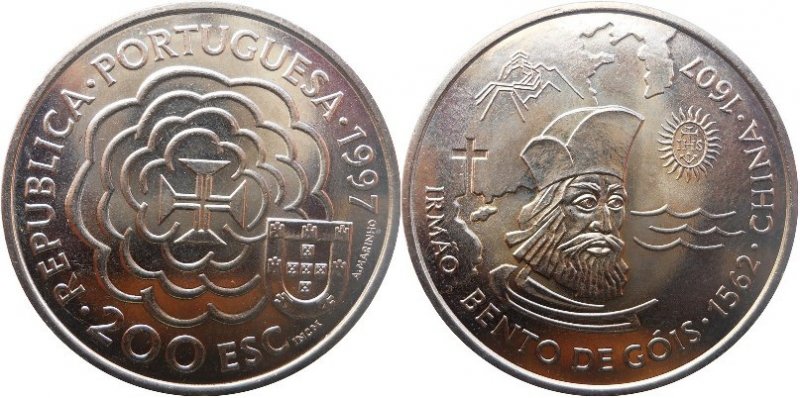
Bento de Góis, a Portuguese Jesuit Brother, Missionary and explorer. Born 1562, Azores, Portugal, died 1607, Suzhou, Gansu, China.
Góis is best remembered for his long exploratory journey through Central Asia, under the garb of an Armenian merchant, in search of the Kingdom of Cathay. Generated by accounts made by Marco Polo, and later by the claims of Ruy Gonzales de Clavijo, reports had been circulating in Europe for over three centuries of the existence of a Christian kingdom in the midst of Muslim nations. After the Jesuit missionaries, led by Matteo Ricci, had spent over 15 years in south China and finally reached Beijing in 1598, they came to strongly suspect that China is Cathay; this belief was strengthened by the fact that all "Saracen" (i.e., Central Asian Muslim) travelers whom Ricci and his companions met in China told them that they are in Cathay.
After some amount of communications between the Jesuit order's superiors in Goa and the authorities in Europe, it was decided to send an expedition overland from India to the Cathay about which visitors to the Mughals' Agra had told the Jesuits, to find out what that country really was. Góis was chosen as the most suitable person for this expedition, as a man of courage and good judgment, well familiar with the region's language and customs.
When the caravan stayed in Cialis (located in modern Mongolia) for three months Bento met with another caravan, returning from Beijing to Kashgaria. As the luck would have it, during their stay in Beijing the Kashgarians had resided at the same facility for accommodating foreign visitors where Matteo Ricci, the first Jesuit to reach the Chinese capital, had been detained for a while. The returning Kashgarians told Bento Góis what they knew about this new, unusual species of visitors to China, and even showed him a piece of scrap paper with something written in Portuguese, apparently dropped by one of the Jesuits, which they had picked as a souvenir to show to their friends back home. Góis was overjoyed, now pretty sure that the China Jesuits had been right identifying Marco Polo's Cathay as China. (from Wikipedia)
Bento de Góis, a Portuguese Jesuit Brother, Missionary and explorer. Born 1562, Azores, Portugal, died 1607, Suzhou, Gansu, China.
Góis is best remembered for his long exploratory journey through Central Asia, under the garb of an Armenian merchant, in search of the Kingdom of Cathay. Generated by accounts made by Marco Polo, and later by the claims of Ruy Gonzales de Clavijo, reports had been circulating in Europe for over three centuries of the existence of a Christian kingdom in the midst of Muslim nations. After the Jesuit missionaries, led by Matteo Ricci, had spent over 15 years in south China and finally reached Beijing in 1598, they came to strongly suspect that China is Cathay; this belief was strengthened by the fact that all "Saracen" (i.e., Central Asian Muslim) travelers whom Ricci and his companions met in China told them that they are in Cathay.
After some amount of communications between the Jesuit order's superiors in Goa and the authorities in Europe, it was decided to send an expedition overland from India to the Cathay about which visitors to the Mughals' Agra had told the Jesuits, to find out what that country really was. Góis was chosen as the most suitable person for this expedition, as a man of courage and good judgment, well familiar with the region's language and customs.
When the caravan stayed in Cialis (located in modern Mongolia) for three months Bento met with another caravan, returning from Beijing to Kashgaria. As the luck would have it, during their stay in Beijing the Kashgarians had resided at the same facility for accommodating foreign visitors where Matteo Ricci, the first Jesuit to reach the Chinese capital, had been detained for a while. The returning Kashgarians told Bento Góis what they knew about this new, unusual species of visitors to China, and even showed him a piece of scrap paper with something written in Portuguese, apparently dropped by one of the Jesuits, which they had picked as a souvenir to show to their friends back home. Góis was overjoyed, now pretty sure that the China Jesuits had been right identifying Marco Polo's Cathay as China. (from Wikipedia)
Edited by svslav
06/22/2012 1:36 pm
06/22/2012 1:36 pm