| Author |
 Replies: 20 / Views: 7,534 Replies: 20 / Views: 7,534 |
Page 2 of 2
|
|
|
|
Valued Member
United States
230 Posts |
Here's one of mine, a 50 Escudos 1968 commemorating the 500th anniversary since the birth of explorer Pedro Alvarez Cabral, who is best known for discovering Brazil.  |
|
Pillar of the Community
 United States
2605 Posts |
Nice, thanks for contributing! I'd like to add a little blurb to another coin gxseries posted above. 1993 two hundred escudos. 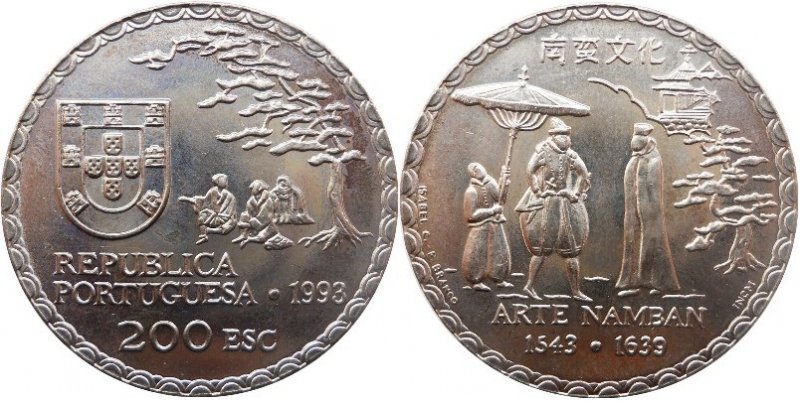 Namban Art is the designation given to an assemblage of works of art, mainly paintings, ceramic, furniture, lacquer, ornaments and cult objects produced after the arrival of the Portuguese to Japan and dating from the last half of the XVI century to the first half of the XVII century. These paintings first appeared linked to the sacred art and evangelization. Other relevant decorative works of arts are the lacquer pieces (urushi), porcelains and jewellery. Many other paintings were also produced in screens, depicting the arrival of Portuguese, vessels (Kurofune), costumes, garments and the native peoples receiving the foreign cortege. Presently, there are probably more than fifty paintings of this kind in Japan. Most paintings were made by artists of the Kano school. |
|
Pillar of the Community
United States
2605 Posts |
1988 one hundred escudos. 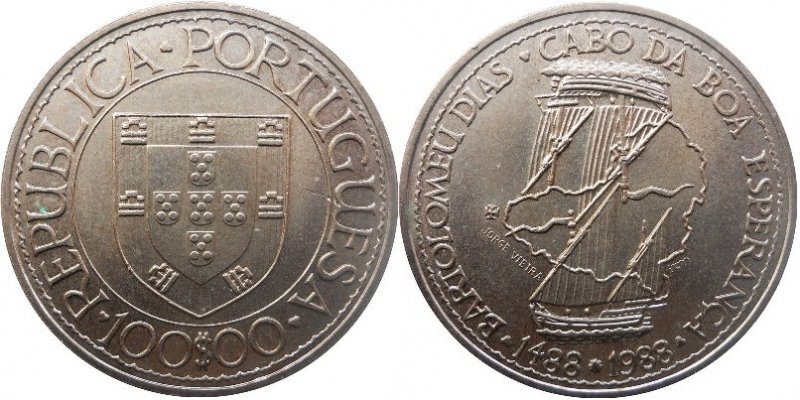 Golden age of Portuguese Discoveries series. This coin is dedicated to Bartolomeu Dias, a nobleman of the Portuguese royal household and an explorer. He sailed around the southernmost tip of Africa in 1488, the first European known to have done so. |
|
Pillar of the Community
United States
2605 Posts |
1992 two hundred escudos. 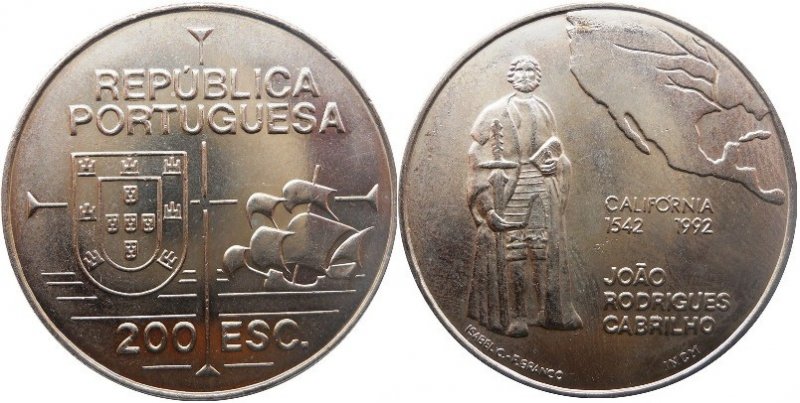 This coin commemorates Juan Rodriguez Cabrillo( 1499 -- 1543), a Portuguese explorer noted for his exploration of the west coast of North America on behalf of Spain. Cabrillo was the first European explorer to navigate the coast of present day California in the United States. He accompanied Francisco de Orozco to subdue the indigenous Mixtec people at what would eventually become the city of Oaxaca, in Mexico. On 27 June 1542, Cabrillo set out from Navidad (in Jalisco) in New Spain with three ships. On 1 August Cabrillo anchored within sight of Cedros Island. Before the end of the month they had passed Baja Point (named "Cabo del Engaño" by de Ulloa in 1539) and entered "uncharted waters, where no Spanish ships had been before". On 28 September, he landed in what is now San Diego Bay and named it "San Miguel". A little over a week later he reached Santa Catalina Island, which he named "San Salvador", after his flagship. On sending a boat to the island "a great crowd of armed Indians appeared" -- which, however, they later "befriended". Nearby San Clemente was named "Victoria", in honor of the third ship of the fleet. The next morning, October 8, Cabrillo came to San Pedro Bay, which was named "Baya de los Fumos" (English: Smoke Bay), after the burning chapperal that raised thick clouds of smoke. The following day they anchored overnight in Santa Monica Bay. Going up the coast Cabrillo saw Anacapa Island, which they learned from the Indians was uninhabited. On 18 October the expedition saw Point Conception, which they named "Cabo de Galera". The fleet spent the next week in the northern islands, mostly anchored in Cuyler Harbor, a bay on the northeastern coast of San Miguel Island. On 13 November they sighted and named "Cabo de Pinos" (Point Reyes), but missed the entrance to San Francisco Bay, something mariners would repeat for the next two centuries and more. The expedition reached as far north as the Russian River before autumn storms forced them to turn back. Coming back down the coast, Cabrillo entered Monterey Bay, naming it "Bahia de los Pinos". On 23 November 1542, the little fleet limped back to "San Salvador" (Santa Catalina Island) to overwinter and make repairs. There, around Christmas Eve, Cabrillo stepped out of his boat and splintered his shin when he stumbled on a jagged rock while trying to rescue some of his men from Chumash attack. The injury developed gangrene and he got infected. He died on 3 January 1543 and was buried. A possible head stone was later found on San Miguel Island. ( from wikipedia) |
|
Pillar of the Community
United States
2605 Posts |
1995 two hundred escudos. 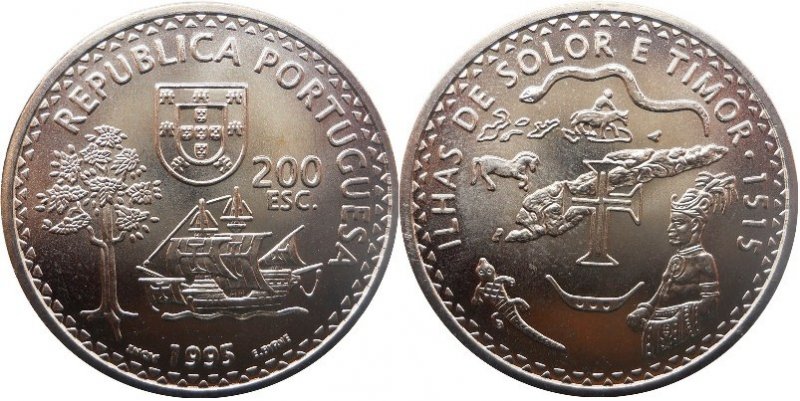 Discovery of Timor. The first Europeans to arrive in the region were Portuguese in 1515. Dominican friars established a presence on the island in 1556, and the territory was declared a Portuguese colony in 1702. Following a Lisbon-instigated decolonisation process in 1974, Indonesia invaded the territory in 1975 ending Portuguese rule. The invasion was never accepted by other countries so Portuguese Timor existed officially until independence of Timor-Leste in 2002. |
|
Pillar of the Community
United Kingdom
2932 Posts |
Thanks for posting this set of coins. They are really quite interesting and a series I knew absolutely nothing about. The "blurb" is really appreciated as it all helps with the context.
Malcolm
|
|
Moderator
 United States
14463 Posts |
Quote:
posted by vb3347
Here's one of mine, a 50 Escudos 1968 commemorating the 500th anniversary since the birth of explorer Pedro Alvarez Cabral, who is best known for discovering Brazil. I have a coin like that in my Birth Year Set. 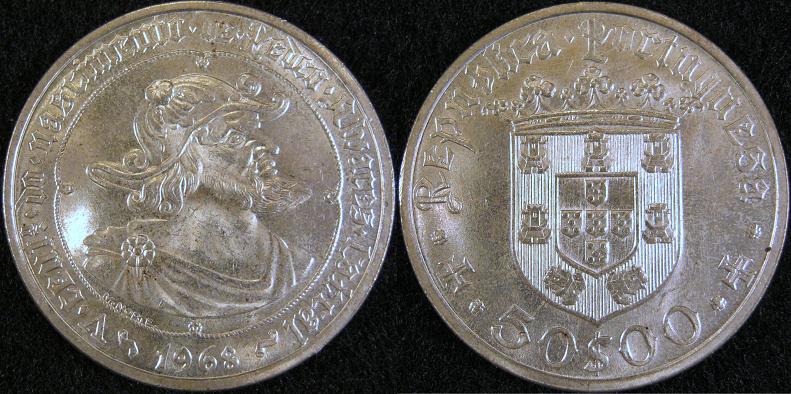 Edited by Fuzzy317
06/15/2012 04:44 am
|
|
Pillar of the Community
United States
2605 Posts |
Thanks! 1995 two hundred escudos. 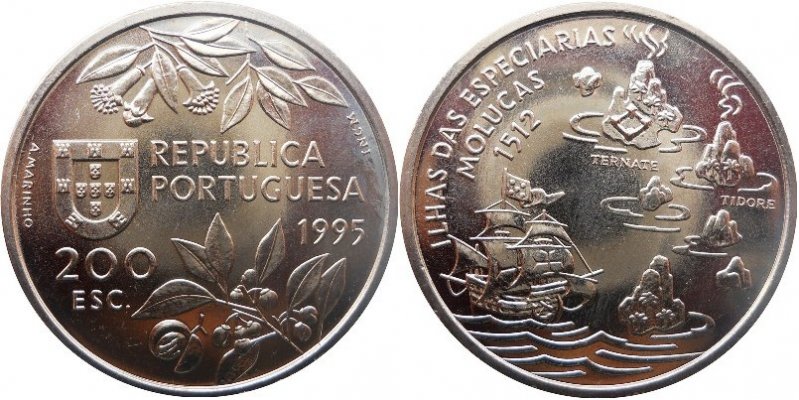 Discovery of Moluccas, the "Spice Islands", an archipelago within modern Indonesia. The native Bandanese people traded spices with other Asian nations, such as China, since at least the time of the Roman Empire. With the rise of Islam, the trade became dominated by Muslim traders, one ancient Arabic source appears to know the location of the islands, describing them as fifteen days' sail East from the 'island of Jaba' - presumably Java -- but direct evidence of Islam in the archipelago occurs only in the late 14th century, as China's interest in regional maritime dominance waned. With Muslim traders came not just Islam, but a new technique of social organisation, the sultanate, which replaced local councils of rich men (orang kaya) on the more important islands, and proved more effective in dealing with outsiders. The most significant lasting effects of the Portuguese presence was the disruption and reorganisation of the Southeast Asian trade, and in eastern Indonesia--including Maluccas -- the introduction of Christianity. The Portuguese had conquered the city state of Malacca in the early 16th century and their influence was most strongly felt in Maluccas and other parts of eastern Indonesia. Afonso de Albuquerque learned of the route to the Banda Islands and other "Spice Islands", and sent an exploratory expedition of three vessels under the command of António de Abreu, Simão Afonso Bisigudo and Francisco Serrão. On the return trip, Francisco Serrão was shipwrecked at Hitu island (northern Ambon) in 1512. There he established ties with the local ruler who was impressed with his martial skills. The rulers of the competing island states of Ternate and Tidore also sought Portuguese assistance and the newcomers were welcomed in the area as buyers of supplies and spices during a lull in the regional trade due to the temporary disruption of Javanese and Malay sailings to the area following the 1511 conflict in Malacca. The spice trade soon revived but the Portuguese would not be able to fully monopolize this trade. ( from Wikipedia) |
|
Valued Member
United States
230 Posts |
Enjoy reading these, keep 'em coming svslav!
|
|
Pillar of the Community
United States
2605 Posts |
1994 two hundred escudos. 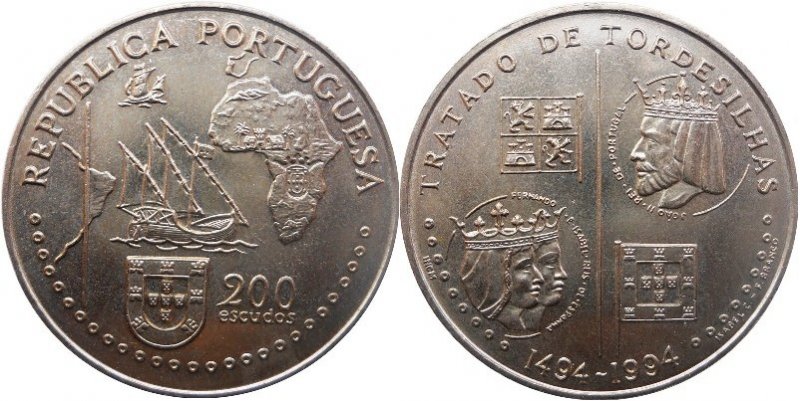 500th anniversary of the Treaty of Tordesillas, signed at Tordesillas (now in Valladolid province, Spain), 7 June 1494, which divided the newly discovered lands outside Europe between Portugal and Spain along a meridian 370 leagues west of the Cape Verde islands. This line of demarcation was about halfway between the Cape Verde Islands (already Portuguese) and the islands discovered by Christopher Columbus on his first voyage (claimed for Spain), named in the treaty as Cipangu and Antilia (Cuba and Hispaniola). The lands to the east would belong to Portugal and the lands to the west to Spain. The treaty was ratified by Spain (at the time, the Crowns of Castile and Aragon), 2 July 1494 and by Portugal, 5 September 1494. The other side of the world would be divided a few decades later by the Treaty of Zaragoza or Saragossa, signed on 22 April 1529, which specified the antimeridian to the line of demarcation specified in the Treaty of Tordesillas. Originals of both treaties are kept at the Archivo General de Indias in Spain and at the Arquivo Nacional da Torre do Tombo in Portugal. Edited by svslav
06/18/2012 2:28 pm
|
|
Pillar of the Community
United States
2605 Posts |
1996 two hundred escudos. 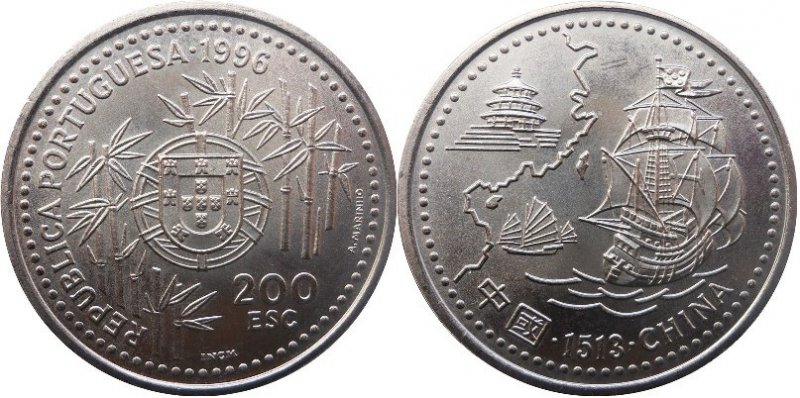 In May 1513 Jorge Álvares sailed under the Portuguese Malacca captain Rui de Brito Patalim in a fleet of junks from Pegu. Álvares made first contact on Asian soil in Guangdong, Southern China in May 1513. Upon landing, he raised a Padrão (a large stone cross inscribed with the coat of arms of Portugal that was placed as part of a land claim by numerous Portuguese explorers during the Portuguese Age of Discovery) from the king of Portugal, where they landed on Lintin Island in the Pearl River estuary. Based on information from their captain, they were to hope to find trade. Soon after this, Afonso de Albuquerque, the Viceroy of the Estado da India dispatched Rafael Perestrello, a cousin of Christopher Columbus, to seek trade relations with the Chinese. In a ship from Malacca, Rafael landed on the southern shores of Guangdong later that year in 1513, being the first to actually land on the coast of mainland China. Álvares later joined the venture of establishing the settlements in Tuen Mun, Hong Kong around 1513 to 1514. This visit was followed by the establishment of a number of Portuguese trading centres in the area, which were eventually consolidated in Macau. The first official visit of Fernão Pires de Andrade, a Portuguese merchant, pharmacist, and official diplomat, to Guangzhou (1517--1518) was fairly successful, and the local Chinese authorities allowed the embassy led by Tomé Pires, brought by de Andrade's flotilla, to proceed to Beijing. However, Fernão's brother Simão de Andrade, whose fleet came to Guangzhou in 1519, managed to quickly spoil the Sino-Portuguese relations, due to his disregard for the host country's laws and customs. Under the pretext of a threat from pirates, and without a permission from the local authorities, he built a fort in Tamão Island, behaving there as if it were Portuguese territory. (Particularly offensive to the Chinese sensibilities was his building a gallows there, and executing one of his own sailors there for some offense). He attacked a Chinese official who protested to the Portuguese captain's demands that his vessels should take precedence in trade with China before those from Asian countries. The worst, however, were his kidnappings of Chinese children and taking them abroad to be enslaved; (untrue) rumors spread that the disappearing children were cannibalized after being roasted by the Portuguese. ( from Wikipedia) Edited by svslav
06/19/2012 1:36 pm
|
|
Pillar of the Community
United States
2605 Posts |
1997 two hundred escudos. 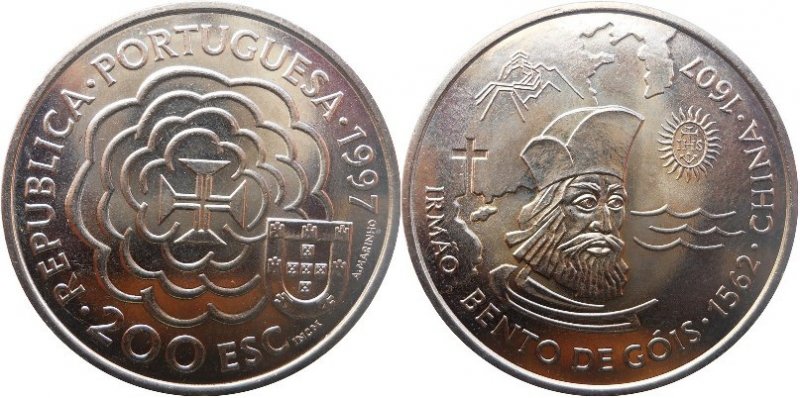 Bento de Góis, a Portuguese Jesuit Brother, Missionary and explorer. Born 1562, Azores, Portugal, died 1607, Suzhou, Gansu, China. Góis is best remembered for his long exploratory journey through Central Asia, under the garb of an Armenian merchant, in search of the Kingdom of Cathay. Generated by accounts made by Marco Polo, and later by the claims of Ruy Gonzales de Clavijo, reports had been circulating in Europe for over three centuries of the existence of a Christian kingdom in the midst of Muslim nations. After the Jesuit missionaries, led by Matteo Ricci, had spent over 15 years in south China and finally reached Beijing in 1598, they came to strongly suspect that China is Cathay; this belief was strengthened by the fact that all "Saracen" (i.e., Central Asian Muslim) travelers whom Ricci and his companions met in China told them that they are in Cathay. After some amount of communications between the Jesuit order's superiors in Goa and the authorities in Europe, it was decided to send an expedition overland from India to the Cathay about which visitors to the Mughals' Agra had told the Jesuits, to find out what that country really was. Góis was chosen as the most suitable person for this expedition, as a man of courage and good judgment, well familiar with the region's language and customs. When the caravan stayed in Cialis (located in modern Mongolia) for three months Bento met with another caravan, returning from Beijing to Kashgaria. As the luck would have it, during their stay in Beijing the Kashgarians had resided at the same facility for accommodating foreign visitors where Matteo Ricci, the first Jesuit to reach the Chinese capital, had been detained for a while. The returning Kashgarians told Bento Góis what they knew about this new, unusual species of visitors to China, and even showed him a piece of scrap paper with something written in Portuguese, apparently dropped by one of the Jesuits, which they had picked as a souvenir to show to their friends back home. Góis was overjoyed, now pretty sure that the China Jesuits had been right identifying Marco Polo's Cathay as China. ( from Wikipedia) Edited by svslav
06/22/2012 1:36 pm
|
|
Pillar of the Community
United States
2605 Posts |
1997 two hundred escudos. 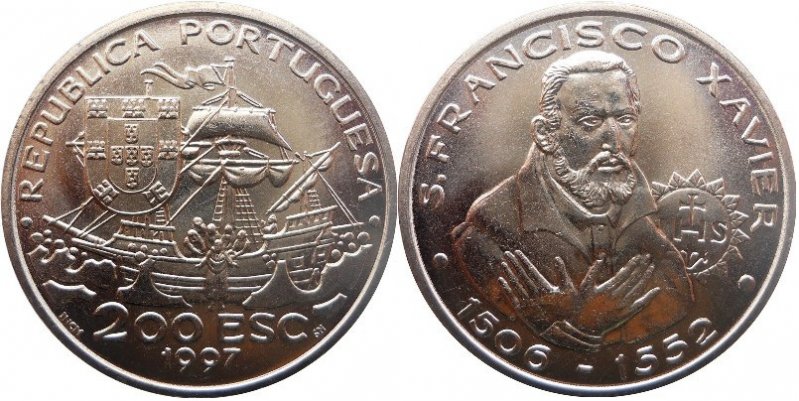 Francis Xavier, born Francisco de Jasso y Azpilicueta (1506 -- 1552) was a pioneering Roman Catholic missionary born in the Kingdom of Navarre (now part of Spain) and co-founder of the Society of Jesus. He was a student of Ignatius of Loyola and one of the first seven Jesuits, dedicated at Montmartre in 1534. Francis devoted much of his life to missions in Asia, after being appointed by King John III of Portugal to take charge as Apostolic Nuncio in Portuguese India, where the king believed that Christian values were eroding among the Portuguese. He was influential in the spreading and upkeep of Catholicism most notably in India, but also ventured into Japan, Borneo, the Moluccas, and other areas which had thus far not been visited by Christian missionaries. In these areas, being a pioneer and struggling to learn the local languages in the face of opposition, he had less success than he had enjoyed in India. It was a goal of Xavier to one day reach China. However, the government in China disliked most missionaries and many were killed. Francis Xavier is noteworthy for his missionary work, both as organizer and as pioneer. He is said to have converted more people than anyone else has done since Saint Paul. Francis Xavier is a Catholic saint. He was beatified by Paul V in 1619, and was canonized by Gregory XV in 1622. He is considered to be a patron saint of Roman Catholic missionaries in foreign lands. ( from Wikipedia) |
|
Pillar of the Community
United States
2605 Posts |
I feel that I'd like to add that while I'm enjoying these commemoratives I myself is not a big fan of Christian mission work, neither past nor present.
There's a very good novel, Things Fall Apart, by Nigerian author Chinua Achebe, an insider account of the Europeans changing the culture of a native universe. The title says it all.
|
|
Pillar of the Community
United States
2605 Posts |
1997 two hundred escudos. 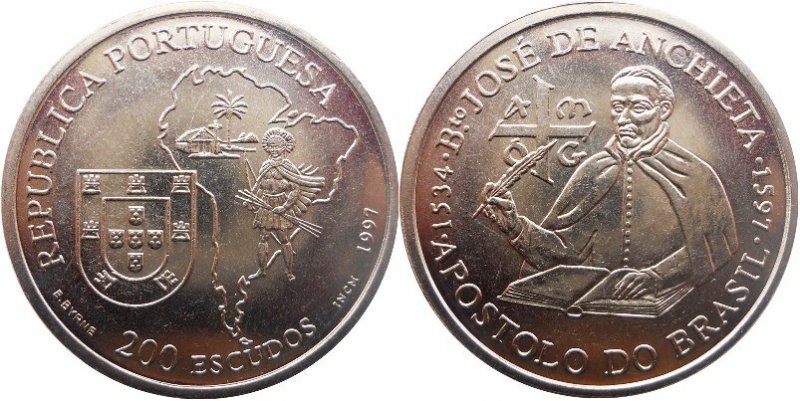 José de Anchieta (1534 -- 1597), a Spanish Jesuit missionary to Brazil. A highly influential figure in Brazil's history in the 1st century after its discovery on April 22, 1500 by a Portuguese fleet commanded by Pedro Álvares Cabral, Anchieta was one of the founders of São Paulo, in 1554, and Rio de Janeiro, in 1565. He was a writer and poet, and is considered the first Brazilian writer. Anchieta was also involved in the catechesis and conversion to the Catholic faith of the Indian population; his efforts at Indian pacification, together with another Jesuit missionary, Manuel da Nóbrega, were crucial to the establishment of stable colonial settlements in the country. |
|
Page 2 of 2
|
Replies: 20 / Views: 7,534 |
Page 2 of 2
|
To participate in the forum you must log in or register.
Disclaimer: While a tremendous amount of effort goes into ensuring the accuracy of the information contained in this site, Coin Community assumes no liability for errors. Copyright 2005 - 2026 Coin Community Family- all rights reserved worldwide. Use of any images or content on this website without prior written permission of Coin Community or the original lender is strictly prohibited.
Contact Us | Advertise Here | Privacy Policy / Terms of Use
|
| Coin Community Forum |
© 2005 - 2026 Coin Community Forums |
| It took 0.46 seconds to rattle this change. |
 |
|








 First Page


 Posted 06/05/2012 12:46 am


