| Author |
 Replies: 20 / Views: 7,535 Replies: 20 / Views: 7,535 |
|
Pillar of the Community
United States
2605 Posts |
I have an interesting series of Portuguese commemorative coins dedicated to their discoveries and world exploration and, of course, colonization. I'll be posting a coin at a time, kind of like Bacchus' "Daily Czech". If anybody else has an interesting Portuguese coin or a colonial one feel free to share, I don't have to hold a monopoly on the topic.  I will start with a coin which stumped the "Guess this" crowd, 1996 two hundred escudos. 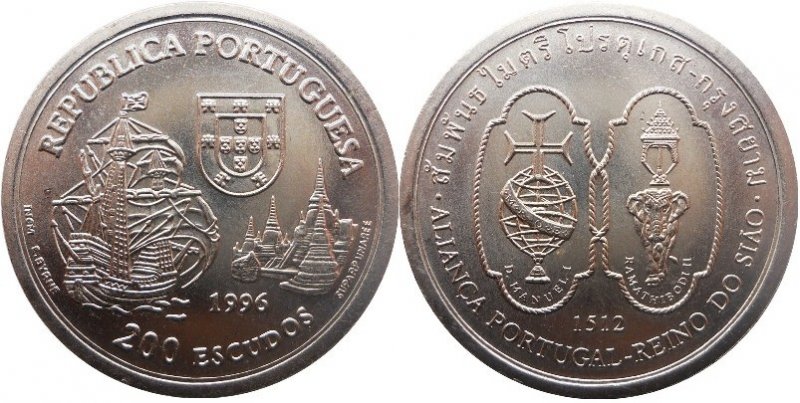 It commemorates 1512 Portugal - Siam alliance. I haven't been able to find much info on this, but it seems that while Portugal was doing some colonization in the region (particularly Malacca and East Timor in 1511 - 1512), they found the kingdom of Siam a power to reckon with, and instead of trying to subdue them Portugal formed an alliance. |
|
|
|
Pillar of the Community
 United States
2605 Posts |
Next coin depicts the "reversed exploration". 1993 two hundred escudos. 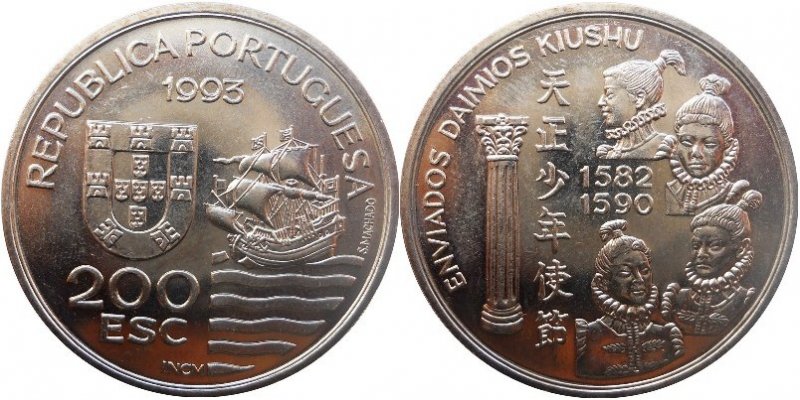 The coin features The Japanese Mission to Europe, 1582--1590. Following the pioneering work of Francis Xavier in establishing Christianity in Japan, in early 1581, Alessandro Valignano decided to send a legation to Europe representing the three Christian daimyo of Kyushu. The purpose of this mission was twofold. It would give Europeans the chance of seeing Japanese people at first hand and appreciating their culture; in this way the expedition would publicize the work of the Japanese Church and increase financial aid from Europe. Conversely, on their return to Japan the envoys would give to their fellow countrymen eyewitness reports on the splendours of Renaissance Europe, thus broadening the Japanese view of the outside world and moderating existing notions about foreign barbarians. It might benefit the impoverished Japanese mission financially and thus promote its expansion. Two Christian samurai boys were chosen as legates together with two teenage companions, and they sailed from Nagasaki in February 1582. After a journey lasting more than two years, the foursome reached Europe and began travelling through Portugal, Spain and Italy. They met King Philip II and his family several times, and in Rome were befriended by the elderly Pope Gregory XIII and his successor Sixtus V. During their progress through Italy the Japanese were lavishly welcomed with speeches, banquets, balls and spectacular firework displays; large crowds gathered to see them solemnly process through the streets, while church bells rang out and cannon fired in salute. The authorities in Venice even postponed the annual festival in honour of St Mark, the city's patron, so that the Japanese might view the spectacle. |
|
Pillar of the Community
Australia
3841 Posts |
My partial coin collection http://www.omnicoin.com/collection/gxseriesMy numismatics articles and collection: http://www.gxseries.com/numis/numis_index.htmRegularly updated at least once a month. |
|
Pillar of the Community
United States
2605 Posts |
Oh, good, I'm not talking to myself anymore. I don't have the first one of your three, gx.
That coin commemorates Portuguese arrival at Tanegashima, an island in southern Japan.
This island is celebrated as the site of the first known contact of Europe and the Japanese, in 1543. A Ryukyuan trading post had been established there several decades earlier, and all traffic from the Ryukyus to Kagoshima on Kyushu, in southern Japan, was obliged to pass through this station. Thus it was that the Portuguese ship, having been blown off course from China to Okinawa made their way to Tanegashima, and not directly to Japan proper.
Until modern times, firearms were colloquially known in Japan as "Tanegashima", due to the belief that they were introduced by the Portuguese onboard that ship.
Edge tools (particularly knives and scissors) made in Tanegashima are famous traditional handicrafts in Japan. Since 1543, when firearms were introduced, ironworking craftsmen on Tanegashima expanded their original techniques to include the creation of high quality firearms.
Edited by svslav
06/03/2012 12:16 pm
|
|
Valued Member
United States
154 Posts |
Wow! I'll have to add those to my list of bilingual coins I'd like to get. These coins are EXACTLY why I love coin collecting. Such a great way to explore history. Thank you so much for sharing =-)
|
|
Moderator
 United States
23731 Posts |
Interesting series, very nice coins.
|
|
Valued Member
United States
230 Posts |
Here's one of mine, a 50 Escudos 1968 commemorating the 500th anniversary since the birth of explorer Pedro Alvarez Cabral, who is best known for discovering Brazil.  |
|
Pillar of the Community
United States
2605 Posts |
Nice, thanks for contributing! I'd like to add a little blurb to another coin gxseries posted above. 1993 two hundred escudos. 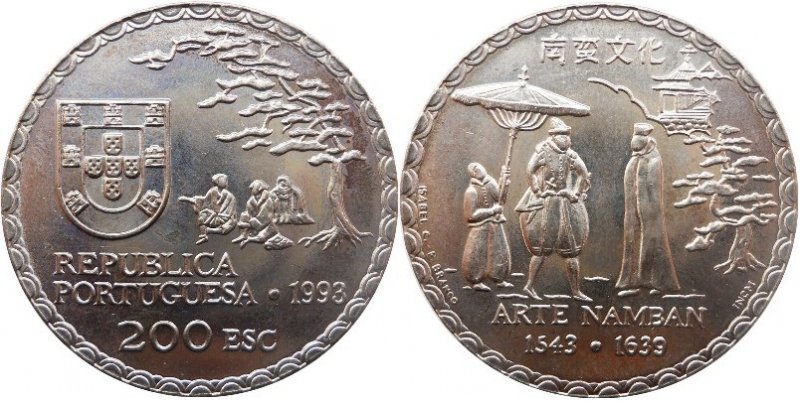 Namban Art is the designation given to an assemblage of works of art, mainly paintings, ceramic, furniture, lacquer, ornaments and cult objects produced after the arrival of the Portuguese to Japan and dating from the last half of the XVI century to the first half of the XVII century. These paintings first appeared linked to the sacred art and evangelization. Other relevant decorative works of arts are the lacquer pieces (urushi), porcelains and jewellery. Many other paintings were also produced in screens, depicting the arrival of Portuguese, vessels (Kurofune), costumes, garments and the native peoples receiving the foreign cortege. Presently, there are probably more than fifty paintings of this kind in Japan. Most paintings were made by artists of the Kano school. |
|
Pillar of the Community
United States
2605 Posts |
1988 one hundred escudos. 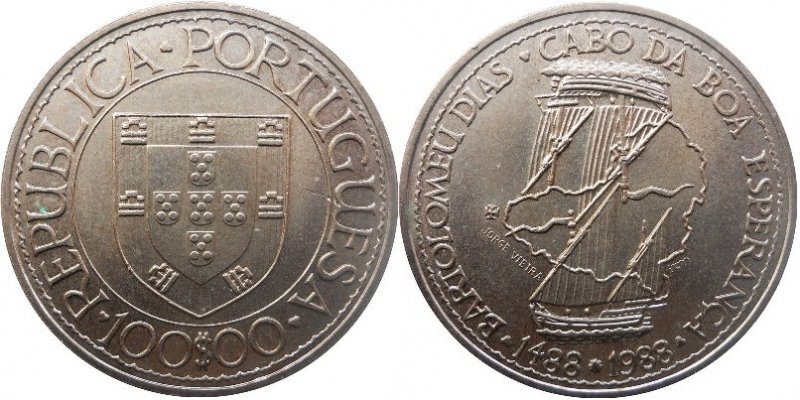 Golden age of Portuguese Discoveries series. This coin is dedicated to Bartolomeu Dias, a nobleman of the Portuguese royal household and an explorer. He sailed around the southernmost tip of Africa in 1488, the first European known to have done so. |
|
Pillar of the Community
United States
2605 Posts |
1992 two hundred escudos. 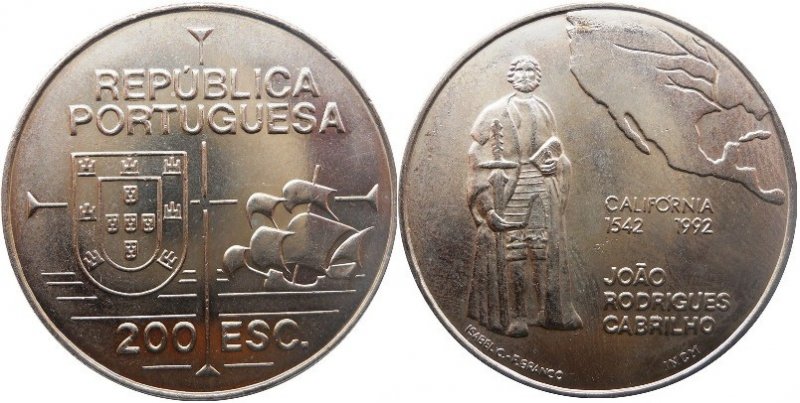 This coin commemorates Juan Rodriguez Cabrillo( 1499 -- 1543), a Portuguese explorer noted for his exploration of the west coast of North America on behalf of Spain. Cabrillo was the first European explorer to navigate the coast of present day California in the United States. He accompanied Francisco de Orozco to subdue the indigenous Mixtec people at what would eventually become the city of Oaxaca, in Mexico. On 27 June 1542, Cabrillo set out from Navidad (in Jalisco) in New Spain with three ships. On 1 August Cabrillo anchored within sight of Cedros Island. Before the end of the month they had passed Baja Point (named "Cabo del Engaño" by de Ulloa in 1539) and entered "uncharted waters, where no Spanish ships had been before". On 28 September, he landed in what is now San Diego Bay and named it "San Miguel". A little over a week later he reached Santa Catalina Island, which he named "San Salvador", after his flagship. On sending a boat to the island "a great crowd of armed Indians appeared" -- which, however, they later "befriended". Nearby San Clemente was named "Victoria", in honor of the third ship of the fleet. The next morning, October 8, Cabrillo came to San Pedro Bay, which was named "Baya de los Fumos" (English: Smoke Bay), after the burning chapperal that raised thick clouds of smoke. The following day they anchored overnight in Santa Monica Bay. Going up the coast Cabrillo saw Anacapa Island, which they learned from the Indians was uninhabited. On 18 October the expedition saw Point Conception, which they named "Cabo de Galera". The fleet spent the next week in the northern islands, mostly anchored in Cuyler Harbor, a bay on the northeastern coast of San Miguel Island. On 13 November they sighted and named "Cabo de Pinos" (Point Reyes), but missed the entrance to San Francisco Bay, something mariners would repeat for the next two centuries and more. The expedition reached as far north as the Russian River before autumn storms forced them to turn back. Coming back down the coast, Cabrillo entered Monterey Bay, naming it "Bahia de los Pinos". On 23 November 1542, the little fleet limped back to "San Salvador" (Santa Catalina Island) to overwinter and make repairs. There, around Christmas Eve, Cabrillo stepped out of his boat and splintered his shin when he stumbled on a jagged rock while trying to rescue some of his men from Chumash attack. The injury developed gangrene and he got infected. He died on 3 January 1543 and was buried. A possible head stone was later found on San Miguel Island. ( from wikipedia) |
|
Pillar of the Community
United States
2605 Posts |
1995 two hundred escudos. 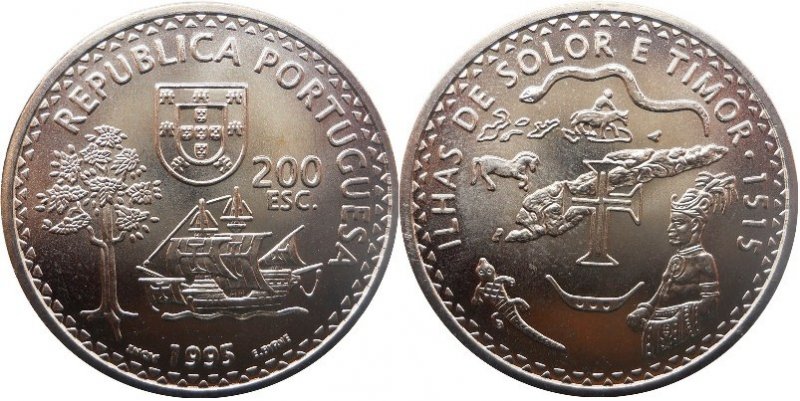 Discovery of Timor. The first Europeans to arrive in the region were Portuguese in 1515. Dominican friars established a presence on the island in 1556, and the territory was declared a Portuguese colony in 1702. Following a Lisbon-instigated decolonisation process in 1974, Indonesia invaded the territory in 1975 ending Portuguese rule. The invasion was never accepted by other countries so Portuguese Timor existed officially until independence of Timor-Leste in 2002. |
|
Pillar of the Community
United Kingdom
2932 Posts |
Thanks for posting this set of coins. They are really quite interesting and a series I knew absolutely nothing about. The "blurb" is really appreciated as it all helps with the context.
Malcolm
|
|
Moderator
United States
14463 Posts |
Quote:
posted by vb3347
Here's one of mine, a 50 Escudos 1968 commemorating the 500th anniversary since the birth of explorer Pedro Alvarez Cabral, who is best known for discovering Brazil. I have a coin like that in my Birth Year Set. 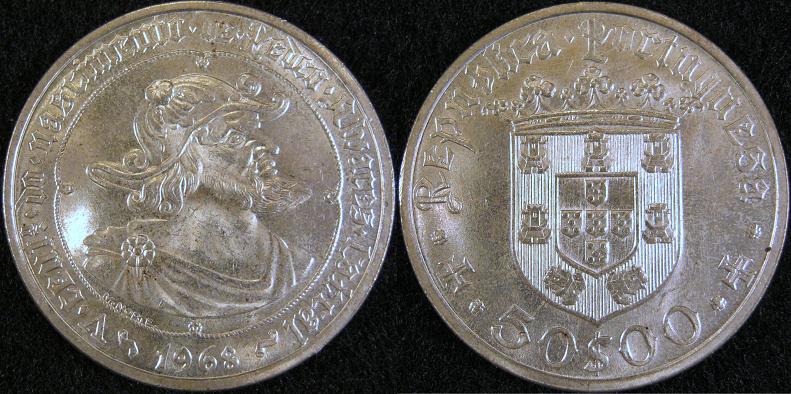 Edited by Fuzzy317
06/15/2012 04:44 am
|
|
Pillar of the Community
United States
2605 Posts |
Thanks! 1995 two hundred escudos. 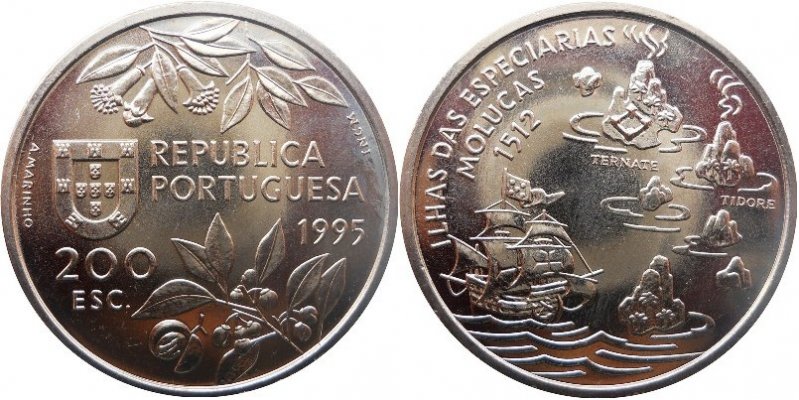 Discovery of Moluccas, the "Spice Islands", an archipelago within modern Indonesia. The native Bandanese people traded spices with other Asian nations, such as China, since at least the time of the Roman Empire. With the rise of Islam, the trade became dominated by Muslim traders, one ancient Arabic source appears to know the location of the islands, describing them as fifteen days' sail East from the 'island of Jaba' - presumably Java -- but direct evidence of Islam in the archipelago occurs only in the late 14th century, as China's interest in regional maritime dominance waned. With Muslim traders came not just Islam, but a new technique of social organisation, the sultanate, which replaced local councils of rich men (orang kaya) on the more important islands, and proved more effective in dealing with outsiders. The most significant lasting effects of the Portuguese presence was the disruption and reorganisation of the Southeast Asian trade, and in eastern Indonesia--including Maluccas -- the introduction of Christianity. The Portuguese had conquered the city state of Malacca in the early 16th century and their influence was most strongly felt in Maluccas and other parts of eastern Indonesia. Afonso de Albuquerque learned of the route to the Banda Islands and other "Spice Islands", and sent an exploratory expedition of three vessels under the command of António de Abreu, Simão Afonso Bisigudo and Francisco Serrão. On the return trip, Francisco Serrão was shipwrecked at Hitu island (northern Ambon) in 1512. There he established ties with the local ruler who was impressed with his martial skills. The rulers of the competing island states of Ternate and Tidore also sought Portuguese assistance and the newcomers were welcomed in the area as buyers of supplies and spices during a lull in the regional trade due to the temporary disruption of Javanese and Malay sailings to the area following the 1511 conflict in Malacca. The spice trade soon revived but the Portuguese would not be able to fully monopolize this trade. ( from Wikipedia) |
|
Valued Member
United States
230 Posts |
Enjoy reading these, keep 'em coming svslav!
|
|
Pillar of the Community
United States
2605 Posts |
1994 two hundred escudos. 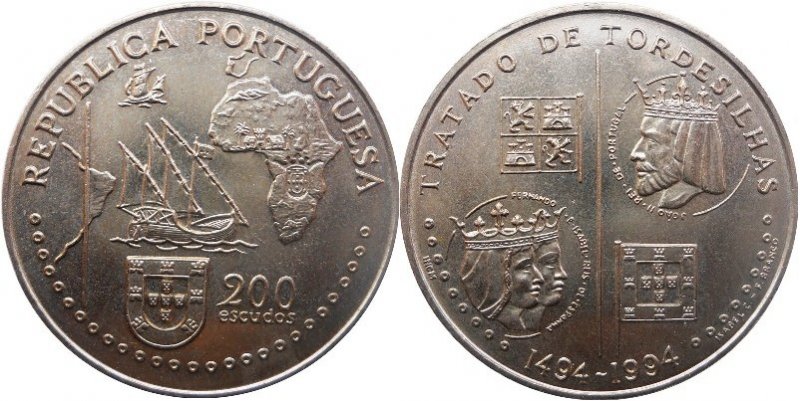 500th anniversary of the Treaty of Tordesillas, signed at Tordesillas (now in Valladolid province, Spain), 7 June 1494, which divided the newly discovered lands outside Europe between Portugal and Spain along a meridian 370 leagues west of the Cape Verde islands. This line of demarcation was about halfway between the Cape Verde Islands (already Portuguese) and the islands discovered by Christopher Columbus on his first voyage (claimed for Spain), named in the treaty as Cipangu and Antilia (Cuba and Hispaniola). The lands to the east would belong to Portugal and the lands to the west to Spain. The treaty was ratified by Spain (at the time, the Crowns of Castile and Aragon), 2 July 1494 and by Portugal, 5 September 1494. The other side of the world would be divided a few decades later by the Treaty of Zaragoza or Saragossa, signed on 22 April 1529, which specified the antimeridian to the line of demarcation specified in the Treaty of Tordesillas. Originals of both treaties are kept at the Archivo General de Indias in Spain and at the Arquivo Nacional da Torre do Tombo in Portugal. Edited by svslav
06/18/2012 2:28 pm
|
| |
Replies: 20 / Views: 7,535 |










 Posted 06/03/2012 11:25 am


