| Author |
 Replies: 40 / Views: 4,915 Replies: 40 / Views: 4,915 |
|
Pillar of the Community
United States
5155 Posts |
All, Just arrived today, and again very pleased. This is my first coin of the Kingdom of Parthia. The name comes from Latin and means "Old Persia". They were located in what is now Iran. A rival of Rome. The Parthian civilization is shrouded in mystery, no known literature survives of them. The first evidence of a Parthia dates back to the about 1000 BC. at different points in time the ruled over much of Mesopotamia and the Modern Persian Gulf Region, East to Afghanistan. There civilization fought numerous battles from Nomads in the North and East to the Seleucids in Syria and the Romans from the West. Eventually Parthia would fall to their very own kinsman the Persian Sassanian peoples, who attacked from the South and succeed in vanquishing them in 224 AD, Having been crippled by internal strife and the series of invasion by the Roman Emperor Trajan. To some point Hellenistic culture prospered here, evident from Greek script surviving on their coins. They amassed great wealth from the taxation proceeds of the Silk Road which traveled throughout there territory East to India. With credit to Wikipedia and Titus Flavius Josephus 37-100 AD also called Joseph ben Matityahu "Gotarzes then added to his coins the usual Parthian titles, "king of kings Arsaces the benefactor, the just, the illustrious (Epiphanes), the friend of the Greeks (Philhellen)", without mentioning his proper name." This guy was a real sicko...he also had his whole family killed.. The specific dating of the coins is rather difficult to comprehend, they dated their coins according to the Babylonian calender but wrote the date in Greek and thus measured time based on the Seleucid system. For example...and I am taking the inscription information from a much nicer coin then my own but mine appears the same),...this coin would read Inscription on left read from outside. Between the heads of Tyche and the king Greek numeral Î-ΝΤ, year 357 of the Seleucid era (A.D. 45/46). Outer line of inscription at bottom, which is read from outside and carries month, is partially off flan, probably reads [Π]Î'ΝÎ- [ΜΟΥ] (June, A.D. 46). with credit to.. http://www.parthia.comHere is my coin... Kingdom of Parthia, Seleucia Gotarzes II 40-51 AD AR 26mm Tetradrachm 13.87g Obverse: Diademed Head of Gotarzes II Left Reverse: Tyche Presenting Diadem to Gotarzes II? [Î'Î'ΣΙΛΕΩΣ Î'Î'ΣΙΛΕΩΝ] / Î'ΡΣÎ'[ΚΟΥ] ΕΥΕΡÎ"Ε[ΤΟΥ] / Î"ΙΚÎ'ΙΟΥ / ΕΠΙΦÎ'ΝΟ[ΥΣ ΦΙΛΕ]ΛΛÎ- Ν[ΟΣ] reference: Sellwood 65.4 Enjoy every one...any addition would be appreciated... 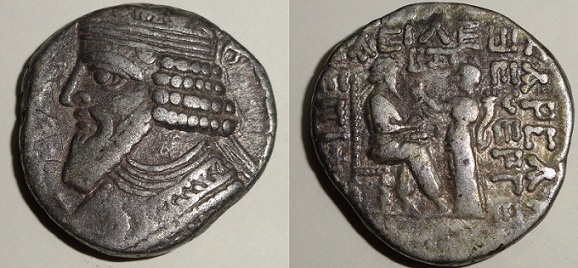 |
|
|
|
Pillar of the Community
United States
4253 Posts |
Nice coin and great history lesson. I have stayed away from these for the same reason I generally stay away from Greek coinage. I just don't understand them. I suppose I would eventually obtain a basic understanding in due time.
|
|
Pillar of the Community
3352 Posts |
|
|
Pillar of the Community
United States
2044 Posts |
Very nice coin. Eventually, I'm planning on owning a coin or two from Parthia. I doubt I will be specializing in them though.
|
|
Pillar of the Community
 United States
5155 Posts |
@JW- I think you know enough from collecting Romans, to collect more Greeks. To fully embrace the ancient coinage. So many coins of many different styles, many different designs, script and symbolism so ancient it was ancient to Caesar or Hadrian. It is so old some of it was so old, when ancient was new. You know what you need..to find a website with fat Tets on big flans...you find what you need. *good thing he's strapped down*
@steve-you too..
Edited by Ancientnoob
08/13/2012 6:52 pm
|
|
Moderator
 Australia
17005 Posts |
Quote:
The specific dating of the coins is rather difficult to comprehend, they dated their coins according to the Babylonian calender but wrote the date in Greek and thus measured time based on the Seleucid system. For example...and I am taking the inscription information from a much nicer coin then my own but mine appears the same),...this coin would read Inscription on left read from outside. Between the heads of Tyche and the king Greek numeral Î-ΝΤ, year 357 of the Seleucid era (A.D. 45/46). I believe the date on your coin, visible in between the heads of the two figures on the reverse, is "BXT" (beta xi tau) -which is "362" in Greek numerals; 362 Seleucid Era correlates to 50/51 AD, right at the end of the reign of this king. When the "how far can we go" thread gets down to 50 AD, you'll be ready.  Don't say "infinitely" when you mean "very"; otherwise, you'll have no word left when you want to talk about something really infinite. - C. S. Lewis
|
|
Pillar of the Community
United States
5155 Posts |
@SAP- Well done, I think I can see it, it kinda looks like a magic eye puzzle. I welcome the correction to my dating. Thank you very much.
|
|
Pillar of the Community
United States
1549 Posts |
I disagree with the ID to Sellwood 65.4 but I can not provide the correct Sellwood number. Between the heads of the two reverse figures is a clear date B xi T which would allow a Sellwood number between 65.28 and 65.32 but further ID would require the reading of the missing legend at the bottom. Each month was given a separate number. I assume the info accompanying the coin is copied from a similar coin since I don't see ZNT in the photo. No? The three letter Greek date B xi T (2 and 60 and 100) translates to year 362 of the Seleucid era (51 AD). Each of the four sides of the reverse had two lines of legend. Almost all (maybe all! - I've never seen a full legend one) coins are on a small enough flan that some of the eight lines of legend are lost. This example is at least average and a coin with the outer line at the bottom would probably be missing both of the lines at the top. IMHO, even having the year date makes the coin quite collectible but certainly I'd like that bottom line which names the month in that year the coin was struck. I only own two month dated Parthian, one of which is shown on my page: http://www.forumancientcoins.com/do.../feac12.htmlMy coin is a century later and the month by then had been moved to the inner line of the bottom making it a lot easier to find a coin with the full date. I'd prefer we not call Parthian coins "Greek". Parthia was a completely separate civilization in the East that fought with Greeks and Romans at almost every period. The large tetradrachms like this were issued for use in the Western part of their lands where local people were accustomed to the Seleucid style coins. The Parthians themselves used what we call drachms (I have no idea what they called them) minted farther East and made of better silver. They also had a large variety of small bronzes which are generally cheap considering their rarity. I once was quite interested in these but when Fred Shore published his book on the subject, the prices went above my cheap head so I have not bought one for years. I'm glad to see someone here who likes them. |
|
Pillar of the Community
United States
4253 Posts |
Now you see why I have stayed away from these?
|
|
Pillar of the Community
United States
5155 Posts |
Parthia was not Greek but it is safe to say they are Persian. Fabulous contribution guys. I am glad we got the correct date out of it. The more I look at it looks like B-Xi-T. Do you guys have a good online source that spells the dating system out, I fear I am lacking in my understanding of the calender conversion. By the way nice King you got their. I'm glad others like these coins as well. I periodically see them and figured Gotares II would make a good edition to my collection of Tets.
|
|
Pillar of the Community
United States
5155 Posts |
@ JW- This is more of a reason to collect these, look its so fat exotic and complicated. I tickles my numispickle.
|
|
Pillar of the Community
United States
1549 Posts |
http://www.forumancientcoins.com/nu...k%20alphabetWhat you want is 2/3 down the page and below it is the start dates for eras (like Seleucid starts at 312 BC so you subtract that to get AD. Remember that not all these eras started in January so you may find a year difference or a spread quoted in texts.
|
|
Moderator
United States
23731 Posts |
Very nice coin and history. Like JW I have stayed away from aquiring any of these. I know very little about them, probably just enough to get me into trouble and spending way to much on one.
|
|
Pillar of the Community
United States
5155 Posts |
Thanks for the source, Doug. I can always count on you to come through.
@echizento- You should get what you like.
|
|
Pillar of the Community
United Kingdom
946 Posts |
Hello Ancientnoob, A really nice AR Tetradrachm of Gotarzes II (Pahlavi=Gudrazdum). Quote:
The name comes from Latin and means "Old Persia". They were located in what is now Iran. A rival of Rome. The Parthian civilization is shrouded in mystery, no known literature survives of them. Someone has misquoted you from the Wikipedia: "The name "Parthia" is a continuation from Latin Parthia, from Old Persian, Parthava" The Greeks called this tribe Parthians, they called themselves "Pahlavi". Their Iranian language, also called "Pahlavi" or "Middle Persian" remained in use in the later Sassanid kingdom. Their "civilization" was what already existed in Mesopotamia, Iran and central Asia, since they were a ruling class and not the entire populace. They are quite well documented, at least by the Greek and Roman historians. Even when the last Arsacid king of Iran was overthrown in in 224 AD by Ardashir the Sassanid, most of the major Parthian families, such as the Mehran, Karin and Suren stayed in power. They even survived the overthrow of the Sassanid dynasty in 651 AD by the Arab Caliphate, eventually converting to Islam. |
|
Pillar of the Community
United States
1316 Posts |
Ancientnoob... sweet coin, love it....  ....I need to get one myself....and great looking Avatar...  |
| |
Replies: 40 / Views: 4,915 |










 Posted 08/13/2012 5:36 pm


