The Library of Congress came into being on 24 April 1800 when President John Adams signed into law the Act of Congress that moved the Federal Government from Philadelphia to Washington, DC and authorized a library for members of Congress; the Act included a $5,000 appropriation for establishment of the Library. Today, the Library of Congress is the world's largest library â€" it houses more than 150 million items (books, manuscripts, photographs, movies, sound recordings, etc.).
200 years later, on 24 April 2000, a special ceremony was held in the Great Hall of the Library's oldest building - the Thomas Jefferson Building â€" to launch the two commemorative coins struck by the US Mint to celebrate the bicentennial of the nation's oldest cultural institution. One of the coins was a silver dollar, the other, a $10.00 coin, was the first gold/platinum bimetallic US coin.
The obverse of the silver dollar features an open book in the foreground, with the symbolic "torch of learning" in the background; the torch is representative of the informational resources contained within the Library of Congress. The coin's reverse features the dome of the Library's Thomas Jefferson Building.
Thomas D. Rogers designed the obverse,
John Mercanti created the reverse.
The authorizing legislation for the silver dollar set the maximum number of coins (proof and uncirculated combined) at 500,000. Sales of the proof version totaled 196,900; the uncirculated totaled 53,400 in sales. The proof coins originally sold for $32.00; the uncirculated for $27.00.
Following are images of my uncirculated version of the coin.
Obverse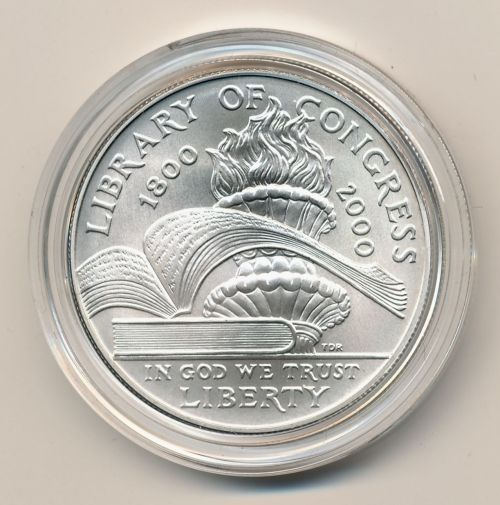 Reverse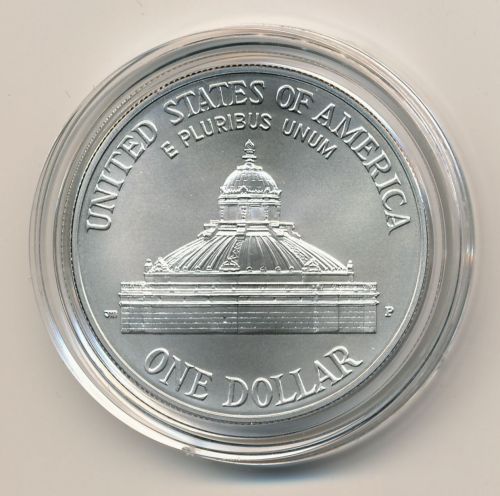
As noted above, the $10.00 coin was a bimetallic coin comprised of an inner core of platinum encircled by an outer ring of gold. The gold and platinum are equal components of the coin - 48% of the weight each â€" with a copper alloy making up the remaining 4%. As this was the first time the US Mint struck a two-piece bimetallic coin, it experienced a number of production issues that caused a fairly large number of defective coins that were rejected and melted. I wonder if this is the reason we haven't seen another such coin attempted?
The $10.00 coin's obverse, designed by
John Mercanti, depicts the hand of Minerva raising the "torch of learning" with the dome of the Thomas Jefferson Building seen at the rear; Minerva is the Roman goddess of wisdom.
Thomas D. Rogers' reverse design is the logo or seal of the Library of Congress encircled by a laurel wreath.
A total of 200,000 coins were authorized, but total sales did not approach such a lofty goal. The proof coins once again outsold the uncirculated, with proof sales totaling 27,167 and uncirculated sales reaching just 6,683. The proof coins had an original selling price of $425.00; the uncirculated sold for $405.00.
Following are images of my uncirculated version of the coin.
Obverse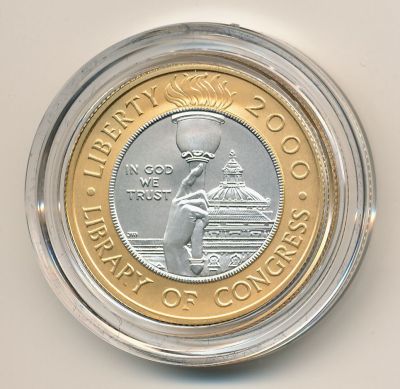 Reverse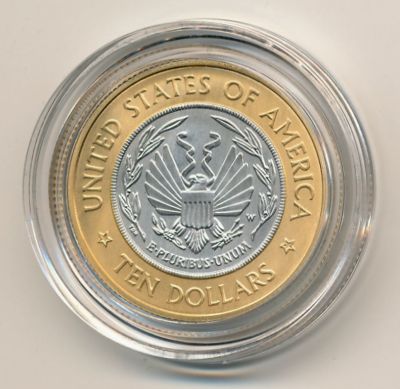
The bimetallic coin is the current key to the entire modern commemorative series, commanding strong prices in the secondary market for both proof and uncirculated versions. I'm glad I was able to purchase mine from the Mint at the time of the coin's release!
I invite those with an interest in learning more about the Library of Congress to visit:
http://www.loc.gov/about/history.htmlRead More: Commems Collection









 Posted 11/08/2012 11:34 pm


