



Coin Community Family of Web Sites Join Thousands of Coin, Bullion, & Money Collectors
Coin, Banknote and Medal Collectors's Online Mall Royal Canadian Mint products, Canadian, Polish, American, and world coins and banknotes. Join Thousands of Coin, Bullion, & Money Collectors Vancouvers #1 Coin and Paper Money Dealer Specializing in Modern Numismatics 300,000 items to help build your collection! Royal Estate Auctions - $1 Coin Auctions


Username:
Password:
Save Password
Forgot your Password?


This page may contain links that result in small commissions to keep this free site up and running.

Welcome Guest! Registering and/or logging in will remove the anchor (bottom) ads. It's Free!

Quarter Eagle (Or Not) Identification Help Please!

To participate in the forum you must log in or register.
Author Previous TopicReplies: 5 / Views: 2,227Next Topic  
New Member
cek1313's Avatar
United States
4 Posts
 Posted 02/20/2013  11:22 am Show Profile   Bookmark this topic Add cek1313 to your friends list Get a Link to this Message Number of Subscribers
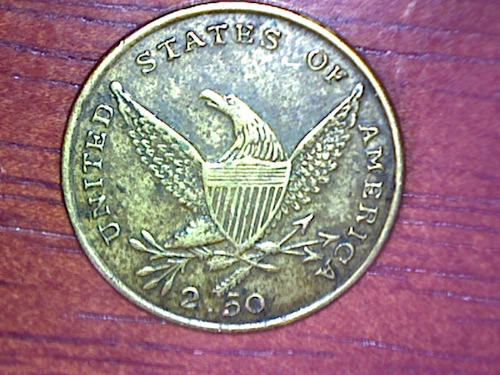
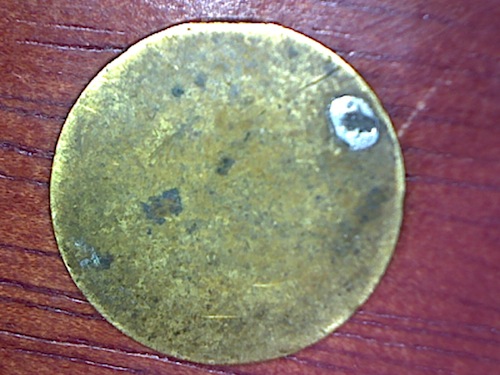
Hello and I am excited to be a part of this community! I have collected coins for around 20 years as has my father and grandfather who passed down their collections to me. I love coins I can research and have a known history however I have a coin that I need help with (see pictures attached). I purchased this coin on ebay around a month ago for relatively little but have had no luck identifying it's origin. My trips to local shops have been fruitless. Two experienced dealers thought it was likely a forgery or replica and two thought it may be some kind of test strike/test coin. The obverse is of course blank and the reverse resembles an 1834-1839 classic head quarter eagle. I have researched google to death and found nothing. Two things sparked my interest: First is the '2.50' at the base of (what I call) the reverse. If this was a forgery, why would they go to such lengths on the detail and then do something as silly as put 2.50 instead of 2 1/2 D? The detail matches the 1834-39 Classic Head Quarter Dollar pretty well - there are some obvious differences but it could be easily overlooked to a novice. The second thing that caught my attention is that it is exactly 18mm in diameter which matches several coins including a quarter eagle and it weighs 2.09g - exactly half that of a 1834-9 quarter eagle. Again it has no obverse strike and is worn and its like its half a coin. I have access to a mass spectrometer so I ran it through to determine exact metal content. Believe it or not its exactly .8992 gold and .1008 copper (mass specs are extremely accurate.)So again why would a forger use real gold to match the mint standards? It obviously has less gold and less copper than does a real quarter eagle but the proportions match. Last thing - In my granddads collection is a very similar coin to this one - no obverse as well and the only difference is that it does have 2 1/2 D. at the bottom - Its in a safe deposit box and I have seen it twice. I don't have measurements/weights/metallurgy but it was among other pages of coins labeled 'Pre-1900' So excuse the long rant but thank you and any advice would be appreciated. (Pictures Below)


Quarter-Eagle-Or-Not-Identification-Help-Please!

Quarter-Eagle-Or-Not-Identification-Help-Please!
Bedrock of the Community
biokemist6's Avatar
United States
12437 Posts
 Posted 02/20/2013  4:33 pm  Show Profile   Bookmark this reply Add biokemist6 to your friends list Get a Link to this Reply

Interesting, this is the second uniface reproduction of a Quarter Eagle to show up here in the past month Your example was mounted at some point and you can still see the remaining solder on the uniface side. Since this one is also uniface, I suspect that is was used as a game counter or some other novelty purpose and not as a counterfeit coin, it is just too much of a coincidence that both of them are completely missing what would be the obverse.

Based on the appearance, I have serious doubts that it has any gold content whatsoever. Gold is a noble metal and does not darken, tarnish, or corrode and the appearance of your piece is highly consistent with that of brass or bronze, i.e. a copper alloy. MS is not a good technique to use on a coin since it is a destructive test, X-Ray Fluorescence(XRF) is non-destructive and is capable of penetrating thin plating so it is much more accurate for analyzing a solid object. How do you know that you did not ionize a bit of gold plating remnant is the MS analysis?
New Member
cek1313's Avatar
United States
4 Posts
 Posted 02/20/2013  5:34 pm  Show Profile   Bookmark this reply Add cek1313 to your friends list Get a Link to this Reply
First Thank you for your reply! I have had the most difficult time in identifying this coins pedigree (which is something I really enjoy doing but often impossible in numismatics) The MS I use is in an Organic Chem lab where I did my grad studies and unfortunately I don't have access to an XRF although I think one of the gold/jewelry shops around here does so I'll retest - the grad assistant who manages the lab told me today upon my asking that the students were practicing (electro) gold plating as the end product of their experiment. This would explain why I found HCL and HNO3 bottles improperly left out :) so with that said I prepared the tiny little sample on the same surfaces they were using so long story short I could have easily ionized a GP remnant since they were using the machine - just weird that I came up with the percentages I did - I looked at the print out and recalculated and they are correct - but I think the sample was tainted as you mentioned.
With that all said and done, I'll figure out the proper metal content Friday if they let me use the XRF but I am interested that this is the 2nd one to turn up. You are correct in that is was clearly soldered to something - maybe as a necklace or mounted, however I just don't know where else to go....Do you happen to have pictures of the first example? I'm curious to see if they are identical. Also I am trying to nail down a time period as this would make it easier to search - in your opinion do you think this would be of a similar time period as the classic head quarter dollar issues? Maybe a token of the era used for some other purpose? I think I am just hoping that this is a cast-off that gobrecht used when making all the changes to the quarter eagle during that time to combat fraud :) Anything else you have would be great and thank you.
New Member
cek1313's Avatar
United States
4 Posts
 Posted 02/20/2013  5:38 pm  Show Profile   Bookmark this reply Add cek1313 to your friends list Get a Link to this Reply
Okay - good job on my part - I should have clicked the link you provided :) They appear identical and based on the person who posted the pics indicating early 1840's dig-site, these are most likely from the 1830's (my guess) and the classic head reverse was apparently liked so much, they used it on the 'reverse' of this coin/token...so now just to find out why they were made and who made them....
New Member
United States
3 Posts
 Posted 01/14/2014  9:50 pm  Show Profile   Bookmark this reply Add VADigger to your friends list Get a Link to this Reply
I lost touch and I am just signing on again. WOW! We are so excited that 2 others exist! Please see our pic as I am afraid I cant figure out how to post here!
Valued Member
judd1552's Avatar
United States
156 Posts
 Posted 01/15/2014  10:17 pm  Show Profile   Bookmark this reply Add judd1552 to your friends list Get a Link to this Reply
This is an altered game counter, probably of European origin and typically known as spielmarke. The remaining design is a crude representation of Mint engraver John Reich's design intended for use on the reverse of U.S. Capped Bust & Classic Head series of copper, silver and gold denominations. My opinion is that the design on the opposite side was planed off to effect a better surface for attachment to a jewelry piece, as evidenced by the remaining solder. Just because it supposedly has a high percentage composition of gold does not make it proper to make the presumption that it was intended as a forgery. It could just as easily have been made to the order of a wealthy individual who had to have the finest of accessories for a game.
Edited by judd1552
01/15/2014 10:24 pm
  Previous TopicReplies: 5 / Views: 2,227Next Topic  

To participate in the forum you must log in or register.


Disclaimer: While a tremendous amount of effort goes into ensuring the accuracy of the information contained in this site, Coin Community assumes no liability for errors. Copyright 2005 - 2026 Coin Community Family- all rights reserved worldwide. Use of any images or content on this website without prior written permission of Coin Community or the original lender is strictly prohibited.
Contact Us  |  Advertise Here  |  Privacy Policy / Terms of Use

Coin Community Forum © 2005 - 2026 Coin Community Forums
It took 0.24 seconds to rattle this change. Forums