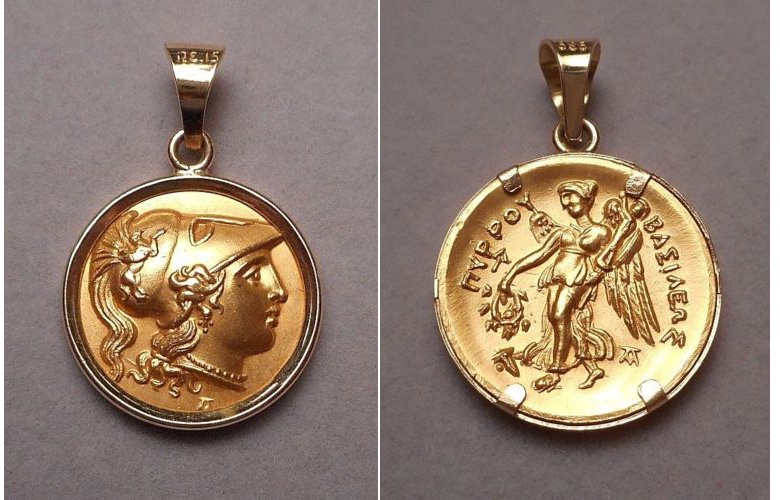
In determining fakes, it's often the details that make the difference. When details of a coin-in-question match those of a documented fake, it follows that the coin-in-question is a fake too.
A couple of years ago I learned this lesson the hard way. Here is an Osroes I drachm that I used to own. I had won it some years back from a major auction house:

I realized mine was fake when the coin below, listed by a German auction house, was publicly condemned as fake because it matched a documented struck fake that had been published years earlier in the Bulletin on Counterfeits. Both the condemned fake and the image from the Bulletin are below.
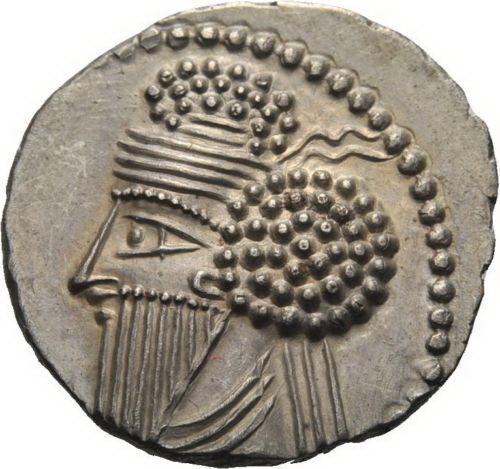

I realized my coin was fake after a thorough examination of its details. I noted that the pattern of dots in Osroes' hair matched the pattern on the fakes. I also noted that in both the Bulletin on Counterfeits image and in the fake coin from Germany, there was a tiny extension of the vertical line of the king's iris...the line extended just a bit beyond his lower eyelid. This was no doubt a slip of the hand of the (modern) die engraver. My coin had this exact same feature.
Luckily for me the auction house took the coin back and gave me a full refund.
With this lesson in mind, let's now look at examples of the obverses of a very rare tetradrachm from Phokis, Delphi. There are no more than a dozen known examples of this type...so these three represent at least 25% of extant examples of the type:

Now, let's get in close and consider the very minute, barely legible legend below the two rhytons that are in the form of ram's heads:

All genuine examples of this very rare coin have these barely readable, tiny legends. Now let's consider documented fakes/replicas of the type:

Notice the legends, both how the letters are drawn and their placement. Consider their legibility compared with genuine examples.
Below is a recently posted coin. I am not condemning it. Rather, I leave it for you to decide:

Next let's consider the obverse of a rare coin from Terone, Macedon. Here is a genuine example:

Here are two documented fakes of the type, struck from identical modern dies:

For consideration now, a coin recently posted to the board:

Remembering that identical details tie coins to the same source material (meaning to the same dies or molds, as the case may be), let's compare the stars on the recently posted coin (it is the middle one in this image) to the two known modern fakes, below. Of course lighting, camera focus, and camera angle can throw things off a bit, but the question a collector should ask is: is there enough resemblance to warrant concern? You decide:

In this image a detail of the left grape cluster of the recent post is shown alongside one of the known fakes. Again, allow for differences in the photography:

I'm not expressing any opinions here about the posted coins. Rather I'm just stressing that, when known fakes of a type exist, it is prudent to compare the details of a coin-in-hand to online images of the known fakes. Photography differences make it a challenging process. So do things like forgers' reworking (re-engraving) of a die after a series of strikes, or adjustments made to molds...sometimes there are "different generations" of casts made, each fundamentally the same but with some minor differences. Buyer beware!








 First Page
 Previous Page


 Posted 01/29/2016 09:38 am