In April of 1997, Representative Frank Mascara (D-Pennsylvania) introduced into the House a bill "to mint coins in commemoration of the 50th anniversary of the Marshall Plan and George Catlett Marshall." The bill had 124 co-sponsors in the House; a companion bill was introduced in the Senate by Richard "Rick" Santorum (R-Pennsylvania) of recent US Presidential candidate fame.
Marshall was a decorated US General during World War II, and served as the US Secretary of State from January 1947 to January 1949. It was during his time as Secretary of State that he developed the US' European Recovery Program which pumped over $13 billion dollars into rebuilding Europe after WWII â€" it became known as the Marshall Plan. Marshall was awarded the Nobel Peace Prize in 1953 for his plan. Of recent note, General Marshall is featured on the 2013 silver dollar that is part of the Five-Star Generals commemorative coin program.
The 1997 bill called for up to 700,000 silver dollars and up to 500,000 clad half-dollars to be struck. The designs for the coins were to be "emblematic of the 50th anniversary of the Marshall Plan, which gave Europe's war-ravaged countries the economic strength by which they might choose freedom, and George C. Marshall, the author of the plan." The obverse design for each of the two coins was to feature a likeness of Marshall; the reverse design was not specified by the proposed legislation.
Each silver dollar was to carry a surcharge of $12 per coin, each half-dollar was to include a $4 surcharge. The funds collected via the surcharges were to be evenly split between the George C. Marshall Foundation and the Friends of George C. Marshall. The Foundation was to use the money to support its educational initiatives while the Friends were to use their allocation for the construction and operation of the George C. Marshall Memorial and Visitor Center in Uniontown, Pennsylvania.
The bill did not make it out of Committee in either the House or Senate and so was never approved. The Friends of George C. Marshall group persevered, however, and through a combination of state, local and private funding, they were able to construct a small memorial plaza to honor Marshall in his hometown of Uniontown, PA. It was officially dedicated on October 26, 2003, with Prince Andrew of the UK in attendance to unveil a plaque honoring Marshall; the plaque was a gift of the British government. You can see a few pictures here:
http://www.waymarking.com/waymarks/...Pennsylvania.
I remember writing an article for a local coin club newsletter at the time about being disappointed that this bill was not approved. Nothing against the four commemorative programs approved for 1997, but the Marshall Plan was an important US initiative that was certainly worthy of commemoration. (At least IMHO!)
While the US did not issue a commemorative coin for the anniversary (a stamp was issued, however), it did not go numismatically unrecognized. The Netherlands issued a 10 Gulden silver coin to mark the Marshall Plan's 50th anniversary. The coin was struck in 0.800 fine silver; it is 33 millimeters in diameter (a bit bigger than a US half-dollar) and weighs 15 grams.
The obverse of the coin features a portrait of Queen Beatrix, the Queen of Netherlands in 1997, while the reverse showcases a portrait of George Marshall. The commemorative reverse design was the work of Berend Strik.
The coin was available in proof and uncirculated finishes; shown here is an example of the proof coin.
1997 Netherlands Marshall Plan 50th Anniversary Commemorative - Obverse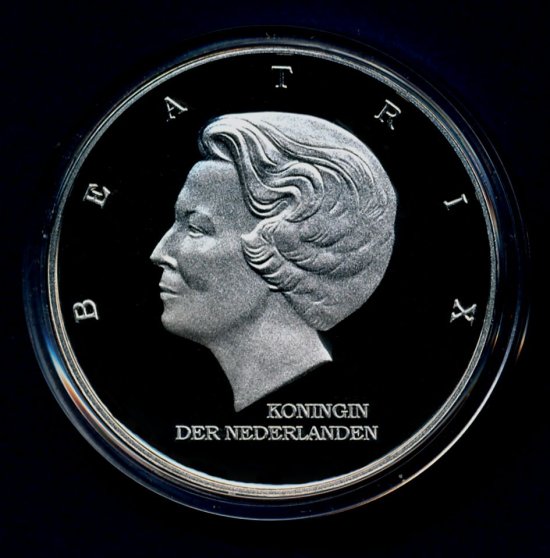 1997 Netherlands Marshall Plan 50th Anniversary Commemorative - Reverse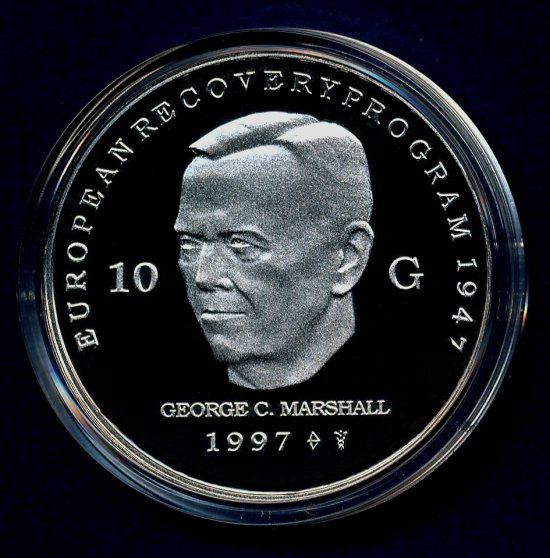








 Posted 09/02/2013 9:15 pm


